Showing posts with label Family history. Show all posts

Wednesday, November 24, 2021

Remembering Stephanie Bogdanski Mack who would turn 110 this month

When I was growing up in the 50s, Aunt Steph was the aunt who never failed to slip me five bucks anytime we had a Bogdanski family get-together. A generous gift, perhaps the equivalent of $20 today. When she visited my childhood home, she was always a force to be reckoned with, often to be found with the men of the family in the living room, while my other aunts gathered in the kitchen. One topic in the living room was union politics at the Mercoid Corporation, an electrical parts factory on Belmont Avenue. It was as close as we get to a family business, as several of my uncles and aunts worked there for a long time.

As a child, I equated her loud voice and strong opinions with power, not having learned yet that it sometimes means just the opposite. Still, Aunt Steph was perhaps my earliest model for an outspoken woman. She cut a fine figure too--usually wearing a body-hugging dress and heels to family affairs. Her presence was never unnoticed, and I always looked forward to seeing her. Not just for the five bucks. I was fond of her and perhaps a little in awe, shy little girl that I was.

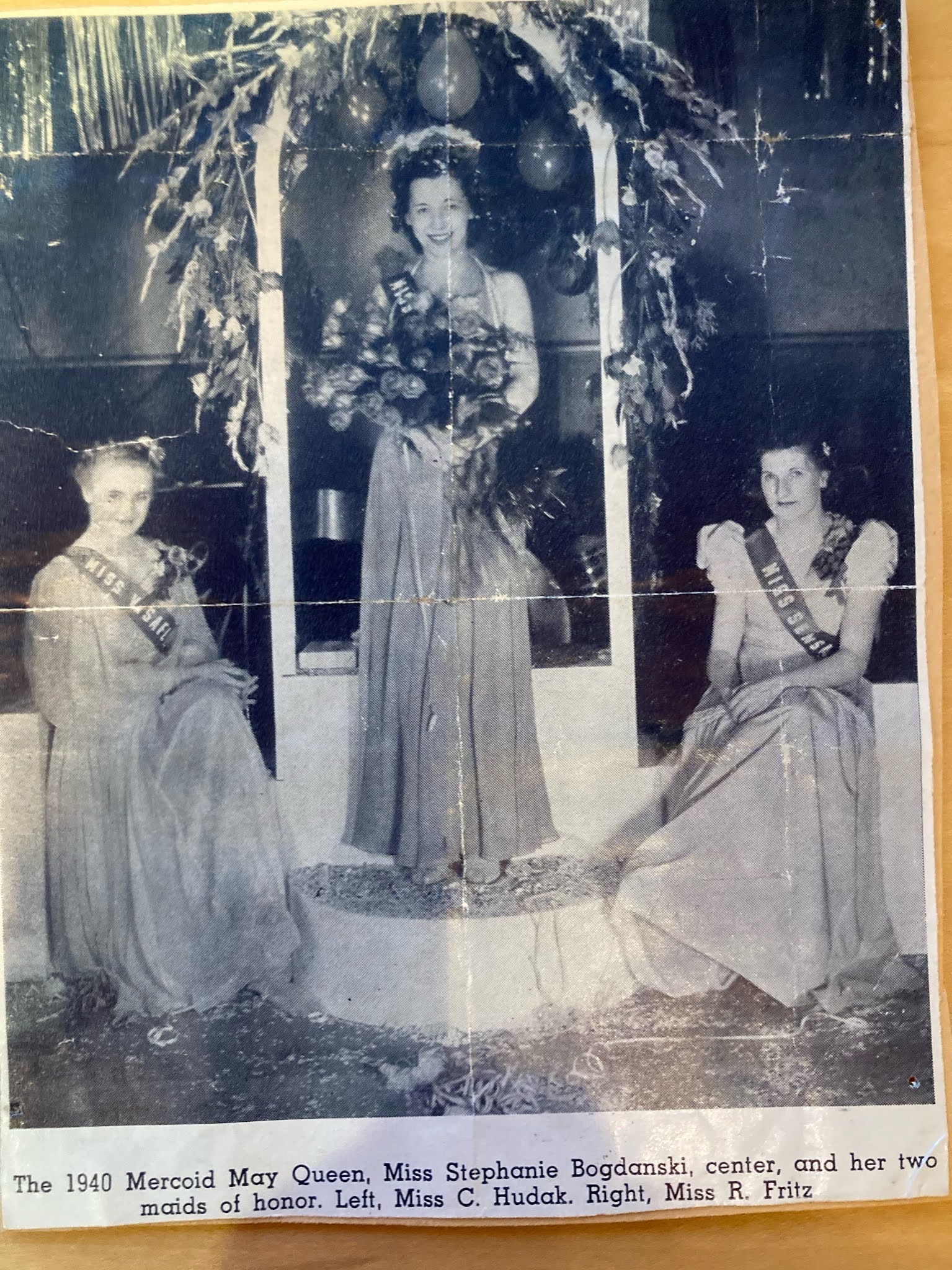
Steph, often called Stefka by her siblings, was the second child of Leon and Barbara, born in November of  1911. I know very little about her early life, other than she was born at home and did not finish high school. She went to work at Mercoid, like her older sister Marie (Myne-ka), and her earnings no doubt helped keep the family afloat during the Depression. She was a dark-haired beauty in her youth (and later as a blonde), and was named the Mercoid May Queen in 1940. (Factories had May queens? you may wonder, as do I).
Stephanie married a quiet man, a bartender named Frank Mack. They had no children, and Frank died of cancer in the early 60s. Later, Steph partnered with a co-worker, Ronnie Wronski, though they never married and the relationship ended after several years. Ronnie had become a friend of the family during Frank's lifetime and you can see all three of them here, along with other family members, in this photo, circa 1960. Taken in the backyard of the Hammond, Indiana home where my sister Joan and I grew up, this photo shows (from left): Ronnie Wronski, Steph, Kitch, Jack Beck, Marie Beck, Frank Mack, Joan Riley and Edward Bogdanski.

After Steph and Ronnie separated, Steph remained in Chicago, living alone, until the mid-70s. It was then that she and my mom, Angie (Anielka) moved into an apartment on the northwest side. They called themselves "the odd couple": Angie liked good books, plain wholesome food, and simple comfortable clothes. Steph, (who "likes everything fried", Angie once confided), was fond of The National Enquirer, and quiz shows. But they both kept a neat house and kept each other good company--at least in the beginning.

By the time Angie and Steph moved in together, I was living in Colorado, but made regular visits back to their home every summer. One year, on a visit back from Colorado, I drove them to the country home of their youngest sister, Virginia (Gina), near Toledo, Ohio. Here they are,  circa 1985, "the girls", as Gina called them, waving to the camera.


I got to know Steph better on those visits. I asked her once how she felt about her job at Mercoid, which she kept for 40-plus years, until she retired at the age of 72. She had been a "floor lady" at one point. She told me that she was proud that the electrical parts she made were used all over the world. I don't know that Steph ever had hobbies, but she enjoyed dressing up, going downtown, visiting department stores like Marshall Fields, and eating at Berghoff's Restaurant. She loved fine food, a highball or two, and always took pride in her appearance. She was also proud that she had what she considered good Polish skills, having once been a secretary for a Polish organization.

Steph never had children, she said, because she had a "tipped womb". Perhaps there were other reasons, as  that condition is not considered a barrier to fertility, I later learned. I never had the sense that she missed being a mother of young children, but later, when her nieces and nephews were grown, she spoke of her regret at not having had kids. Toward the end of her life, when she was in the Alden nursing home with advanced dementia, she was convinced that Joan and I were her children, and perhaps we were in a sense. Joan, especially, as she and her husband Jim navigated Steph's medical issues until Steph died in 2002.

Steph was devastated when Angie, her younger sister by 6 years, died suddenly of a heart attack in 1994. Both had suffered some health issues in the last few years, and Steph had become fearful, which caused Angie stress. After Angie's death, Steph coped for a few years on her own in the apartment they had shared, but after a fall and an injury, she was moved to Alden,  By then, dementia had set in, and she could no longer live on her own. Joan and I and others visited her there until her death. She was not an easy patient/resident, being confined to a locked ward and being a smoker.  On my visits I would take her to the patio to smoke. Conversation was difficult, and one time, at one poignant moment, she opened a compact in her purse, looked at herself and said, "How did I become a hag?" More than anything, this broke my heart, for this once-proud and attractive woman.

Steph would have shuddered at the idea of living to 110, which she would be on Nov. 26 this year. "I want to go like Marilyn Monroe," she used to say more than once, referring to that star's death from an overdose of sleeping pills. Yet I doubt she would have ever taken steps to end her life, even knowing the coming end. Had she been asked, I think she would have agreed the end should be left up to God, as was the beginning and everything in between.


Sunday, July 14, 2019

Their questions and my questions

Note: this blog entry, originally written in 2019, was updated in November, 2021.
My tour of the Emigration Museum on Veddel Island in Hamburg, Germany, ended in a room with a huge Statue of Liberty painted pink. Surrounding it on the floor were signs, each one representing one of 29 questions immigrants were asked on arrival at Ellis Island. In addition to the standard expected questions such as name, age, gender, marital status, race, national origin, last address, final destination, name of contact in America and the like, there were others, all designed to weed out unsuitable immigrants.


Leon and Barbara, my grandparents, arrived there on December 20, 1910, after a 10-day journey from Hamburg. There they faced lines--for registration and medical check-ups. They had left Hamburg with two children--2-year-old Marie and baby Kasimir; they arrived with only Marie. Kasimir had died on the journey--we have no records of the cause--most likely of illness contracted on the journey. Like most emigrants coming to America in that era, the Bogdanski family traveled in steerage, while upper and middle class travelers could book a first or second class cabin. At one point Barbara and Kasimir were quarantined in a second-class cabin. As my mother Angeline told me, Barbara believed that "a kind person" had given her the cabin--a sweet story. Yet, I wonder if ship rules mandated that, given the high concern with contagious disease on board.

On arrival, after Barbara and Leon got to the front of a long line, they had (according to the Emigration Museum booklet) 60 seconds to answer the basic questions above along with these: Have you ever been in prison, an almshouse or a mental institution? Are you a polygamist? Are you an anarchist? Are you deformed or crippled? And then there was a critical question about work: a yes answer would result in immediate deportation: Are you coming by reason of any job offer? Then as now, the possibility of immigrants filling jobs that should go to native Americans was a very sensitive subject. Another question, "What is the condition of your health?" was critical. Any answer indicating illness could also get you sent home. Hence, the many medical exams before departure and after arrival. One question never asked in this era was, "Where is your passport?" Although travel documents were necessary before departure, passports were not required upon arrival. Passengers in first and second class were usually spared all this, receiving medical checks in their cabins before being escorted off the ship.

Much has been written about the difficult conditions in steerage compared to first and second class cabins. Steerage reportedly had poor ventilation and poor facilities for maintaining hygiene. Fortunately, due to improvements in steam ships by 1910, the journey was half as long as it had been in the late 19th century. Also, Barbara and Leon were fortunate to travel on the Hamburg-America line.This line, created by Albert Ballin, who was himself an immigrant (to Germany from Denmark), created a good system for passengers waiting to board in Hamburg. (See my earlier blog When Millions Sailed from the Port of Hamburg for more information on this.)

Ballin also created the very popular "one ticket" system.* That means you could buy a train ticket from Warsaw to Hamburg and then upon arrival at Ellis Island continue all the way to your destination. What relief that must have been to anyone about to travel to a country with plenty of unknowns. If the Bogdanski family had this ticket, as is likely, that must have gone a long way to easing their minds.
   
Leon was 30 and Barbara 25* when they arrived at Ellis Island after just 5 days before Christmas. The next step in their journey was a train ride to Chicago. That's where they settled, as they had family expecting them there. Barbara's older sister, Marianna, had arrived from Poland in 1905, traveled to Chicago, and begun earning money as a seamstress. Family lore has it that she earned the money that brought her siblings to America--a common immigrant pattern in that era. In May of 2010, Barbara's mother, Agnieska Lugowska, and her two sisters, Valentina and Anna, arrived at Ellis Island, continuing on to Chicago. The destination they listed was the Chicago address of Felix Lugowski, Agnieska's husband. How long they stayed there, if at all, is unknown.

There are no diaries or handed-down stories of Barbara and Leon's experiences and impressions as they entered a new country and new life. If you visit the Ellis Island Museum or Statue of Liberty website, you'll find stories of the awe many immigrants felt as they saw the Statue of Liberty for the first time. I wonder if Barbara or Leon felt this, grieving as they must have been so soon after the death of their infant son, and possibly feeling unwell themselves. Perhaps the family's total focus was on the process of disembarkation and the continuation of their journey on land. 

When I was in 8th grade, I memorized and recited The New Colossus,  the famous poem by Emma Lazarus about the Statue of Liberty, written in 1893. The ending stays in my mind:
 “Give me your tired, your poor,
Your huddled masses yearning to breathe free,
The wretched refuse of your teeming shore.
Send these, the homeless, tempest-tost to me,
I lift my lamp beside the golden door!”
I thought it was very beautiful and dramatic at the time, but it doesn't impress me so much now with phrases like "wretched refuse".  I much prefer this one instead, written very recently by Tracy K. Smith, US poet laureate 2017-19. It's called Harbor. And I like to imagine it might capture something that Barbara and Leon might have been feeling.
"Stranger, I find myself lost. Let us watch this new age gather
Overhead. Let’s see what rains onto unaccustomed skin.
Once, we were pelt, fur, hide. Only the seasons mattered. Now,
We shiver, crying out. Not from winter, but the fear in skin.
I see the tall masts of history in horizon fog. They dip
And rise. The tides they ride swell under human skin.
Be my guest. Drink tea, taste fruit and bread. The meat rests,
Cooling on the slab, but see how wine has flushed our skin?
This land you’ve sought is peopled with enemies and kin.
You’ll learn to read the whole long story written on skin.
We passengers wait. Our restless waiting forms an island.
One woman stands, sings. Her music enters through my skin.
Stranger, you’re the words to a hymn I’ve only ever hummed.
Come. Let’s erase the distance between skin and skin."

*There is some uncertainty over Barbara's birth date. We believe the likely year is 1885, but it could have been as late as 1889. 

**For an interesting view of the differences between cabins and steerage, see this short video: https://www.youtube.com/watch?v=FSBwrCMcj_g&t=206

***For more resources on the experiences of immigrants to Ellis Island, try these sources: https://www.statueofliberty.org/discover/educational-resources/ and https://www.statueofliberty.org/ellis-island/national-immigration-museum/


Tuesday, July 9, 2019

When millions sailed from the Port of Hamburg

My maternal grandparents, Leon and Barbara Bogdanski, were among the millions who left Europe in the early 20th century. Their destination was the USA, specifically Chicago, Illinois, where relatives had worked to fund their passage. When I visited Germany and Poland this spring, I knew I had a chance to retrace at least some of their footsteps. First stop: Veddel Island in Hamburg, from which nearly 6 million sailed to new countries between 1850 and 1938. Leon and Barbara, living in what was then the Russian-held Polish city of Warsaw, traveled there in 1910.

What might that experience have been like? I wondered, not having known either of them. Barbara died before I was born and Leon, who I rarely saw, died when I was 9. My mother and her 7 siblings--none of whom are still alive--either did not know or did not volunteer the information. Thanks to the relatively new Emigration Museum Ballinstadt, built on the site of this mass migration, I was able to learn something of what they and so many others experienced in the days or weeks leading up to their departure.

I learned much more, as the museum looks at migration as a global phenomenon over centuries and helps viewers see just how many people have been, are or will be on the move. What is the push that sends someone away from home and the pull that brings him or her to a particular place?


The museum is spread through three low brick buildings near the Veddel train stop in Hamburg, bordered by a busy highway and much greenery as well.. Few were walking around the Friday morning in April when I arrived, this area that was once a mini-city, where travelers could stroll along tree-lined streets and ate in dining halls that could accommodate thousands at a time. The main man behind all this was shipping magnate Albert Ballin, who realized that running an emigration service in addition to cruises would boost the fortunes of what became one of the biggest shipping companies in the world.

As I followed the English guide to the German-language exhibits, I immediately saw how Ballin's enterprise put to shame current US immigration policy on the border with Mexico, where asylum seekers and children are kept in overcrowded conditions, without basic necessities and with dwindling hopes for a better life.

Thinking back to 1910....After arriving at Veddel--after a several-days-long journey--with their 2-year-old daughter Marie and infant son Kasimir in tow, Barbara and Leon were probably tired and hungry. Relief came soon. After registering, they received an accommodation assignment card that doubled as a meal ticket. They were able to stay together, being a family, while single men and women had separate living quarters. Clothing and luggage were disinfected and stored upon arrival, hand luggage only being allowed in the residence halls.

I was impressed--Were Leon and Barbara impressed too?--with the description of this little town with its numerous trees and paths. There was a church and a music hall and there were outdoor concerts on fine days. Children had a playground. Did all of this mitigate the frustration of the wait for departure? There were medical exams every morning--an important point for the shipping company, as it had to pay the return fare for any immigrant turned away at their destination for illness. There were practical matters involving waiting for travel papers and acquiring supplies for the voyage. On-site shops carried clothes, sanitary supplies and remedies for seasickness.

There were two dining halls: one for Jewish immigrants, where food was prepared according to dietary laws, and another kitchen for Christians. The kitchens, equipped with steamers and an ultra-modern potato-peeling machine could feed 3,000 people an hour. Tea and coffee, bread and butter for breakfast; soup with meat or fish, potatoes and vegetables for lunch, and tea, bread, sausage, cheese and stew for dinner.

Not that it was paradise. In the early days after its opening, the mini-city suffered from overcrowding and sanitary problems. However, a  solution was reached well before my grandparents arrived--new construction and a doubling of the size of the site. The museum has collected many letters from emigrants, and a constant theme was fear of failing a medical exam. There were delays in departure, timetable glitches and the like. Were Leon and Barbara often stressed out? Or were they patient, knowing they had tickets and people who would welcome them in their new home. Barbara's sister, Marianna, had emigrated 5 years earlier; her mother and two sisters in the spring of 1910.

On departure day, Leon and Barbara, with infant Kasimir and little Marie in tow, either walked or were ferried the 3 miles to the Grosser Grasbrook quay, the place where they would board a small feeder boat that would take them to the steamer. More waiting and still another medical exam. A nervous time perhaps, given the calamity it would have been to be turned away. Leon and Barbara and kids passed and were allowed to board the Amerika, the boat that would take them to Ellis Island. (Photo below is from the Ellis Island website.


Viewing the exhibits, I was disappointed to find nothing specifically about Poland. However, the "push" factors affecting affecting Polish emigrants were common to people in other countries as well: poverty as a result of growing population and lack of land or employment opportunities. For Jews, there was severe religious persecution. Poles in my grandparents' region,  I learned from later reading, suffered from the neglect and oppression of the Russian Empire. (Poland did not become an independent country until the end of World War I, having been partitioned for more than a century into three regions controlled by Russia, Germany and Austria.)

Family lore had it that Leon and Barbara emigrated to keep Leon out of the Russian Army. That's quite likely true, although one photo that survives shows him in a military uniform. Perhaps he was in fact conscripted, prompting him to escape by leaving Poland. According to one source, "Russian-occupied Poland experienced increasingly abusive Russification in the mid-19th century. From 1864 onward, all education was mandated to be in Russian, and private education in Polish was illegal. Polish newspapers, periodicals, books, and theater plays were permitted, but were frequently censored by the authorities. All high school students were required to pass national exams in Russian; young men who failed these exams were forced into the Russian Army. In 1890, Russia introduced tariffs to protect the Russian textile industry, which began a period of economic decline and neglect towards Poland."

Meanwhile, there was an industrializing country that wanted workers--The United States. The same source quoted above continued, "Immigrants...were attracted by the high wages and ample job opportunities for unskilled manual labor in the United States, and were driven to jobs in American mining, meatpacking, construction, steelwork, and heavy industry—in many cases dominating these fields until the mid-20th century. Over 90% of Poles arrived and settled in communities with other Polish immigrants. These communities are called Polonia and the largest such community historically was in Chicago, Illinois."

To be continued: Arrival on Ellis Island and a new life