Friday, April 17, 2020

Journal of a plague year: the first six weeks

March 6--exactly six weeks ago from today, and I was busy planning my normal weekly schedule. I went to a women's salon at The Center for our usual monthly discussion. For the upcoming weekend, it was a tax preparation appointment, and then a Sunday afternoon rehearsal with SAGE Singers, the senior chorus I'm part of. On Monday, my usual session of Laughter Yoga at St. Barnabas Church followed by lunch in an area restaurant--this time The Irish Snug. Square dance was a possibility for Tuesday and then a theater performance at Aurora Fox on Thursday to see Secrets of the Universe. Those events marked my last "normal" week. The following day, March 13,  everything changed. Gov. Polis ordered a ban on large gatherings and closure of non-essential businesses to stem the spread of Covid-19.

As I look back, I see a series of emotional and behavior changes that none of us could have anticipated just 2 months earlier when we toasted to the new year. And now, as I write this today, April 17, it's hard to remember the feeling of the "old normal"--one that I had taken for granted my whole adult life. An old normal of freedom from invasion whether it be a foreign army or a plague. With two exceptions. In childhood I remember being called inside by my mother, ordered to rest for fear of catching the polio virus. I didn't quite understand what it was, but I knew it traveled silently through the air and could cause terrible paralysis damage to victims. Then in junior high came the Cold War-induced scare of nuclear war. Radiation would come from the air, we were told--another invisible enemy. Today you can find online now-humorous stories of kids crouching under desks during school drills and families building bomb shelters in hopes of surviving the deadly radiation sure to come. I remember giving a speech in school arguing in favor of those shelters, though neither I nor my family ever tried to build one. On some level we all knew it was absurd. (Below: a New York Times photo of a "duck and cover" exercise)

Those fears and responses passed, and now we're in another fear and response period--one with much uncertainty: the Covid-19 pandemic. As I look back to that first week--the last one of the old normal--I think of it as  a time of trying to get a grip on what was happening. I remember joking that I wish I had studied for my ACTs as hard as I studied this virus--one showing disturbing signs of not being contained.

In the days following the governor's call for closures, all of my usual activities were cancelled. At home in Montview Manor, where all residents are over 62--a high-risk group for Covid--a series of new procedures were rolled out. By the end of the month, all gatherings in common areas were stopped, the building was closed to all but essential visitors and residents were urged to stay in their apartments. Sanitizer appeared in the lobby, and we were exhorted to wash our hands frequently. "Social distancing" had already become a household phrase. During those mid-March days, I remember thinking of Covid as the third invisible enemy of my lifetime, and I was quite diligent with the precautions. The only exception during week two and three was the lack of masks. Public health officials did not want to cause a run on badly-needed N95 respirators for medical workers, so we were not encouraged to wear them. By early April Gov. Polis encouraged masks--homemade cloth ones or simple surgical ones--for everyone going outside. I think of weeks 2 and 3 as the time of adjustment and making of new habits. I was pleased to find a no-sew pattern for a cloth mask that can be made in two minutes from a handkerchief and two loops of stretchy nylon or elastic. Meanwhile, I was becoming proficient with Zoom, the app of choice for groups wishing to communicate during this ban on in-person meetings. (More on that in a separate blog entry.) Daily, sometimes twice-daily walks in City Park across the street, became my new normal--a comforting reminder of the old normal, as many in the neighborhood showed up to walk dogs, go bike riding with their kids, or simply watch the beginnings of spring.

All the while information-gathering continued. Should we wipe down groceries or not? Is it necessary to wear gloves? What is the best way to handle shopping? We were encouraged to limit grocery shopping to once a week, and stores began instituting senior shopping hours. An unfortunate incident at my local Sprouts store--where two neighbors encountered a sick check-out clerk--caused me to change my allegiance. I now shop at Trader Joe's where I'm confident of their procedures. You can read about them here.  Meanwhile, all of my information gathering continued. I spent at least two hours a day reading my digital New York Times, checking the spread in other countries as well as the emerging facts about the virus. And then there were the human stories--the deaths, the heroism of medical workers, the machinations of a US administration that belatedly acknowledged the pandemic while creating daily doses of misinformation. Dr. Fauci became almost everyone's standard-bearer in the battle to "flatten the curve", by then another household phrase.

During the second half of March I began to settle into a new home routine. I cooked more--something I've always liked to do, but now it had the added benefit of focusing my concentration. Neighbors, including me,  offered to pick up things for others during their weekly shopping excursions. Many cultural offerings went online, including free daily streams of filmed operas from The Metropolitan Opera via the Met on Demand app. I'm a fledgling opera listener, so these streams were a wonderful opportunity.  In addition, Youtube became my go-to source for inspirational music performances or plays, such as Jane Eyre by the National Theatre of London. 

As the first week of April came to a close, I had become a nightly howler from my balcony. It's still happening, every night at 8 p.m., and many Denverites and others are joining in with voices or the banging of pots and pans. It's our tribute to medical workers and others who are risking their lives to help Covid victims. The battle had become more personal. There appeared to be no infections in my building, where a nurse is stationed in the lobby, 7 to 3 every day to check temperatures and monitor deliveries. However, Jeff, a friend in Denver, and Laura, my niece in Illinois were suffering from the virus, both recovering slowly. Reports of infections and deaths continued to dominate the news, but the conversations began to shift. When would it be time to begin a restart of the economy? 

The economy had been in free-fall for awhile, rising or sinking like a leaky balloon, depending on the outlook for bailout plans in Washington. Battles for political power ensued. Meanwhile, far too little was known about the path of Covid infections and test availability was far too small. The race for a vaccine was underway, a worldwide effort, but no timetable was claimed. Shelter-in-place orders were just a month-old. What would be possible as spring became summer? What would happen to planned events? In January my biggest dilemma had been how I could attend the national square dance convention to be hosted by my club, The Rainbeaus, in July. It would overlap with The SAGE Singers planned debut at the GALA festival in Minneapolis. I dithered back and forth: Could I do both? I finally made a decision, but that decision is now moot. GALA 2020 has been postponed for a year, and the fate of the square dance convention is in doubt. "Man plans, God laughs" is an old saying I used to quote when things would fall apart. It now had a whole new resonance. (Next: my life on Zoom)


Friday, March 13, 2020

To my father on his 117th birthday

My dad, John Riley, would have been 117 today--March 13, 2020--an event he did not live to see. Fortunately. How terrible, he told me once, to outlive your friends and have a body you cannot move or control. As a young woman with a young body then, I could not understand or accept: Life is meant to be lived as long as possible! Make new friends! Now, decades later, I understand. There is a time to live and a time to die, and now I, like most of my older friends at least, would not want to exceed our "quality of life" expiration date.

Not that Dad wouldn't have liked more time. He died at the age of 74 in 1977. Too soon, but in just the way he would have wanted--in his sleep.  He still had "all of his faculties" as people used to say, and could get around without assistance. Still, if you asked him, he'd probably say that while his life ended too soon, it still had an amazing arc. Born in 1903 when the Wright Brothers first flew an airplane, he lived to see the moon landing in 1969. A gift of history--never imagined by earlier generations.

I was 30 when Dad died--and for all of my previous years, really considered myself lucky in the father lottery. John was kind at heart, gentle, funny, a father who took time for his family. With my mother, he gave me the great gift of freedom. In my childhood, "free range parenting" was the norm. I was not driven to lessons, but rather spent time outside playing with friends, watching TV, reading books. He was also a great storyteller ("Your father has the gift of the gab", my mother said often).  His stories were entertaining, and before I grew older and wiser, never suspected how embellished they were. For awhile, he convinced me that his estranged family of birth were all horse thieves. He had left the Kansas City of his youth for Chicago, where all the jobs were, and could spin stories of "Two-gun McGann" and other infamous characters of Depression-era city life.

John's early life was not easy, but he always made his life a series of stories, not complaints. His mother left him, his three siblings and their father when he was 9, and he was farmed out to Aunt Mag, a woman with a heart of gold, and her stingy husband, Uncle Jim. Dickensonian stories masked the pain he must have felt. Enrolled in Catholic school--not a kind and gentle place in that era--he "dropped out in third grade", in his words, and ended up in reform school, as it was called then, certainly not a kind and gentle place either. In 1918, as World War I was reaching an end, he and his older brother Clarence decided to join the Navy. John was only 15 and had to lie about his age, and apparently the recruit-starved Navy was not too particular about proof. He and Clarence were assigned to a ship sent to Guantanamo Bay, Cuba, a memory he savored for the rest of his life--the freedom of adult life, the beauty of the water and island.  The war ended just a few months after their enlistment. Dad had never seen a minute of combat, yet was honorably discharged with a lifetime of veterans' benefits. Benefits that eventually saved his life when he developed tuberculosis and was treated in a veteran's hospital--one of the first places to get life-saving antibiotics.

Jumping ahead a few years, here's John with my sister Joan, circa 1976.


John was opinionated--a strong supporter of unions, including the one he belonged to: Local 150 of the Union of Operating Engineers. He was a construction worker, starting in the 1940s. Too old for military service in World War II, he went to Alaska to help build the Alaska Highway, an event that he described as a great adventure: the beauty of the Yukon and Dawson Creek, like nothing he had seen before in Kansas or Illinois. Returning to Chicago, John met my mother, his second attempt at creating a family. An early marriage ended in divorce after the birth of a daughter, Bernice, who along with her family, remained a part of his life until he died. At the age of 41, when he married my mother, Angeline, he was ready to give family life another try.

John and Angie moved to Hammond, Indiana, in 1952, when I was 5. The highway construction business was booming, and jobs paid enough for a man to support a family and buy a small house. It was the first house they owned, the only house they owned. There they raised me and my younger sister, Joan. Usually laid off in the winter (with unemployment benefits!), Dad worked spring through fall, doing work that he made to seem important.* There was a right way to grade a road, he said, and from his stories I intuited there was value in doing it well. An important lesson for a child to learn--along with the other ones: the adventure of travel, the value of unions for working people--and oh yes, the necessity of buying only what one could afford. No credit cards in those days; if you didn't have the cash, you didn't buy. And oh, yes, education is a good thing. Both John and Angie went to parents' nights at school; they took me to spelling bees and bought books. I felt their pride when I did well.

In 1n 1962 John made what he considered one of the biggest mistakes of his life. He and my mother sold the house in Hammond and returned to Chicago, where they bought a small card and variety store with living space in the back. It was a financial disaster from the beginning, and John blamed himself. Before long he and Angie unloaded it and picked up the pieces. They rented a modest brick house nearby, and John retired, settling into life as the family cook while my mother worked. A rather handy guy, he also did odd jobs for widows in the neighborhood. And he also spent a fair bit of time on a system for winning at the racetrack. I sometimes went to the Arlington Heights racetrack with him, enjoying the outings very much--the beauty of the horses, the colors, the excitement of the races. Dad never found the perfect system, usually breaking even at the end of the season, but he taught me an important lesson about gambling. Every summer he would remind us that he didn't put money into sports or betting pools. Rather he would take a set amount of money--maybe $400--and when it was gone, it was gone. Doing something you enjoy and putting limits on it--that was the message.

As I grew older, entered college and became involved in civil rights and the antiwar movements of the 1960s, Dad and I often argued about politics. And this is the part that is hard for me to describe without making excuses. Is there always that tendency--to minimize the faults of those we love?  Without doubt, his beliefs and actions were racist. While not hateful, he was still a white man, born in Missouri in the early 1900s, one who believed races were best kept separate and integration should never be "forced". (In fact, our move from Chicago to Hammond had been based on racism as much as economic opportunity. The Great Migration had brought thousands of African-Americans to Chicago, and John and Angie did not want to live next door to Black people.) We often argued, neither side backing down. In 1968, Dad voted for segregationist George Wallace, the Alabama governor who carried 5 southern states that year. I volunteered for Eugene McCarthy, the independent who tried for the Democratic nomination, losing to Hubert Humphrey who then lost to Richard Nixon. As I look back on our heated arguments, I wish I had tried to understand more and argued less. I've since learned all about cognitive bias, the near impossibility of changing committed beliefs. And I might then have appreciated his treating me as an equal conversation partner. He never berated or bullied me.

It's been 43 years since John Riley died. I wish I had thanked him before his death and told him how much I admired his strengths as a person, beyond the gifts he gave me as a father. He survived a difficult childhood in a working-class culture without the educational opportunities we take for granted today. He was honest and hard-working, a great story-teller, an excellent cook. He lacked what I consider some of the most annoying human faults: self-pity, self-absorption, arrogance. He was generous with his time and his affection. How lucky I was to be his daughter. Happy Birthday, Dad.
*Dad's working life was not entirely in road construction. I believe he also worked for U.S. Steel in nearby Gary, Indiana, where in his later years he had the graveyard shift monitoring "pumps." He also spoke of the now-defunct Bethlehem Steel Corporation, but they did not build a plant in northwest Indiana until 1962 (according to Wikipedia).


Tuesday, February 18, 2020

What's a girl to do as the big dance approaches

It may seem frivolous to compare the upcoming US presidential election and election to a high school homecoming dance, but please bear with me. This dance metaphor speaks to an important point about electability: we look to a candidate to inspire us, to bring us closer to our goals and dreams. Barack Obama could do this, as did the late John Kennedy. Arguably, Bill Clinton too. We usually chalk it up to charisma but that concept isn't quite broad enough. We need inspiration married to possibility. Homecoming dances are all about that.

Exploring the slippery electability issue, one column I read recently suggested that given all the uncertainties this time, we are better off looking at how candidates make us feel, as opposed to parsing polls and platforms. And that's just what I plan to do in this blog, as I explore my hypothetical dilemma: finding a partner who can take us to the epitome of Homecoming: the election of a king and queen, the biggest prize of a school's biggest football event. Like election campaigns, it's so much spectacle, but much is at stake. My vote counts, and I want to have the perfect partner for the top spot in the Homecoming parade.

At first, as I looked for my perfect dance partner,  I thought I should go for the sensible choice--class president, Joe. We could get the most votes, I thought--surely the most important thing in a campaign even if he would not shake things up in this Homecoming world--a world that most of us agree has become dysfunctional. But then, nice a guy as he is, I just couldn't get excited about him. Maybe it was the frequency of slips, his forgetting my name. Sigh. His loyal supporters--let's call them his would-be court--told me to pay no mind. That's just Joe, they said. Don't forget how much support he has!  But then my eyes turned to the one who was about to capture my heart and mind--Elizabeth.

Perhaps she made me feel so good and proud because she's my better self: like me in age and background, but, unlike me,  one who really applied herself to become a champion debater, a Harvard professor and member of Congress. And now she was expressing a plan, one that would take Homecoming to a whole new level--one that kept the tradition while solving long-standing problems at our school. She didn't want to centralize Homecoming, as the campus radical proposes; she has a more developed and nuanced view. If elected, she would be the first woman to become Homecoming King. What a thrilling thought--how I'd be at her side on the big night.

But then....her campaign slipped. The plainspoken campus radical started surging in the polls. He was becoming so popular--even among the younger students.  (How is he still in school? I wondered privately.) Still, what a good, progressive school we could become if Bernie and I became a team--an enticing thought. Then too, he's such a good, consistently honorable man, a fighter for fairness. And together we could win! His court assured me of this, pointing to various polls. He's like Elizabeth--but stronger, they said. I was tempted, but then....I thought about Amy. Yes, why not Amy? She could also become the first woman to hold the top spot.

The polarization in our school had become intense. What we needed at the front of our Homecoming parade was a well-spoken, experienced person, one who has gotten things done during her years in school. One who was once overlooked, but was now being noticed. Yes, I thought, we could win! Her court says so and our school's top newspaper endorsed her, along with Elizabeth. I imagined going with Amy, visualizing her calm smile and assurance, calming my nervous excitement and the fears of fellow students put off by the campus radical.

My thoughts were interrupted by a student passing out Bloomberg flyers, talking about this candidate's accomplishments and large donations to many progressive causes over time. I paused, and then two African-American students walked by, raising their eyebrows. Suddenly I found myself humming a tune, "....You can't buy my love with money 'cause I never was that kind...." I walked on, deep in thought.

Thinking about my philosophy classes, I remembered Plato and his belief that democracy could not survive without a philosopher-king in charge of things. I began to consider whether I should choose the candidate best suited to this exalted state, the kind of person our school could really be proud of. An image of youthful, smiling Pete came to mind. While only a freshman, he had a shot at the top prize, that I could see.

Such a paragon--a veteran of conflict, an accomplished concert pianist who speaks 7 languages. A man who can listen, admit mistakes, who understands the incremental nature of change; a person about whom there is absolutely no whiff of scandal; a gay, married man who knows that love is love, regardless of gender. A communicator, a bright young man with a stake in the future. Lots of people had come around to appreciating his virtues recently. Surely he should be my partner, and in my mind, we waltzed together for several days. Inspired by him, all students would surely become better versions of themselves.

Still....as I fantasized through my choices, I kept coming back to how these hopefuls made me feel. They all sought my hand....I pictured all of them in turn and paid attention to what I was feeling. I also kept focusing on that intersection of inspiration and possibility--the blossoming of charisma. I looked at Elizabeth's and Bernie's platforms again.* I returned to my feelings. For awhile the images blurred, and then one became clear. Elizabeth held out her hand. My heart-mind said yes, and I knew: While I will applaud the winner of the final vote, I will dance with Elizabeth as long as I can.

I hope to tell her so on Sunday, Feb. 23. She will have a rally at The Fillmore Auditorium, Colfax and Clarkson, at 3 p.m. I plan to be there.

*For a discussion of the differences between Bernie's and Elizabeth's platforms, see this recent article in The Atlantic.


Tuesday, February 4, 2020

On turning 73 and greeting a new lunar year

Yesterday I turned 73, a number that was once quite inconceivable but not anymore. Like a number of friends in my generation, I prepare for my upcoming new age at least 6 months early--not unlike my childhood behavior: "I'm 8! Ok, I'm 7-1/2, almost 8!" Three of my friends have just turned 70, going through the shock of entering a new decade. I'm probably a little smug in thinking I'm well past that--still several years away from my next decade shock at 80. "If I make it," I whisper to myself, as if just saying that will appease the luck gods into letting me continue to savor this wonderful gift of life.

And then again, I'm lucky to be able to put age in perspective.  I live in a senior building, where I occasionally join neighbors in our optional one-menu-per-day dinner program. Last Friday, I chatted with Joan, who is in her early 90s, and Jeree, perhaps in her mid-80s. They asked me how old I would be on Monday (monthly birthdays are posted in our elevators). When I answered, they smiled with a look of nostalgia in their eyes. Oh, yes, I remember 73....

I moved into this community of mostly-retired over 62-year-olds nearly four years ago, and have not regretted it for a minute since then. It's independent living with many opportunities for socializing or simply enjoying life in a vintage but well-managed building (sort of like my body, I like to think). It's centrally located in Denver, next to City Park with its many trees, twice as many Canada geese,  a small lake, a couple of ponds. I spent a good part of my birthday gazing at the park from my 11th floor window and enjoying birthday greetings, written or spoken, from neighbors and friends. I did venture out into the falling snow at midday to meet friends in my laughter yoga group for a celebration and well, lots of laughter.

I didn't mark the occasion with a photo, so I took a few selfies today, marking varying reactions to being 73. So here I am, posing in front of a wood framed photo and card exhibit in my living room.


Yes--surprise, acceptance, laughter at the joy of having made it this far. I'm continuing to celebrate all week. Why not? A filmed version of The Met's Porgy and Bess tomorrow with an opera-loving friend; a Friday women's salon where we talk about a variety of topics relating to life, love, imagination or survival, one each month; another monthly meeting (OLOC, an aging support group), a dress rehearsal for a Valentine's Day dinner concert of The Sage Singers (my first chorus!). Today I'll miss dancing with the new class of square dancers in The  Rainbeaus, due to reluctance to driving on icy streets, but will catch up with one of their always-celebratory events soon.

This year my birthday coincides with the lunar new year, a period of two weeks which began Jan. 25. I plan to mark the occasion Thursday with a dim sum lunch at one of Denver's best (as in tasty) Chinese restaurants with several long-time friends. Although Japan celebrates the new year on Jan. 1, like most Western countries, I always felt during the years I lived there that the lunar holiday was a far more suitable time. At certain latitudes (e.g. Tokyo), the first hints of spring are already apparent. The plum blossoms emerging, a few green shoots poking through the soil. Also, the lunar holiday feels like a kind of second start. Still feels that way--a decade after I left Asia. So for you, dear readers, whether or not your January 1 new year started out well or not, happy new year to you! Especially to those of you who may have already broken a new year resolution. (It's not too late to begin again.)  We are starting the Year of the Rat (or mouse if you prefer), supposedly an auspicious year, as rodents proliferate when harvests are bountiful. Unless, as a Chinese friend informs me, you were born in such a year (coming around in 12-year cycles). In that case, you will have some challenges.

My challenge lunar year was 2019 (The Year of the Wild Boar), the year I experienced a stress fracture in one toe--and a lesson in how one small thing can impact activities for weeks. Other challenges: replacing my passport, stolen after a careless moment, and paying a big repair bill for body damage to my aging car, done in a not-mindful moment. Otherwise, it was quite a fortunate year: continuing love from people I love, several reunions--one in Germany and Poland with 2 special friends from Tamagawa University days. Other first get-togethers in a long time came in Chicago and environs with relatives in the Bogdanski family (my mother's side), and another with my first boyfriend, Phil, who I had not seen in nearly 50 years. And then treasured yearly reunions with my sister and brother-in-law, Joan and Jim, the Orozco clan, and old friends from my youthful life in Chicago. And then there was treasured time in rural Colorado at my tiny house in Florissant, still nestled on the property of my long-time friend, Linda. Only a few weeks there, due to being sidelined with my broken toe, but precious all the same.

And now a new year of life and new lunar year begins, so last year's memories will blend into the new ones created. And hopefully new actions--dare I say, accomplishments? My prime goal is to do everything I can to help Democrats win in November and end this years-long nightmare on Pennsylvania Avenue, as well as my intermittent despair over it all. Among other things, I'm eyeing organizing some weekly sessions with neighbors and friends to write postcards to voters in flippable districts. See Postcards to Voters for more information on that. Another prime goal: to be a good friend to my friends and family, especially those with health challenges. Other less urgent goals: to continue the Essentrics exercise program I'm doing with neighbors every week. And of course to write more entries in this blog. And in general being mindful all the time and especially with passports and cars. May each of you reach your goals this year too.

Tuesday, August 6, 2019

A revival of Jewish life in Kazimierz

Poland, now considered a relatively homogenous country with a government hostile to immigrants, was once a country with a very diverse population. I was surprised to learn that more Jews lived in Poland than in any other country in Europe. There were periods of harmony and conflict over centuries, and then came the 20th century: the Holocaust, when 90 percent of the Jewish population perished or fled; survivors returned to a country that felt like a cemetery, controlled by the Soviet Union. Later, Jews were blamed for the 1968 student protests, and once again, more Jews felt emigration was their only or best choice.

The fall of communism in Poland in 1989 allowed a Jewish cultural revival to begin. Fast forward to 2019. There are now festivals, study programs and completed restoration of historic synagogues. Kazmierz, a suburb of Krakow, a short walk from Wawel Cathedral, is one locus of this revival as well as being a rather lively area of coffee houses, bars and restaurants popular with young people.

Renate had been looking forward to visiting Kazmierz ever since we arrived in Krakow for our 5-night stay. She wanted to see the revival, the blades of grass after the scorched earth of the Holocaust. We planned it for the last day. I have to confess I dragged my heels, it being the day after our Auschwitz visit. On my own I would have chosen something frivolous, but in retrospect, I'm glad we stuck with our plan. It turned out to be one of our best days of the trip to Poland.

The picture that returns to mind most often is of this proprietor in the Jarden Jewish Bookshop on Szeroka Street.
I was entranced by the music playing in the shop on the morning of our visit.  Both Renate and I enjoy klezmer music, and this man who took the time to chat with us about his favorites, led to the discovery of what is now one of my favorite CDs: Nigel Kennedy and the Kroke Band. It's a fusion album, and this piece, Lullaby for Kamila, is especially beautiful.

First stop on our walk that chilly morning in early May was the Isaac Synogogue, built in the 1620s. Ransacked by the Nazis,the surviving hull of the building was fully restored in the 1990s. We spent a quiet time there, enjoying the peaceful atmosphere and the ornate stuccoed ceiling.

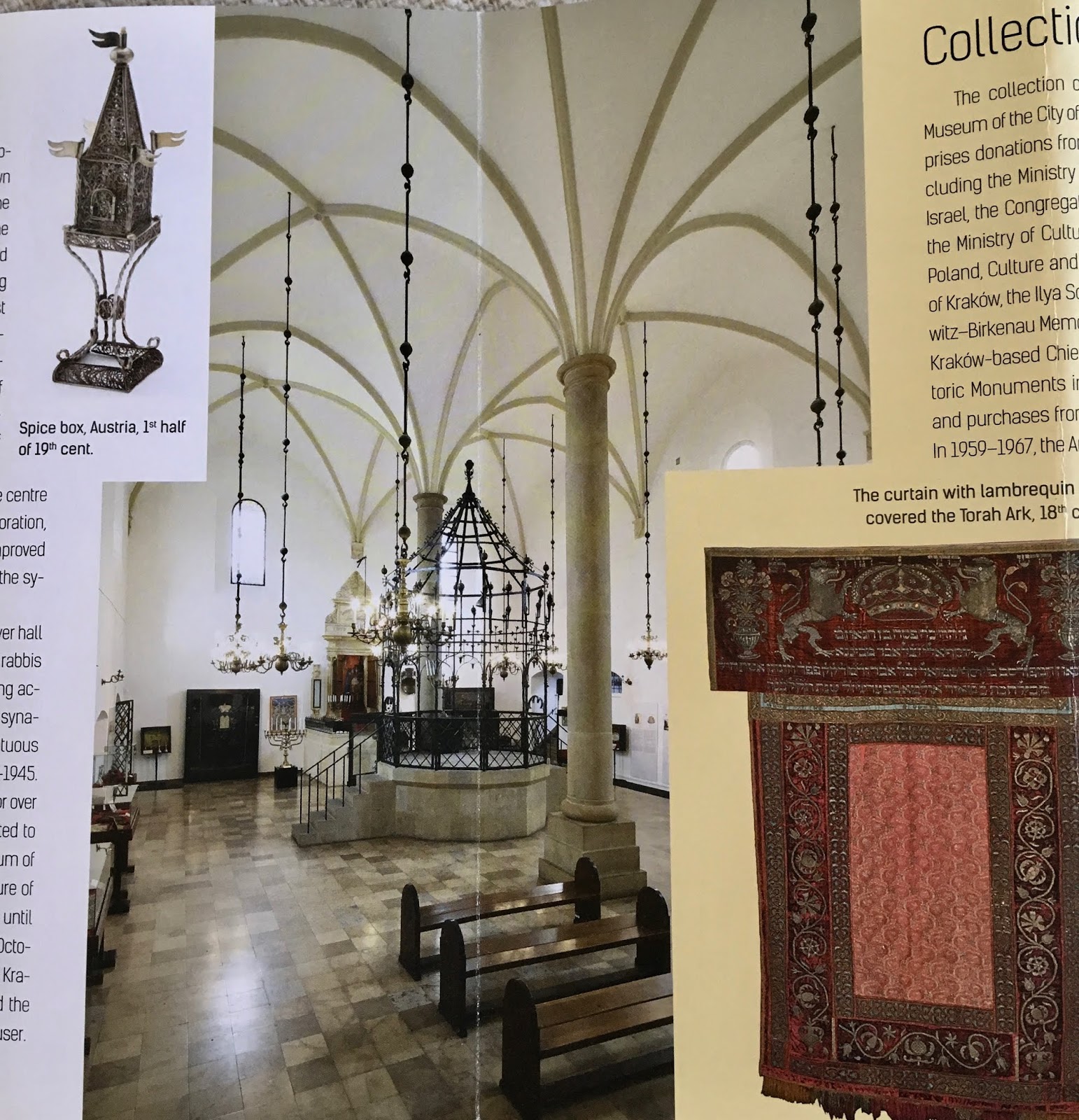
The oldest and most impressive synagogue we saw was the Old Synagogue (Stara Synagoga) on the utica Szeroka (Wide Street), once the focus of religious life in Krakow. The Renaissance building, designed by the Florentine architect Matteo Gucci in the 1570s, provided another peaceful interlude, as well as a look at historical events that took place here. Destroyed by the Nazis, the painstakingly rebuilt structure has become a museum of Jewish life in Krakow.
My favorite painting was this one of a Jewish girl in 1901. I loved her somewhat sassy and sweet expression.

At noon Renate and I stopped at the Hamsa restaurant serving "New Israeli" cuisine. Ancient exterior, modern interior; the website is worth a look. Eco-friendly, peace friendly: "Make hummus, not war."Kid-friendly place too, as you can see from this photo, and a menu that pleased Renate immensely. 

In the afternoon we visited the Remu'h Synagogue, which is still a prayer house and pilgrimage site. Built in 1557, probably in memory of victims of the plague. It's named after the founder's son, Rabbi Moses Isserlis, whose Talmudic school was renowned in 16th century Europe. Behind it as an ancient cemetery. A number of tombstones were dug up in the 1950s, having been covered by earth in the interwar years, as the Nazis smashed the site during their occupation. Outside the entrance to this small synagogue is a collage of torn up tombstones, linked to form a high, powerful Wailing Wall.

We finished our tour of this section of Kazimierz with a stop at another bookstore. Though we didn't buy anything, it was a pleasure to touch real books in this well-lit spacious place.


On the wall outside it, there was this mural:
And this wonderful quote, perhaps the best to see as one enters a bookstore or begins any journey:

Our final stop in Kazimierz was the amazing Ethnographic Museum, a treasure house of Polish folk art. As for learning about the resilience of Jewish religious and cultural life, it wasn't until our next city, Warsaw, that we experienced what is probably the finest museum of all: POLIN Museum of the History of Polish Jews.  This museum focuses not only on suffering and oppression but on a wide view of culture, including what has been called the "golden age of religious tolerance" before the 20th century. Our time was short on the day we visited, and I'm so glad I bought the excellent guidebook for this museum--opened in 2013 on the site of the former Warsaw Ghetto.

Wednesday, July 31, 2019

Remembering Kim Oswalt

I'm thinking of Kim Oswalt, a dear friend of mine, who died two years ago today. Writing this blog today is my way of remembering her and sharing with readers some photos and memories of the the times I spent with her over the years, starting in the early 90s in Japan.

First, here's a picture of her in 2009, smiling and holding her sweet dog, during a walk we took in Kariuizawa, a small mountain town north of Tokyo.

Kim lived there with her partner, Mima, in a beautiful house. In the early spring of that year Junko and I visited her, enjoying the crisp cool air and the natural beauty around the house. Here's what it looked like from the outside.

And here's what it was like from the inside, revealing a lot about Kim. I spent two happy days there that spring. Note the flowers, comfortable pillows, wide views of nature, art on the walls, a dog in the background, a coat hanging on the door, ready for a walk, planned or unplanned. 

So much beauty in early spring--still the muted colors of winter, but broken by soft greens.

Kim was probably best known as a musician among friends and appreciators of traditional Japanese music. Born in Japan when her family was stationed there by the US Army, Kim spent some of her formative years in Japan before the family went back to the US. After college, Kim returned to Japan, and became one of the few westerners to study the 20-string koto at that time (1980). By the time I met her in the early 90s, she was an accomplished koto player who performed with her fellow musician, Helen Dryz.  I was a little in awe of them both then. Helen played the shakuhachi (Japanese flute), and as a duo, they performed both traditional and modern tunes. One of their concerts is recorded on youtube and it's well worth a listen. Click here (Note: concert begins a minute or so into the video.) They performed beautifully, both then and today, when I listened to their performance once again.

While living in Japan, Kim met Mima Yufu and they became life partners. Several years later, they moved to the US, to Boulder, Colorado, where Kim studied psychology and counseling at Naropa University. During their 10-year stay in Boulder, Kim received a master's degree and began a private practice. Then in 2002 they returned to Japan, and that's when I came to know Kim as a friend. 

We often saw each other at "dyke weekends", periodic gatherings north of Tokyo, where lesbians came together to socialize and share ideas. Kim had an innate gentleness and ability to listen--no doubt fostered by her training at Naropa.  Once, when I was asked to facilitate a session between two members of a group I belonged to--members who had conflict and difficult feelings about each other, Kim talked to me about facilitating strategies, and I was able to create a dialog that worked well. A success all around thanks to Kim. 

Over time we came to know each other better, perhaps due to being relatively close in age (I was 6 years older), sharing an extended lesbian community, and also having an interest in social and political change. As undergraduates, I had majored in political science and she in criminal justice. Her obituary notes that she was a "social activist-minded individual who was passionate about changing the world and worked in the Cuban Refugee resettlement, for fair housing rights for African Americans and with Acorn and Witness for Peace." We talked about many things, such as the peace movement that developed in the wake of Bush's war in Iraq, as well as the challenges facing transgendered people in Japan. Kim worked with members of that community through her private practice in Tokyo. Toward the end of my stay in Japan (2009-10), we started to meet once a month for dinner in Yokosuska, site of a naval military base near Yokohama. Kim had contracted to train counselors enlisted in the Navy. Trains made it possible for me to make the 2-hour round-trip journey from my place in Machida, and I always looked forward to our get-togethers. We both loved Japanese food and good conversation.

Then I returned to the US. Except for a brief visit in Boulder after that, I didn't see Kim again until early 2014--this time in San Miguel de Allende, Mexico. She and Mima spent two months there following a visit to Kim's mother in Texas, and I came for the second month of that. We stayed in different places, but enjoyed meeting up before and after massage sessions (by a local practitioner at her home), for art events, and of course for good food and conversation. Here we are on a happy afternoon after a massage and on another at a San Miguel restaurant.


Throughout the time I knew her, Kim bravely faced a major health challenge: kidney disease. She had two transplants over a 20 year period, and when the second one began to fail, hoped to have a third. That was not to be. Kim and Mima returned to the US in 2015, primarily for Kim's medical treatment. On July 31, 2017, at the age of 64, she died in her home in Ashland, Oregon. She had been under hospice care, and from what I later learned, among loving friends who supported her in her final months. 

I think of Kim with a mixture of gratitude and regret--gratitude for the great opportunity to be her friend and regret that I didn't really stay in touch during the three years between our last meeting and her death. It comforts me that she had Mima and her friends close to her, people who could give her the daily love and support that's difficult to give over distance. Today I remember her with love, feeling close to all others who also had the great good fortune to be her friend and who still carry her memory in their hearts. 


Saturday, July 27, 2019

Auschwitz-Birkenau: 75 years later

When I was first planning a trip to Poland, I thought I might pass on a visit to Auschwitz, the largest Nazi death camp and only one preserved in much of its original condition. I had been to the Dachau concentration camp on my first visit to Europe half a century ago, and in the intervening years, learned how the Holocaust had shaped postwar history. I had seen so many movies, read many books and articles. What more was there to learn or feel? But Renate wanted to go, and yes, of course, I realized, how could I not go to this place during a trip that took me so close to it.

So one afternoon during our stay in Krakow, we boarded a mini bus for the hour's ride to the Auchwitz-Birkenau Memorial. On arriving with our tour group, we were assigned a guide--in Spanish or English--and began our tour of Auschwitz I, the main camp. A sobering walk from the first moment. We filed through exhibit halls, through barracks, down a basement corridor and rooms where lethal injections took place, a room where prisoners awaited "trials", past gallows and a courtyard where people were shot. We filed past exhibits of piles of prosthetics, shoes, suitcases, and chillingly, human hair. In a women's dormitory, photos of the inmates with their direct gazes stared back at us, and I can still see their faces, mostly impassive, and all the more heartbreaking for that.

A three-kilometer bus ride to Birkenau showed us the ruins of the crematoria and a monument to the victims. We walked along the train tracks where selections were made--to one side, death, and to the other forced labor under cruel and  humiliating conditions. Most victims were Jews, but there were also Slavs (also considered an inferior race in Nazi ideology), Roma, gays, political prisoners and many others. Categories that would have included me had I lived in that time and place.

Although I was already aware of most of the facts our guide related, the emotional impact of walking in this place where such massive crimes occurred caught me by surprise. I could not take photos--how could any capture the reality of what this place once was. At Birkenau, I took just this one.
Auschwitz was clearly more visceral and overwhelming compared to the Dachau memorial in Germany. Sobered by that visit, I remember staring at "Never Again" engraved in stone. I think I believed it then--in the sense that surely the world had learned its lesson. That was in 1969, 20 years past the Nuremberg trials, well into an era of people's liberation movements rising in many colonized countries. Many of my generation shared a belief that we were well past the horrors of World War II, and that these progressive movements around the world would bring more and more freedom into being. 

Today an older me, with a half century more of history behind me, sees elements of fascism reemerging in places around the world. Just yesterday PBS carried a story of the suppression of the judiciary in Poland; of course, the US has Trump, Russia has Putin, and nationalist, anti-immigrant, anti-Semitic parties have gained power in many places. Not as toxic as the Nazi regime and without the military might behind it, but a potentiality; Never Again will always remain a hope and challenge rather than stated fact.

Renate and I spent the last day of our Krakow visit in Kazimierz, the historic center of Polish Jews, once its own city, now a part of Krakow. In a bookshop there I bought a copy of Man's Search for Meaning, by Victor E. Frankl. I remember reading this book in college, this story of Dr. Frankl's imprisonment in Nazi camps and his story of survival. "The classic tribute to hope" was the phrase on the cover of this book. I decided to read it again to counter the despair I felt after visiting Auschwitz. When we left Poland, I took it home and finished reading it just yesterday. I found more in it than I had remembered from my first reading all those years ago.

Frankl, an Austrian medical doctor and psychologist, argued that humans can endure any "how" as long as they have a "why". He saw that prisoners who could imagine a positive outcome--a reason to stay alive--often lived longer than others who had given up. A Wikipedia synopsis of the book put it this way: "Frankl concludes that the meaning of life is found in every moment of living; life never ceases to have meaning, even in suffering and death. In a group therapy session during a mass fast inflicted on the camp's inmates trying to protect an anonymous fellow inmate from fatal retribution by authorities, Frankl offered the thought that for everyone in a dire condition there is someone looking down, a friend, family member, or even God, who would expect not to be disappointed. Frankl concludes from his experience that a prisoner's psychological reactions are not solely the result of the conditions of his life, but also from the freedom of choice he always has even in severe suffering." He also notes a connection between hope and the immune system. Death rates spiked during the last week of the year, after those who vainly hoped for freedom by Christmas faced another year with no freedom in sight. 

Clearly positive thinking won't save us. On the contrary, only 1 in 20 concentration camp laborers--those who survived the initial "selections"-- would survive their ordeal, dying from typhus, starvation, cold and overwork, the random brutality of SS guards. Also, another much-less-quoted section from Frankl in Chapter 1 tells us this: "On the average, only those prisoners could keep alive who, after years of trekking from camp to camp, had lost all scruples....they were prepared to use every means, honest and otherwise, even brutal force, theft, and betrayal of their friends, in order to save themselves. We who have come back, by the aid of many lucky chances or miracles....we know: the best of us did not return." 

By 1997, when Frankl died, his book had sold more than 10 million copies and been translated into 24 languages. A gift from the past to those of us entering a future of continuing injustices around us.  
And a message to remind us that we have to create our own "why"in life, remembering we always have the power to choose our response to what befalls us.
Next: a tour of Kazmierz and the resilience of Jewish culture