Showing posts with label Growing food. Show all posts

Friday, November 25, 2016

Remembering a great man and friend: Lee Willoughby

I'm mourning the loss of a friend today. Lee Willoughby passed away yesterday, Thanksgiving Day. It was very sudden, I was told, and I don't know any details yet, not that they matter to grief. This morning I look through the photos I have, remembering times with Lee, a man I started to get to know when I moved back to Colorado and settled in at my cabin in 2010. Here's a photo posted and reposted on Facebook, Lee with an expression so many of us remember: warm, relaxed, gentle, an invitation to neighborliness and conversation. Nature is up front and center and behind, as it was during Lee's life.


Most of our friendship took place at the Woodland Park Farmer's Market, where Lee and friends faithfully set up a Harvest Center booth on market Fridays every summer. I often sat at the booth for an hour or more, chatting with Lee about many different topics: high altitude gardening--the focus of our group, about politics, the movement for healthy, local food--which he was passionate about, music, and friends. He was a joy to talk with because he was so present; he listened, he shared his thoughts, he could see humor and hope in much.


A initiator and mainstay of The Harvest Center, along with his wife Kathy, he was the best kind of leader: one who valued everyone's contribution and encouraged their efforts, all the while bringing energy and ideas of his own. He showed up. Every weekly market day for a number of years, later every other week, setting up the booth in the early hours, usually along with Paula and Jim Bennett, other Harvest Center mainstays. He also organized periodic gardening and food preservation workshops, indoors at the Woodland Park Library for much of the year, or outdoors. Spring was time to prepare raised beds, a necessity for short season gardeners. The photo above is from a 2013 workshop in Divide.

At other times Lee and Kathy helped organize and display the produce section at Mountain Naturals, a grocery store in Woodland Park, ensuring that we could enjoy food any day of the week. Kathy and Lee also took care of the all-season Harvest Center greenhouse at nearby Aspen Valley Ranch. They maintained it year-round and were present for special events, including annual Harvest Center greenhouse tours. Here's a photo I snapped when I stopped there during this year's greenhouse tour.


Another friend of Lee's, Laura Hatfield, posted a Youtube link on Facebook of a 2008 lesson Lee gave showing how to build a planter box. I couldn't watch it all the way through today--too many tears, but I will another day here.  For more video and photos, see the Harvest Center Facebook page. As Lee's Facebook friend, I had other glimpses into the man he was: one who loved hiking and the outdoors, who was active in the community (attending a meeting on the promotion of non-motorized transportation in Woodland Park just days before his death), who knew when to sit back and enjoy a bit of good music, who suffered through this year's election loss, posting Hillary Clinton's touching and powerful concession speech.

Lee was only 72 when he died. He left this planet much too soon, and as all of us will leave, with much work undone. I hope to honor his memory by continuing his commitment to healthy, sustainable living in whatever ways I can, and I hope that the community where he lived will find a way to permanently honor his life and work. Rest in peace, Lee. Thank you for the gift of your friendship.  My deepest sympathy to his family and all friends who are grieving his death.

Thursday, September 22, 2016

Farewell to summer through the senses

I’ve been working at the cabin all day, getting ready to close it over the next two weeks, and making my farewells to summer here at Littlehorse.  How to talk about farewells? Maybe through the experiences filtered through senses over the course of the day: evening silence, the color gold, the taste and smell of harvest veggies, the touch of a paintbrush from a postponed summer task, a yoga sequence.

I always feel a little out of sorts at transition times, trying to fight a sense of loss and the anxiety that comes with it. I go through this every year when I get ready to go back to the city. Anxiety be damned--I want to focus instead on gratitude for the chance to spend so much of my summer here as well as the anticipation of returning to Denver friends and activities.

So as the day winds to an end, I decide to take a long walk.  The evening is so very quiet, and the silence reminds me of what’s missing after summer ends: bird cries and the buzz of hummingbirds, thunder from a late afternoon summer storm, the occasional RV bumping over the gravel road on its way to 11-Mile Reservoir.  The strong afternoon winds have stopped and the air is absolutely still. I hear my footsteps crunch on gravel as I climb up into the trees across the road. Two birds call to each other. As the light fades, I hear coyotes howl in the distance. I start to breathe more deeply. There are no human sounds, and as my anxiety lessens, I’m grateful for that.

Gold--the color of Colorado in autumn. The aspen trees have been turning gold this week, and I can see the change daily. Peak colors will come in another week or so. This background of this selfie, taken last Saturday, gives you an idea.


Then there’s the gold I see almost every evening and morning at sunrise and sunset. This sunset photo, taken a few days ago, features the reds that are more common as fall approaches. No gold tonight, though. The sky was a study in various shades of blue, matching my mood.


I spent the afternoon cooking, steaming broccoli and sweet potatoes, and putting together a pasta salad featuring the cherry tomatoes from plants which *finally* started producing in mid-August. They grew in Linda’s small greenhouse, which I happily share every summer for the pleasure of picking fresh lettuce, scallions greens and herbs all summer. Any fruiting plant—peppers, squash, tomatoes—requires patience. Such is the nature of gardening at nearly 9000 feet. Just as it’s time to pick our reward, well, it’s time to say goodbye to the season. The tomatoes were worth waiting for, however; tasty in the salad but best picked right from the vine. Here’s a photo from Aug. 18 of one day's pickings.


Mornings are the best time for outside chores. The wind is usually calm and my energy is high. This morning I stained the cabin stairs, front and back, and the deck railings. The high altitude sun is merciless on wood, and a touch-up was overdue. Generally I dislike painting/staining—the smell of the chemicals and messiness of it all, so I had put off the job all summer. Today I got it done—testament to the value of deadlines. Final cabin closing day is close and I knew I wasn't likely to get better weather. Surprisingly, the work was pleasant: the dry bleached wood soaked up the stain, and I liked the feel of gliding the brush back and forth.

Perhaps the most delightful sensory experience of late summer came last Saturday when I visited Karen Anderson’s beautiful home and gardens here in Florissant. Karen and yoga teacher Debbie Winking invited me to a yoga day outdoors, along with several other friends and yoga practitioners. I wrote about Karen’s gardens and summer yoga events in this blog last year. (Click here for that entry.) We started with greetings and coffee in Karen’s kitchen. From this photo you can see the visual treat she has every day when she does dishes and looks out at the soft colors outside the window. The inside view gives you a glimpse of the spirit of her home and gardens.


Later we moved outdoors on that sunny and temperate day, and did yoga amid the trees (How perfect for the tree pose!). There was mat work too, and we all found places where we could stretch out and gaze at the gardens and the sky. Here was my spot.


Then came a tasty potluck lunch and time for a circle to close the day. We each drew a word from a bag of small folded papers and reflected on its meaning. I drew the word “solace". I have a Catholic background, and it immediately evoked a mental picture of the Virgin Mary: a tender touch, a soft word, loving gaze. The image/idea of solace has returned to me during the past week. It’s something we give others when a heart is hurting or fearful or just unsettled. And solace, I thought as I walked this evening, is something we can give ourselves. One of the yoga sequences we did involved turning to each of four directions, squatting, scooping energy from the earth and raising our arms to the sky. Each direction represented a quality: acceptance (north), gratitude (east), letting go (south), and trust (west). The elements of solace perhaps? I started today with this activity and plan to do so again tomorrow.

Sunday, September 27, 2015

Yoga and flowers at Paradise Gardens

The season turned this past week, officially shifting from summer to fall on the calendar—a process that started much earlier and still continues, as colors turn and temperatures drop. I’m enjoying both, while at the same time, taking out summer memories, like smooth stones in a pocket. Today I’m turning over one of my favorites—visits to Paradise Gardens here in Florissant. Here I love to indulge two of my passions—garden appreciation and yoga.

Paradise Gardens is the name of the home and garden of Karen Anderson and her husband, Mike McCartney. They’ve been living on this forested land for 38 years. For the first 18 years, they lived in a small house, without electricity or running water—an accomplishment that Thoreau would certainly acknowledge and applaud if he visited our consumer-driven century. Karen started small with gardening, planting in a space that is now her herb garden.

Over time, the cabin and amenities developed, and Karen brought their high altitude acres into bloom. She’s known locally as “The Plant Lady”—deservedly so, as gardening is her passion. She has shared her knowledge and plants with just about everyone who consults her about growing stuff in rocky soil at 9000 feet. Would-be gardeners can attend a class, phone for an appointment or come to one of her open houses. My first visit was a couple of years ago during the annual greenhouse tour sponsored by the The Harvest Center. I was totally charmed from the moment I stepped onto her winding paths.


There are structures too, including a small shed, where Karen displays her artwork as well as plants. 


Raised beds contain outdoor plants, and a greenhouse is essential for extending the short growing season here.


For Karen, gardening involves much practical attention to the needs of plants—location, soil, nourishment. It’s also a spiritual practice. She’s approaches her work with awareness of The Great Law—or seven-generation concept. “Plant it Forward”, in other words. Basically that means thinking about how our actions will affect others—and the planet—through the next seven generations. Accordingly, that means gardening nature’s way, without the use of chemical pesticides or fertilizers, focusing on organic ways to build the soil and conserve moisture. 

Karen’s spiritual orientation also drew her to yoga. Her long-time friend, Debbie Winking, teaches yoga classes locally. I attend them as often as I can during the summer. At least a couple of times during the season—often at the full or new moon—they have a yoga day (or eve) at the gardens. Participants come from Debbie’s classes and the number is usually small—10 or fewer. That allows us to gather around the pond (a converted satellite dish) or in open spots on the lawn, where we lay our mats. My last visit was in August, the evening full moon. In July we stretched one morning under the sun after introductions and a sharing circle.

Yoga outdoors feels special. So many things do, but a practice designed to promote relaxation and gratitude feels, well, especially special. Science backs up that common experience.  Beautiful scenery stimulates those pleasure-enhancing endorphins in our brains. Ester Sternberg, in her book Healing Spaces: The Science of Place and Well-being (Harvard University Press, 2009), asserts that touching green or a sandy beach produces even more stimulation, which in turn promotes healing.

At our yoga sessions, Debbie reminds us that standing barefoot on uneven ground helps with balance—an important component of yoga practice for so many of us. Standing in the Tree Pose, I realize that my balance is not nearly as good as I want it to be. I vow to do this more often. 

Sometimes evening yoga events are rained out, but this August we were lucky. No drops at all, as we saw the moon rise, glimpsing its travels as we continued stretching or holding poses. The evening ended with our going inside Karen and Mike’s comfortable home for tea and snacks and conversation. Then came my 40-minute ride back home through the darkness, keeping an eye on the moon and all attention on the road and deer-inhabited roadside. A yoga mind was essential for that.

This photo, taken in 2014, shows Debbie (left) and Karen holding Buttons, her canine companion. 


Writing this September day in 2015, I turn that yoga day memory stone over in my mental pocket, thinking back with gratitude and forward with hopes for another season of yoga and flowers next year.

Thursday, August 27, 2015

Folk art hideaway on Ranger Station Road

They’ve been living down the road from Little Horse since the mid-1980s, when they bought a beautiful piece of land here in Park County. They started with a log cabin kit, and in the decades since, have made their home into a model of sustainability and beautiful art. I’m talking about Barb Lane and Reed Arnold—the same husband-wife team saluted in my earlier blog, With a little help from my friends. They apply the same work ethic to their creativity with folk art, which graces many spots around their cabins, greenhouses, and other small structures on these wooded 40-some acres. I’ve visited a number of times over the years, each time enjoying newer pieces along with their older work.

Today I joined Linda and Jane, a visiting friend, in taking a walk through the land with Linda’s dogs, Hop and Belle, who of course had their own priorities, most filtered through their sensitive noses. Ours were focused on casual strolling and gazing at the art—beautiful, often playful, and arranged with care. Barb and Reed were both off the land today, so these photos will not include them, but you’ll have a chance to enjoy their work as you stroll along with us online.

Near the gate, you’ll see this sometimes-kinetic structure: two bicycle wheels adorned with painted wooden animals.


With these driftwood birds, nature does just about all of it. They reminded me of the Deborah Butterfield horse sculptures, which I saw last week at the Denver Botanic Gardens.


A few yards down the road is their newest addition, the still-incomplete spider web, made of stripped and varnished aspen branches. A spider piece may be added soon.


Off in the distance, if you glance right, this structure appears in the trees. Walk closer and you can enjoy the fantasy critters. Barb and Reed use recycled materials as much as possible. The painted curvy wires hanging from the log are bed springs.


Approaching the house, you’ll see one of two porches draped with mobiles, antlers, artfully-placed stones from the artists’ many collecting excursions. The chicken wire structure hanging in the back was done by a friend.


More stones, arranged with a practiced eye.


In back of the house, off to the right, is my favorite structure—a bottle house. The light and warmth are amazing, and I know if I lived there, I’d make it my morning meditation spot. In the door window photo, I tried to catch the painted horses behind the coyotes, but managed to capture only some reflected colors.


And of course, there’s a bottle tree, which caught the mid-morning light today.


Walking past the bottle house and down an incline, we reached a clearing. To the left is another bottle-enhanced aspen-branch structure. There’s a bench in front, which Jane found was a perfect spot for reading, as Linda and I strolled on, keeping an eye on the dogs.


Nearing the main greenhouse, we stopped taking photos, as we decided to take up Barb and Reed’s standing offer to help ourselves to produce in the greenhouse and raised beds. To give you an idea, here are two photos from a 2014 visit. We left with a modest helping of peas, chard and a few carrots. 


We walked back to the entrance. The dogs, panting and looking a bit tuckered from their adventures, joined us in the car, and minutes later we were back at Little Horse. Wanting to relive our tour, I uploaded these photos and wrote this blog. I hope you enjoyed the stroll.

Tuesday, August 25, 2015

Gardening as delight and folly

Gardening is ultimately a folly whose goal is to provide delight. Deborah Needleman

This morning I started the day by picking salad greens, chives, mint, squash and a few cherry tomatoes in the greenhouse. Then I dug into my raised bed for the first potatoes of the season. It’s an almost-daily pleasure when I’m here at Little Horse, as I am most days in the summer. Here’s how the harvest looked today after I brought it inside, washed it off, and had it pose for a photo session. The lettuce and tomatoes are now history, having been part of a tasty lunch.


For the last few years, I’ve been helping Linda with her greenhouse, an 8 x 10 structure that she and her sister, Barbara, built. For Linda, who lives here year-round, the gardening year starts in the dead of January, when seed catalogs start to arrive. By early spring, in March, the focus is the weather: When will the time be right to prep the soil and plant the first cold-hardy crops. Timing varies dramatically year by year in this mountain climate. This year spring came late, with little sun and lots of cold,hail-peppered weather through May. After the watchful time came the buying of seeds and transplants and imagining the season to come. 

By the time I arrived in June, the beginning of the gardening year for me, tomato starts had gone in along with peppers, onions, beets, peas, “toy choy” (a very cute mini bok choy), a few flowers (including sunflower, seeds) and those cool-weather standbys, lettuce and chard. I added beans, herbs (parsley, cilantro, mint and basil), more flowers, and made still another attempt to grow French breakfast radishes. Outdoors, Linda had planted potatoes next to the greenhouse and in my raised bed. These cold-tolerant plants were already 6 inches high.
If you judged the harvest economically, the folly of it all would be apparent. Neither Linda nor I keeps a tally of our costs. Who cares? For both of us, the goal is less to provide food than to provide delight: beauty, freshness, and the pleasure of seeing things grow. Here’s how one of the beds looked in early July. Greens did so well in this relatively cool, humid summer. So pretty.

If there’s one thing I can say about my garden, it can always surprise me. David Hobson, The Mad Gardener

Notice the plant on the lower left in the picture above, the one growing through the gravel path. One day I yanked it up, not sure if I was weeding or harvesting. Here was the result—a beautiful turnip that became part of a roasted veggie platter that evening. It was a reminder that sometimes nature does it all without any coddling on our part. Yes, very humbling.


Sometimes the surprises are disappointing, of course. This year, once again, I got lots of greens from my radish plants, but no radishes. The cilantro went to seed early. Aphids arrived to devour the spinach and bean plants—and developed colonies, which neither Linda or I noticed until it was too late to save a number of plants.  The beautiful heirloom tomato plant I put in in June never did fruit. Something started nibbling on my potato leaves—unbelievably, as the leaves are toxic and even the numerous ground squirrels left them alone. No critter invasions in the greenhouse this year, luckily.

Fortunately, we can fill the gaps in our harvest thanks to the Woodland Park Farmers Market, held every Friday throughout the summer. One of my favorite stands is run by the Mauro family, who have a farm in Pueblo (warmer and much lower in elevation). They show up every week with buckets of seasonal produce—buckets of beans, zucchini, onions, beets, and tomatoes; cantaloupe and melons too.  Many other vendors are there as well, with Palisade peaches and a variety of other produce and/or prepared foods. My absolute favorite booth usually sells nothing except information. The Harvest Center booth is there bi-monthly, with flyers about workshops and local food events. 

Show me your garden and I shall tell you what you are. Alfred Austin

I think Linda and I are a good team. She does the lion’s share of the work by getting everything organized and planted in the spring. After that, she proves her diligence and loyalty everyday. Even on work days when she leaves at the crack of dawn, she first opens the screen door and window to get air flow moving inside the greenhouse; she waters regularly, and monitors the weather so she’ll be ready to cover cold-sensitive plants overnight. She hates thinning plants, so I take over that job, showing my cool willingness to pluck out tiny shoots of life (great microgreens!) to let others grow. I also pull plants that are past their prime and take care of succession plantings. We have canine help as well. While Belle prefers to dig holes in the potato bed to forestall any burrowing rodents, Hop is ready to assist with watering, as she did in this 2014 photo.


Half the interest of a garden is the constant exercise of the imagination. —Alice Morse Earle, 1897, Pot-Pourri from a Surrey Garden

Linda is fond of sunflowers—the tall ones—and plants them every year. Once grown, they seem to provide an Alice-in-Wonderland feeling in the greenhouse, which makes me feel, well, more imaginative. At the beginning of the season, the focus is on imagining how big things will grow and how they’ll look together. By the end of the season, we’re looking at the gap between hope and result, beginning to imagine next year. So far we’ve discussed planting fewer marigolds and less lettuce, and more peas and beans. Forget the zucchini. Maybe move the mint to my raised bed, where ground squirrels are constantly prowling in search of tasty shoots. Try protecting the summer squash that didn’t make it in our stacked-tire planters outside, most likely due to drying winds. OK, the melon plant was worth a try, but….Still, the sunflowers remind us to imagine all the possibilities.


Fates willing, there will be certainly be another garden, possibly more prolific, possibly not. It doesn’t matter, because we both know we'll enter the cycle again. as Karel Capek reminds us, “Let no one think that real gardening is a bucolic and meditative occupation. It is an insatiable passion, like everything else to which a man gives his heart.” 

Thursday, July 30, 2015

Growing potatoes: a modest tribute to the past

I’ve often envied people with a long family history connected to the places they live, especially those who live on farms or ranches. They might see trees their grandparents planted or remember stories of great-grandparents who first worked the land. As a city-dweller, I’ve never had that experience, never occupied a house where my parents or grandparents had been brought up. Now, living part-time on Linda’s 50-acre spread named Little Horse, I find myself wondering who lived or travelled this land before Linda bought it in the 90s. For generations, the Ute Indian tribes claimed it for camping and hunting, and I’d like to examine that history in another post; but right now, I’m looking at the mid-20th century, when potato farmers lived in this area, in or near the towns of Lake George, Florissant and Divide.

I have no records of previous owners, but I see evidence of their work from my southwest-facing windows—the remnants of ponds and irrigation ditches for collecting spring run-off after snowmelt.


There were other such features in the area. A Wikipedia article on Lake George asserts that the town was once the center of an extensive potato-growing area. A Ute Pass Historical Society document says that Divide was the only town with any real agricultural base, which was virtually gone by the 1930s. Another source reports that farmers in the 30s and 40s, in an effort to survive drought years, built ditches and numerous small dams to channel water; the dams were seen as an ecological
problem decades later, and have since been removed. Today the San Luis Valley in Southern Colorado is the center of potato growing in Colorado and claims to be the #2 fresh potato shipper in the country.

It was a wetter climate during the last century, and we rarely see water here past early spring; this spring, an unusually wet one, we had a small waterfall when the snows began to melt and many rainy days ensued. The pond and ditches are marshy now—late July, with small pools that delight Linda’s dogs. Though we don’t use them for growing crops, we do grow potatoes, and this year’s wet, cool weather is just what this plant likes. In March Linda planted potatoes in a raised bed next to her greenhouse, as well as in my raised bed, covered with shade cloth. They were already growing vigorously by the time I opened my cabin in early June. It’s a small crop. This photo was taken in mid-July.


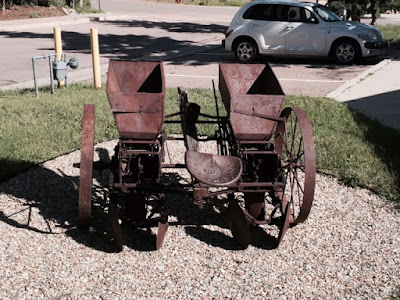
Of course, farming in hopes of feeding a family or earning income was a much more challenging proposition. The Ute Historical Society in Woodland Park has this planter*, a far cry from today’s modern, climate-controlled versions. Thoreau’s potato farming methods were even simpler; after hiring a neighbor to help clear and prepare the soil, he planted by hand and used a hoe to cultivate.


Though my relationship to the land here is recent, my connection to the potato is more fundamental. I would not exist if not for the Irish Potato Famine of 1845-46, which my Dad told us, was responsible for his paternal grandparents’ arrival in the US a few years later. Like so many other Irish, seeing widespread starvation in Ireland after the potato crop failed there, they came to the US seeking new lives. Railroad work, not farming, was their best option, and that’s what they did.

Growing up in Indiana a century later, my association with the potato was mainly through the delicious mashed potatoes my mother served often at dinner. (The potatoes were store-bought, as our small backyard garden featured only tomatoes and flowers). I never did develop a taste for the ubiquitous french fry—except during a childhood phase of craving McDonald’s perfect fries and thick, creamy milkshakes. That’s just as well, as this nutritious vegetable has become a starchy travesty on too many fast food menus, promoting monocultures on American farms, geared to the requirements of corporate buyers. Monoculture was the root of the problem in the Irish potato famine, historians remind us. A fungus attacked the crop, and there were no varieties that might have survived it.

Thoreau, who built his cabin near Walden Pond in 1845, just as the potato blight hit Ireland, had a number of Irish neighbors. At least one of them was skeptical of Thoreau’s decision to farm 11 acres—for food and as a means of earning “10 or 12 dollars by some honest and agreeable method” in order to meet his building expenses. The land, covered with pines and hickories, was considered by the skeptical neighbor to be “good for nothing but to raise cheeping squirrels on”.** Thoreau focused on beans, but also grew potatoes, corn, peas and turnips. Come harvest time, he had 18 bushels of potatoes and a rather modest income after expenses: $4.50. He was pleased with that, all things considered that year—plowing expenses and a late start.

Here at Little Horse, Linda and I are resisting monoculture in our small way. We have yukon golds, reds, and some fingerlings. Potatoes thrive when temperatures are between 45 and 75 degrees Fahrenheit, just what nature has provided this year, and Linda’s plants are already flowering. We continually hill straw and soil around them, and it seems that just a day or so later, they’ve popped through, seemingly as tall as before. This photo shows one day’s harvest late last summer.


We are already fantasizing about the harvest and possibly a small potato festival in honor of the crop and our unknown predecessors on this land. We’ll try new recipes and old favorites, and assuming I’m a successful shopper, a Mr. Potatohead game. Stay tuned.

*Thanks to Lee Willoughby for sending me this photo.
**Source is Walter Harding's annotated edition of Walden.