Showing posts with label Country life. Show all posts

Saturday, December 30, 2017

The crumbs of one woman's year: 2017

"Slung as though in a hammock, or a lull, between one Christmas forever over and  a New Year nearing full of relentless surprises, waywardly and gladly I pry back at those wizening 12 months and see only a waltzing snippet of those topsy-turvy times, flickers of vistas, flashes of queer fishes, patches and chequers of a bard’s eye view….

‘Look back, back, the big voices clarion, look back at the black, colossal year,’ while the rich music fanfares….(but) I can give you only a scattering of some of the crumbs of one man’s year, and the penny music whistles."  —Dylan Thomas in The Crumbs of One Man’s Year

Sitting here in front of my window this warming morning, in this lull between Christmas and New Year’s Day, I see the last melting patches of snow in City Park, as I try to channel Dylan Thomas. I think I have. Though the news feeds are full of “best of’s” and “most importants” of 2017, I sit back and see, as Thomas did, a few “waltzing snippets” that stay in memory. Start with a memory, any memory will do.

I’m near Mudbiscuit, my cabin in Florissant, one June morning, walking down Ranger Station Road with Linda and her two dogs, Belle the Border Collie and Hop the Corgi, breathing the crisp, high altitude air, grateful that I can still return to this beautiful place every summer. I’m watching the dogs, sniffing the history of the night with the focus of a rookie detective. I’m distracted by Hop’s butt, long white and gold hair swaying in the wind. An icon of my country life, like the hummingbird feeders, always my first task when I arrive to open the cabin, filled with a vague anxiety that these tiny birds, having made their home in a nearby cottonwood tree, altitude 8,800 feet, will not survive if I stop providing a daily ration of sugar water. Here's Hop and Belle with their human, Linda, that morning.


Then it’s  time to check the greenhouse. Linda planted early and the greens are thriving. Sunlight on the red-stemmed chard, the park choi, lettuce and peas. Back to the cabin to wash, chop, serve, eat. The day passes: I putter, read, answer email, all a blur until the sky colors change, the great magnificent sky, that surprises me every season I return after being away.


Is it any wonder that the Japanese word for nostalgia, natsukashii, has the root, natsu or summer—where memories wander first? But I have winter memories too, this winter of our resistance following the 2016 upset and deeply upsetting presidential election in the US. So many of us then were frightened, disoriented, still disbelieving.

Jump to Jan. 21, the day after the inauguration of the Divider in Chief, and I’m about to join thousands of Coloradans at the Denver Civic Center for the Women’s March. We don’t know yet that it will become the largest protest in US history, with nearly 5 million taking part around the globe. It’s early, I’m anxious, as full buses pass us at the stop near home. A neighbor gives us a lift and within the half hour we’re walking toward the 16th Street Mall. Then I see it—a steady stream of pussy-hatted women, men pushing strollers, kids, a stream of signs, and I can feel the energy and anticipation of the day. I’ll soon see many more that day. But it’s that first glimpse, as the sun appeared over the heads of those early arrivals, that brought both a thrill and sense of relief. We’re all in this together….

A season of protests reminding us of our unity across race, gender, class and generations. On Valentine’s Day, also known as V-Day--observed by the global activist movement to end gender violence--I was again on the Mall with friends and celebrants, dancers, chanters, and speakers--all pledging to work for justice. Images of red and movement and words, but the image that stays is this one of the young STEM women, remembered partly because I learned what STEM meant that day. We’re all in this together....


The year moved into spring, and I see more images of actions: The silent procession around the State Capitol on International Women’s Day, Climate Action on Earth Day, also a March for Science, notable for its creative signs and the youth of many of the participants. A march and rally in support of “our Muslim neighbors”. In my senior building here in the city, we’re writing postcards to our representatives. Having just moved in the previous October, I’m getting to know my neighbors. So much to resist and encourage. Yes, we’re all in this together….

Delicious moments—cooking being the most ephemeral art, its appreciators also its destroyers. Sitting at a long table at The Mercury Cafe with dear friends on my birthday, eating a pagan vegan plate (greens, tofu, veggie green chili, fried cornmeal), perhaps my 100th plate of it, the menu item I order there  most often….An exquisitely expertly-prepared plate of sushi, a birthday gift from a friend, at Denver’s premier sushi restaurant….Another dinner treat from visiting friends in August at a local artisan restaurant, probably my prettiest food picture of the year.


Summer also brought disillusionment. I watched the Rachel Maddow Show nearly every evening with country or city friends, the stories flowing by, marking the damage this hobbled and flawed democracy brought about by electing the current president and Congress. Then one evening, I was sitting with neighbors in the lobby of my apartment building, not distracted by the slivers of visible sunset, and realizing that there can be no giving up. Maybe it was after 45’s insulting speech at The Boy Scout Jamboree or after his refusal to support more safety measures for football players, saying they  would ruin the game. Not the worst he had done, but the gratuitous cruelty and ignorance struck me viscerally. Remembering, I feel again that shiver of fear, then a calmness, a resolve. We simply cannot give up. Elections are coming in 2018. We’re all in this together….

Moments of joy: that’s what my laughter yoga friends call those moments when we look around us, fully present in the beauty that presents itself, perhaps always there if we just bother to notice. Burying my face in a blossoming tree in City Park across the street from me here in Denver; handing out water bottles to exhausted and grateful marathon runners in City Park, probably my most rewarding volunteer experience.


In October, gazing at a sea of student faces at Metro State University. I was on a panel with 5 other women who had worked on Big Mama Rag, a feminist newspaper published in Denver in the 1970s--more than 40 years ago. We were talking to students in the women's studies department, telling them so many important things--about our passion, our mistakes, what we tried to do and what still needs doing. I remember the expression of the transgender youth in the 2nd row who was really listening, as many others listened impassively or took notes; never doubt the importance of the audience's role in a presentation. We hoped they were listening too--not enough time for Q & A before their next class. Afterwards, as we panelists sat around a table in the student center, I remember a relaxed pleasure and pride: remembering this time we shared and our gratitude for being a part of what is now history!

Death made itself visible to me this year, not exactly a next door neighbor, but more like a silent and solemn newcomer who has moved in down the block. In the spring two women died, members of one of my groups (OLOC), one suddenly and one from cancer. Both were honored at one of our monthly meetings in a ceremony led by another member--who herself passed away later in the year from cancer. In early March a former neighbor turned friend—Joanne, age 85—died from complications of cancer and an accident. A day earlier, Gerry Starbuck, my first employer in Denver in 1977, passed away. Later, a good friend from my days in Japan, Kim Oswalt, passed away. Not long afterwards I was telling a neighbor about these deaths. “ It will be more and more like this,” she told me matter-of-factly but not without sympathy. She didn’t need to explain how aging brings knowledge--the sense of one’s own vulnerability accompanied by increasing losses. The image I call up most often is the one below from the Day of the Dead exhibit and celebration at the Denver Botanic Gardens in early November. I paused for several moments before this altar where the artist explained her story and art to a group of children. In the past few years I’ve seen this holiday grow beyond its Mexican roots into a developing North American holiday, with numerous events around town. We need it to recognize the role of death in human life and honor the lives of those no longer with us.


Moments of auditory joy: sitting on the stage of the Grant Park Orchestra in Chicago, listening to a young woman play Bach’s cello suite No. 5 on her viola, the lights of Millennium Park behind her.
The Sound Circle a cappella chorus, singing beneath the stained glass windows of a Boulder church.

This fading year of 2017 will always be the year I discovered song. In September I joined my first flash mob where more than 100 of us sang Holly Near’s "Singing for Our Lives", as we peeled off jackets to the surprise of onlookers at the DCPA. Yet the scene that returns is the short concert we gave on the Mall afterwards, becoming celebrities of the hour to passersby. One solitary older man caught my eye, watching silently and then finally, slowly joining in on a song. World Singing Day came a month later, and I was there, on the Pearl Street Mall in Boulder, where anyone who came by got a lyric booklet with tunes ranging from "Uptown Funk" to "Imagine", and where we sang our hearts out, in one big outdoor karaoke session. Instead of an electronic screen, we had various small choirs lead us, and instead of a room, the sunny, chilly outdoors. In December I was back on the 16th Street Mall in Denver, singing “alternative lyrics” to popular Christmas carols, all aimed at mocking the GOP tax bill, It  passed the Senate the following day, unfortunately, but the singing helped sooth and energize.  I think we’re on to something as we head into Resistance Year #2.

And then Christmas and the company of friends, and some slow easy days with time for reflection.

“And one man’s year is like the country of a cloud, mapped on the sky, that soon will vanish into the watery, ordered wastes, intro the spinning rule, into the dark which is light.” —Dylan Thomas


Wednesday, July 5, 2017

A changing ecosystem: on wildlife small and large

Coming back to my cabin after months away always evokes feels that old John Denver song, Back Home Again. Things seem pretty much the same as I remember from last year, and then I start to notice the differences. There’s always the weather, some years being wetter, others drier, and the result is more or fewer worries about fire. This year Linda and I have been talking about how the eco-system is decidedly different from other years. Top changes are the disappearance of ground squirrels, the fewer numbers of hummingbirds and the proliferation of an animal that rivals humans for domination of the planet: ants.

Below is a photo of a ground squirrel, taken a couple of years ago. Ground squirrels live in burrows underground, sleeping for most of the year. By the time I would arrive in the early summer, the young ones were out of the nest, gamboling in my compost pile and chasing each other through the yard. At one point I worried that they would reproduce in such numbers that my backyard would start to look like those 19th century photos of the American West, the ones showing thousands—no, millions—of prairie dog burrows along train tracks. But the population never exploded, as predators kept the balance. Still, I always had mixed feelings about the ground squirrels living next door to me—enjoyment of their playful antics and annoyance that outdoor gardening was impossible.


Those critters are nowhere to be seen this year, and it’s pretty clear there are two reasons for that: evidence (large holes) of one or more badgers during the winter and the appearance last fall of a family of feral cats. Mercifully, the 3 cats are all male, one the father (presumably) and the other grown kittens. How do you know they're all male? I asked Linda, picturing a future “prairie dog village” of felines. “I know,” Linda replied. “I felt their balls.” Reassured by her confident assertion, I began to appreciate them more. They are actually semi-domesticated, and they have names. Linda, who loves this little family, built a hay fort for them to get them through the winter and supplemented their hunters’ diet with cat food. One of the grown kittens, Buttons, likes to be petted, and all three can be seen napping in the shade on Linda’s doorstep during the afternoon. Here is a photo of Babe, the other grown kitten, looking, well, quasi-feral.


Yet, even with these three, it’s clear how the introduction of a predator species can alter the wildlife landscape. The wild rabbits are gone, hopefully safe and nesting in a neighbor’s woodpile; so are the mice (no regrets there, I confess). There also seem to be fewer flies. Is there a connection in that fewer rodents means fewer insects/fleas for flies? Is there a connection with the drop in the number of hummingbirds, who, contrary to popular belief, rely on airborne insects for food as well as on the nectar I still faithfully put out. At the same time, a male broadtail I call “bully bird” has been guarding my feeder, chasing away others except for one female, presumably his. Perhaps something else is going on in the hummingbird world, something we don’t see. Or, as it’s a dry year with fewer wildflowers than usual, the birds could have found a more hospitable micro-climate. With complicated ecosystems, all we can do is speculate.

Then there are the ants. Plenty outside and sometimes they bite. Not too many inside, but enough to bring out my murderous instincts: too close to my kitchen counter? Swat! Hoping to balance out my ants-as-pestilence attitude, I checked out a DVD of a PBS special on E.O. Wilson, the renowned biologist who dedicated much of his life to studying ants. There are 16,000 species of them in the world—which I find astonishing—and that’s just the number that have been discovered. Professor Wilson, now Emeritus, contends that if you put the weight of all of the ants in the world on one scale and the weight of all humans on the other, the weights would be roughly equal. I confess that didn’t curb my swatting instincts. Since our species seems well on the way to promoting our own extinction, I find myself mumbling to them, “You’ll have the earth soon enough!) Wilson says people often ask him what to do about ant invasions. “I tell them to crumble a cookie on the counter and then watch their behavior,” he advises. Clearly it’s better to ask a scientist about curiosity, not extermination. As for me, most days I just focus on not dribbling hummingbird nectar on the floor, cleaning counters and hoping for the best.

In the years I’ve been coming to stay here for stretches of time, my sightings of larger wildlife have been astonishingly few. A small herd of pronghorn crossing the land at a distance, a discreet coyote near the dry stream bed at dusk, an occasional deer jumping the fence across the road, a few wild turkeys. Neighbors with forested land or rocky outcroppings can usually add bears and occasionally, a mountain lion, but here, on this open former pastureland, they would never pass during daylight. Include the semi-wild mammals, and I can add visiting herds of donkeys that stayed for a day or a few before heading out the always-open gate. Then there are the domesticated llamas, cows and horses seen along the road from time to time.

I miss the donkeys. As a species, they’re the descendants of pack animals used during Colorado’s mining days. They’re legally protected in Colorado, and often something of a tourist attraction. Cripple Creek, a neighboring town, boasts a resident herd and a summer donkey race event. “Our” donkeys stopped coming a couple of years ago after the rancher who supposedly owns them built a better fence (or so we heard), stopping their wanderings in the neighborhood.

I suppose scarcity breeds appreciation. This morning, while walking with Linda and her two dogs through the trees across the road, we spotted a deer, a beautiful young buck, wandering freely through the trees. A beautiful moment it was in a changing and dynamic ecosystem. And as we reached the road, we looked over at the haze above distant mountains. Smoke from wildfires in Utah and Arizona,   where ecosystems will undergo major changes this summer. We're grateful to be spared--today.

Friday, November 25, 2016

Remembering a great man and friend: Lee Willoughby

I'm mourning the loss of a friend today. Lee Willoughby passed away yesterday, Thanksgiving Day. It was very sudden, I was told, and I don't know any details yet, not that they matter to grief. This morning I look through the photos I have, remembering times with Lee, a man I started to get to know when I moved back to Colorado and settled in at my cabin in 2010. Here's a photo posted and reposted on Facebook, Lee with an expression so many of us remember: warm, relaxed, gentle, an invitation to neighborliness and conversation. Nature is up front and center and behind, as it was during Lee's life.


Most of our friendship took place at the Woodland Park Farmer's Market, where Lee and friends faithfully set up a Harvest Center booth on market Fridays every summer. I often sat at the booth for an hour or more, chatting with Lee about many different topics: high altitude gardening--the focus of our group, about politics, the movement for healthy, local food--which he was passionate about, music, and friends. He was a joy to talk with because he was so present; he listened, he shared his thoughts, he could see humor and hope in much.


A initiator and mainstay of The Harvest Center, along with his wife Kathy, he was the best kind of leader: one who valued everyone's contribution and encouraged their efforts, all the while bringing energy and ideas of his own. He showed up. Every weekly market day for a number of years, later every other week, setting up the booth in the early hours, usually along with Paula and Jim Bennett, other Harvest Center mainstays. He also organized periodic gardening and food preservation workshops, indoors at the Woodland Park Library for much of the year, or outdoors. Spring was time to prepare raised beds, a necessity for short season gardeners. The photo above is from a 2013 workshop in Divide.

At other times Lee and Kathy helped organize and display the produce section at Mountain Naturals, a grocery store in Woodland Park, ensuring that we could enjoy food any day of the week. Kathy and Lee also took care of the all-season Harvest Center greenhouse at nearby Aspen Valley Ranch. They maintained it year-round and were present for special events, including annual Harvest Center greenhouse tours. Here's a photo I snapped when I stopped there during this year's greenhouse tour.


Another friend of Lee's, Laura Hatfield, posted a Youtube link on Facebook of a 2008 lesson Lee gave showing how to build a planter box. I couldn't watch it all the way through today--too many tears, but I will another day here.  For more video and photos, see the Harvest Center Facebook page. As Lee's Facebook friend, I had other glimpses into the man he was: one who loved hiking and the outdoors, who was active in the community (attending a meeting on the promotion of non-motorized transportation in Woodland Park just days before his death), who knew when to sit back and enjoy a bit of good music, who suffered through this year's election loss, posting Hillary Clinton's touching and powerful concession speech.

Lee was only 72 when he died. He left this planet much too soon, and as all of us will leave, with much work undone. I hope to honor his memory by continuing his commitment to healthy, sustainable living in whatever ways I can, and I hope that the community where he lived will find a way to permanently honor his life and work. Rest in peace, Lee. Thank you for the gift of your friendship.  My deepest sympathy to his family and all friends who are grieving his death.

Saturday, September 24, 2016

A Memoir of Sounds

I wish to hear the silence of the night,  for the silence is something positive and to be heard.  --Thoreau

I sometimes wish I had an album of sounds, from childhood through the present, in all of the places I've lived. Turn the page, hear a different one. Sounds are harder to recall than visual images, yet hear them again, and a memory jumps into place. Favored ones, pleasant ones, tend to float to the top of the memory pile; my survival instincts push others, such as the sound of quarreling relatives, to the bottom. Others, mercifully,  get filtered out as noise: screeching tires, yapping small dogs, yesterday's buzzing mosquito. This blog entry is a journey through sound memories, enhanced through technology. Of course, music is a soundtrack for life as well, but that’s a subject for a another day.

The first sound I heard--and you heard--when we were tucked into our mothers' wombs was a heartbeat. You can hear it again today, courtesy of this Youtube recording of womb sounds. Listen for a few minutes, as I did today. Designed to calm sleepless babies, they’re still comforting for adults, aren't they? Looking for something more complex, we have all sorts of other sound comforts in adult life, also thanks to YouTube. I loved this one: what’s more conducive to sleep than soft rain falling on leaves?


One of my aural memories of Hammond, Indiana, the town where I lived from age 6 to 15, was a train horn. Hammond had a lot of train tracks, and legend had it that more women gave birth unexpectedly at train crossings than in any other town. I remember the train sounds at night, a kind of sweet melancholy. Here's one 41-second train horn recording I found--just like what I remember and hear sometimes in Denver now too.  Also recalled from childhood summers: the “hiss of summer lawns”—to borrow the title of a Joni Mitchell album, the whirr of a push lawn mower, the barely audible broadcast of a baseball game on a transistor radio, passing trucks on a nearby highway, the bells of ice cream vendors riding bicycles.

After moving to Chicago with my family as a teen, graduating from high school and moving on to college, I often heard the city’s iconic elevated trains. No doubt I also heard them during my first 5 years of childhood in that city. Perhaps I heard the sounds of “the el” in the womb, along with Mom’s heartbeat. Chicago trains helped me realize how the brain filters out repetitive sounds, noticing them only in the absence. Low-cost apartments, where I usually lived, were often near the el, so my brain did a lot of filtering. Here's one of the el in the snow. Another Chicago sound memory: waves lapping on the shore of Lake Michigan. Mundelein College, where I spent 4 years, was located right next to the lake on the city’s North Side.

I missed the trains and the lake when I moved to Denver in 1976. Sometimes at night I could hear freight trains passing, but for the most part, I don’t connect Denver with trains. Lake Michigan sounds were replaced by those of rushing mountain rivers, as moving to Colorado introduced me to my first real non-urban soundscapes. Encountering mountain wilderness on camping trips taught me to listen to natural music: the wind blowing through Ponderosa pine, the distant howl of coyotes, the crunch of heavy boots on gravel.

The sounds of urban Japan entered my life in 1990 when I moved to Machida City in the greater Tokyo area. During those first months, on some mornings, I thought I heard the strangest sing-song phrase coming from trucks passing by my apartment building; could it be a Buddhist chant? Eventually, I learned that those trucks were selling laundry poles! Listen to the last few seconds of this 30-second link to hear the laundry pole “chant”.  A pleasant sound, unlike the ubiquitous loudspeakers on campaign trucks during election season. Those were only a periodic annoyance, fortunately.  Years later, living in my own place a train stop away, I awoke to frogs nearby, exactly where I was never sure, and the muffled sounds of the Odakyu Line train. Japanese trains do not run at night, a boon for sleepers, if not party-goers. Miss the last train, and you stay out until they start again at 5 a.m. in the morning--unless you splurge on a taxi. Nights were relatively quiet except for occasional bozozoku, young men who were or fancied themselves members of motorcycle gangs, racing down the Tsurukawa Kaido a block away. Their unmuffled motors were almost impossible to filter out. As summer progressed, the cicada chorus grew louder, and its vibrations made the air hum. Last year I was Skyping with my Japanese sister, Junko, and I could the cicadas in the background as we talked. I was surprised at how homesick for Japan they made me feel. Here's the sound of autumn crickets.

Now I live in Denver most of the year, and my brain continues to filter sound, pleasant from unpleasant. Every time I hear a loud leaf blower—which always seems to accomplish very little actually—I miss the soft swish of the bamboo brooms that staffers used on the Tamagawa campus to rake fallen leaves. My apartment is on busy Grant Street, near downtown and the State Capitol building, and if I had no sight, I could clearly tell the time of day from the first pre-rush-hour traffic sounds to the constant stream at its height. Annoying sounds include shouts of inebriated nightclub-goers when the bars close at 2 a.m., but not long after that, a silence ensues, punctuated by an occasional siren.

In Florissant, where I spend a good bit of the summer, sounds have a different rhythm and I take notice of different things. Windows open, I hear the buzz/chirp of the hummingbirds at my two feeders from early morning to sunset. Nearly all were on their way south by Labor Day, and when I came back in September from a short trip to Chicago, the silence of their absence was deafening.  Occasional sounds from the summer that has just passed: tires crunching the gravel of Ranger Station Road, a distant generator, Linda’s dogs, Hop and Belle, barking at something. Very occasional sounds: target practice gun shots (a former neighbor’s grandsons visiting the now-mostly-vacant family cabin), a passing herd of cows, a couple of braying burros announcing the arrival of the herd for a day or two of grazing. Owned by a somewhat neglectful neighboring rancher, they used to visit the land periodically but haven’t been around all summer this year. We've had good rainfall this year, so the grass is probably tasty enough in their home pastures.

By sundown, the land descends into true silence. Sometimes I hear the sound of rain or distant coyotes. Otherwise, my ears seem to ring, seeking some auditory vibration. I have electricity and access to technology; I could watch a DVD or listen to music, but I generally don’t. I enjoy the quiet—for awhile. Nights are generally much cooler than the days here, and by the middle of the night the house begins to make sounds. I often wake with a start when I hear a small noise: Was that a mouse or just a creak? A nighttime visitor (that elusive badger who’s been digging holes outside)? My hearing is acute, so acute, too acute. Like Thoreau, I want the positive sounds of silence, yet too often I just wish the sounds of morning would arrive and calm my beating heart.

*Photo from npr.org


Thursday, September 22, 2016

Farewell to summer through the senses

I’ve been working at the cabin all day, getting ready to close it over the next two weeks, and making my farewells to summer here at Littlehorse.  How to talk about farewells? Maybe through the experiences filtered through senses over the course of the day: evening silence, the color gold, the taste and smell of harvest veggies, the touch of a paintbrush from a postponed summer task, a yoga sequence.

I always feel a little out of sorts at transition times, trying to fight a sense of loss and the anxiety that comes with it. I go through this every year when I get ready to go back to the city. Anxiety be damned--I want to focus instead on gratitude for the chance to spend so much of my summer here as well as the anticipation of returning to Denver friends and activities.

So as the day winds to an end, I decide to take a long walk.  The evening is so very quiet, and the silence reminds me of what’s missing after summer ends: bird cries and the buzz of hummingbirds, thunder from a late afternoon summer storm, the occasional RV bumping over the gravel road on its way to 11-Mile Reservoir.  The strong afternoon winds have stopped and the air is absolutely still. I hear my footsteps crunch on gravel as I climb up into the trees across the road. Two birds call to each other. As the light fades, I hear coyotes howl in the distance. I start to breathe more deeply. There are no human sounds, and as my anxiety lessens, I’m grateful for that.

Gold--the color of Colorado in autumn. The aspen trees have been turning gold this week, and I can see the change daily. Peak colors will come in another week or so. This background of this selfie, taken last Saturday, gives you an idea.


Then there’s the gold I see almost every evening and morning at sunrise and sunset. This sunset photo, taken a few days ago, features the reds that are more common as fall approaches. No gold tonight, though. The sky was a study in various shades of blue, matching my mood.


I spent the afternoon cooking, steaming broccoli and sweet potatoes, and putting together a pasta salad featuring the cherry tomatoes from plants which *finally* started producing in mid-August. They grew in Linda’s small greenhouse, which I happily share every summer for the pleasure of picking fresh lettuce, scallions greens and herbs all summer. Any fruiting plant—peppers, squash, tomatoes—requires patience. Such is the nature of gardening at nearly 9000 feet. Just as it’s time to pick our reward, well, it’s time to say goodbye to the season. The tomatoes were worth waiting for, however; tasty in the salad but best picked right from the vine. Here’s a photo from Aug. 18 of one day's pickings.


Mornings are the best time for outside chores. The wind is usually calm and my energy is high. This morning I stained the cabin stairs, front and back, and the deck railings. The high altitude sun is merciless on wood, and a touch-up was overdue. Generally I dislike painting/staining—the smell of the chemicals and messiness of it all, so I had put off the job all summer. Today I got it done—testament to the value of deadlines. Final cabin closing day is close and I knew I wasn't likely to get better weather. Surprisingly, the work was pleasant: the dry bleached wood soaked up the stain, and I liked the feel of gliding the brush back and forth.

Perhaps the most delightful sensory experience of late summer came last Saturday when I visited Karen Anderson’s beautiful home and gardens here in Florissant. Karen and yoga teacher Debbie Winking invited me to a yoga day outdoors, along with several other friends and yoga practitioners. I wrote about Karen’s gardens and summer yoga events in this blog last year. (Click here for that entry.) We started with greetings and coffee in Karen’s kitchen. From this photo you can see the visual treat she has every day when she does dishes and looks out at the soft colors outside the window. The inside view gives you a glimpse of the spirit of her home and gardens.


Later we moved outdoors on that sunny and temperate day, and did yoga amid the trees (How perfect for the tree pose!). There was mat work too, and we all found places where we could stretch out and gaze at the gardens and the sky. Here was my spot.


Then came a tasty potluck lunch and time for a circle to close the day. We each drew a word from a bag of small folded papers and reflected on its meaning. I drew the word “solace". I have a Catholic background, and it immediately evoked a mental picture of the Virgin Mary: a tender touch, a soft word, loving gaze. The image/idea of solace has returned to me during the past week. It’s something we give others when a heart is hurting or fearful or just unsettled. And solace, I thought as I walked this evening, is something we can give ourselves. One of the yoga sequences we did involved turning to each of four directions, squatting, scooping energy from the earth and raising our arms to the sky. Each direction represented a quality: acceptance (north), gratitude (east), letting go (south), and trust (west). The elements of solace perhaps? I started today with this activity and plan to do so again tomorrow.

Sunday, July 24, 2016

Western Wildfires: Smoke gets in your eyes

It was a wet spring when I opened the cabin in early June this year. I didn't think about wildfires very much until after a week-long stay in Denver the following month. Returning to the cabin in mid-July, I discovered that seven fires were burning in Colorado, bringing a smoky haze to the horizon some days and worry that this summer would bring more fires, more smoke, and possible evacuation. So far we've been spared, but the summer is just at the midway point. The environment continues to dry as we move farther away from spring snowmelt and the July monsoons, which were very sparse this year. The causes of fires are diverse and unpredictable: lightening strikes and careless campers being at the top of the list.

When I moved to this rural area 6 years ago, I had to readjust my concept of fire. To a person like me who has lived most of her life in cities, a fire means a kitchen accident, a forgotten cigarette, or a burst pipeline--occasionally arson. Usually the fire department arrives promptly and puts it out. Larger fires, part of riots ensuing from injustice, euphemistically called "civil unrest", happen too sometimes, and they also are contained, usually within a day or two. The massive fires of yesteryear--the Great Chicago Fire of the 19th century and the ones that nearly destroyed Tokyo after the 1923 earthquake--seem consigned to history, unlikely to repeat with modern building codes, alarms and well-equipped fire departments.

I've been fortunate in that I've never suffered a home fire; nor have I been evacuated because of one nearby. When I was a child I remember seeing the burned shell of a house a few blocks from us in Hammond, Indiana, and shuddering with a kind of dread--that something so big and solid as a house could be vulnerable, could be destroyed.

My next experience with fire close-up was in 2012. My Japanese sister, Junko, was visiting that June, and I wanted to show her nearby Manitou Springs. We stayed at a motel there, and as we were leaving the following morning, we saw the plume from what became the Waldo Canyon Fire. Manitou Springs was evacuated later that night as the fire spread. By then we were west of the area and were never in any danger, though the air was heavy with smoke when I drove Junko to the Colorado Springs airport several days later. Others were not so fortunate. The fire, which spread over 18,000 acres west of the city, was not contained until 17 days after it began. Nearly 350 homes were destroyed and 32,000 people evacuated. Six were injured and two died. Wildlife suffered. This photo shows one view of that fire.


The cause of the Waldo fire was arson, and the arsonist was never found. I wonder if s/he or they ever repented or even knew of the harm that ensued. Hazards from the resulting burn scar remained for the next few years, causing road closures, flooding, and the deaths of two people--one of whom I knew: John Collins, a much-loved and respected local man. Meanwhile, so many had to start over and live with the feeling I had as a child, that something as sturdy as a home could be gone within hours. You can still see the burn scar as you drive along US 24 west of Colorado Springs, but fortunately, much mitigation has been done since the fire.

The largest fire burning near me now is the Hayden Pass fire, about an hour and a half away, southeast of the town of Salida. Started by lightning on July 8, it's now 50 percent contained, expected to burn until October. October! More than 16,000 acres are involved. Will there be other fires in Colorado? Very likely.

The West has always been prone to summer wildfires, but the problem has gotten worse during the past decade and more. More people, more carelessness, more buildings are here. Climate change has brought damage from insects such as the pine beetle, previously killed off during colder winters, resulting in more dead timber. Underlying it all has been a century or more of misguided land management policy. Unlike Native American stewards who did periodic burns to remove ground-level brush, modern land managers have suppressed fires, resulting in more fuel ready to ignite. Climate change predictions are for a steadily drier Western US.

And so, as I spend another summer here on Linda's land in Florissant, I stay tuned to fire-monitoring sites. One of the best is the Incident Information System. It includes progress reports on wildfires in other states as well as Colorado. Today there are 16 burning in California, one of the most vulnerable states this season. I'm holding all of those affected in my heart.


Tuesday, October 13, 2015

Healing connections at Tierra Sagrada

Yesterday the City of Denver joined a growing number of cities that have declared October 12 Indigenous Peoples' Day. In a year that saw the removal of the Confederate flag from many public places, the celebration of Columbus Day is being deconstructed as well. A long overdue event! The anniversary of the so-called "discovery" of America by Christopher Columbus has now been reframed as a day to acknowledge the tragedy that ensued for Native Americans after the European conquest and a day to celebrate their cultures. Therefore, it seems like a good time to write about a neighbor, who lives five miles down the road from me. She honors indigenous cultures just about every day of the year. Her name is Patricia J. (Pati) Turner and she is the founder of the Tierra Sagrada Foundation.

I met Pati several years ago after I retired from teaching and returned to Colorado. I learned then that she's a retired marine scientist from California and that she was looking for land in this area to follow what has become her new life's calling--honoring the wisdom of indigenous cultures. Eventually, she bought an 8-acre forested parcel in the Echo Valley Subdivision of Florissant and began making that place a center for healers and artists from different indigenous traditions. She called her place and foundation Tierra Sagrada, which means sacred earth. The foundation is a non-profit "dedicated to the conservation of indigenous cultures, protection of their territories, and preservation of their wisdom". In an article she wrote for the September issue of The Ute Country News, she quotes a Kallallit Eskimo Shaman from Greenland, who believes the greatest goal in the world "is to melt the ice in the heart of man". The greatest distance in the existence of humankind is not a matter of land geography, he says. Rather, it's the distance "from his head to his heart." Our task is to bridge that gap if we wish to know "our own immensity within". This way of thinking resonates with me.

Pati has sponsored guests from various countries over the years, offering workshops, sweat lodges,  initiations, or festivals. Although I joined her mailing list and read about her programs, I never attended one apart from an evening fire circle in 2010. Sometimes the dates didn't work for me, but even when they did, I felt that working with shamans wasn't, well,  quite my thing. I'm more of a politico in my approach to ideas and social change.

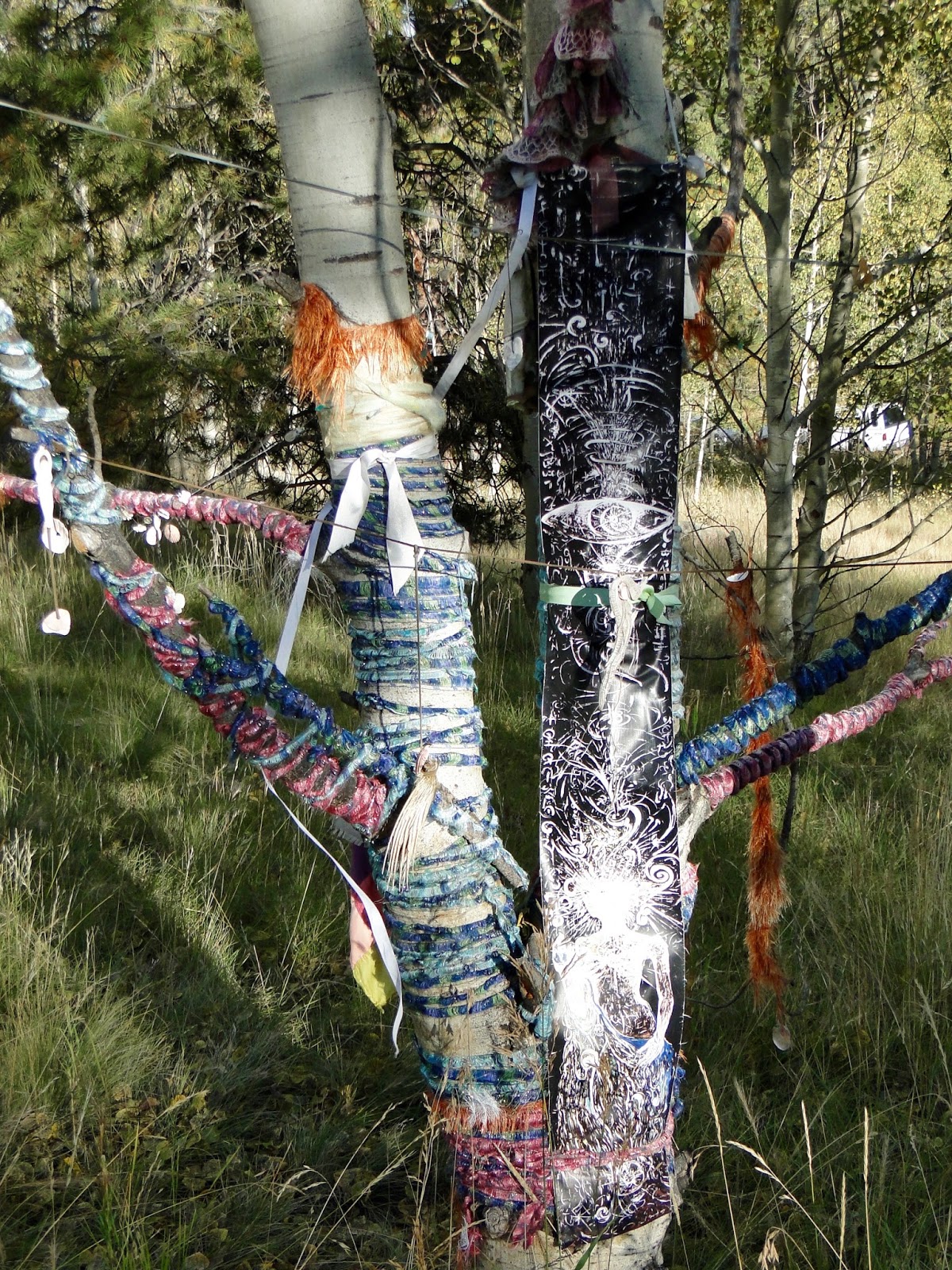
Then, last month,  came notice of Music and Magic in the Mountains festival last, and I decided to visit Tierra Sagrada and get a sense of what it's all about. The day included music of all kinds, artisan booths, a small blessing ceremony led by Pati, and various workshops, mostly related to healing or dance. Some sessions took place in Pati's house, but most things were outdoors on that beautiful autumn day. Two friends from Denver joined me, along with local friends Linda and Barbara, and the day proceeded as a festival day should: lots of time to set up lawn chairs, eat our picnic lunches, watch kids and dogs, listen to music, and chat with artisans. Wandering down to a food truck for a bowl of hemp broccoli soup, I spied a hammock from which I could gaze at the aspens, and nearby, a beautifully-decorated tree.


I think I realized then that participating in events there had nothing to do with "believing" or not believing in shamans. It had more to do with just being open: open to different forms of wisdom and beauty and healing. It's not an intellectual process, but rather one of spirit. You can see that in this photo of Pati (from her website) and feel it when you meet her.


Pati was introduced to this path she's chosen through the anthropology courses she took when she returned to college in mid-life. She became deeply interested in ancient cultures, especially the Huichol people of Mexico, with whom she spent short periods of time during her college years. She was impressed with the joy she experienced in their community--one with no running water or other Western amenities. In contrast, she says, those of us brought up in consumer culture often experience stress and disconnection rather than joy.

I'd love to visit Tierra Sagrada again soon, and events are scheduled this month and in November. But this week I'm going back to Denver, where I live most of the year. Next summer, when I hope to return to my cabin for most of the season,  I will make time for a return visit. Meanwhile, thanks to Pati, I feel more sensitized to the opportunities around me for connecting with the wisdom of indigenous cultures.

In Denver, there's a monthly indigenous film showing at the Museum of Science and Nature, and I attended several last year. The Internet has brought other opportunities. This year I've been following Honor the Earth, an organization founded by Winona LaDuke and friends/allies to unite Native communities in working for energy justice and protecting their lands from fossil fuel pipelines. There are a number of ways to contribute to their efforts, such as buying the wild rice they harvest. (I'm already preparing for Thanksgiving!) Also in Denver are the state's majority Native American population: 56,000 people if you count those who identify solely as American Indian/Alaskan Native, or nearly twice that if you consider those of mixed race heritage. I should have many opportunities to participate in the struggles, ceremonies, wisdom and art they share.

I'll close with some words from Thoreau--my favorite person to quote--in Walden.* Thoreau had a strong aversion to housework and the tendency of humans to cling to heaps of possessions. He especially admired the customs of the Mucclasse Indians, who had a yearly "custom of the busk" in which they burned all their old possessions (having previously gotten a modest number of new ones). After 3 days of fasting and abstinence, the fire was extinguished, a general amnesty was called permitting all "malefactors" to return to town. And then came the feast of new corn and fruits, which involved 3 days of feasting and dancing and singing. Mercifully, they had no plastic.

Such wisdom there is in downsizing--always an ongoing process for me, when it's a celebration rather than just a list of chores. No doubt some ideas for prison reform in there too.

*Thoreau admired Native American culture a great deal, and there are more than 50 references to it in Walden.


Sunday, September 27, 2015

Yoga and flowers at Paradise Gardens

The season turned this past week, officially shifting from summer to fall on the calendar—a process that started much earlier and still continues, as colors turn and temperatures drop. I’m enjoying both, while at the same time, taking out summer memories, like smooth stones in a pocket. Today I’m turning over one of my favorites—visits to Paradise Gardens here in Florissant. Here I love to indulge two of my passions—garden appreciation and yoga.

Paradise Gardens is the name of the home and garden of Karen Anderson and her husband, Mike McCartney. They’ve been living on this forested land for 38 years. For the first 18 years, they lived in a small house, without electricity or running water—an accomplishment that Thoreau would certainly acknowledge and applaud if he visited our consumer-driven century. Karen started small with gardening, planting in a space that is now her herb garden.

Over time, the cabin and amenities developed, and Karen brought their high altitude acres into bloom. She’s known locally as “The Plant Lady”—deservedly so, as gardening is her passion. She has shared her knowledge and plants with just about everyone who consults her about growing stuff in rocky soil at 9000 feet. Would-be gardeners can attend a class, phone for an appointment or come to one of her open houses. My first visit was a couple of years ago during the annual greenhouse tour sponsored by the The Harvest Center. I was totally charmed from the moment I stepped onto her winding paths.


There are structures too, including a small shed, where Karen displays her artwork as well as plants. 


Raised beds contain outdoor plants, and a greenhouse is essential for extending the short growing season here.


For Karen, gardening involves much practical attention to the needs of plants—location, soil, nourishment. It’s also a spiritual practice. She’s approaches her work with awareness of The Great Law—or seven-generation concept. “Plant it Forward”, in other words. Basically that means thinking about how our actions will affect others—and the planet—through the next seven generations. Accordingly, that means gardening nature’s way, without the use of chemical pesticides or fertilizers, focusing on organic ways to build the soil and conserve moisture. 

Karen’s spiritual orientation also drew her to yoga. Her long-time friend, Debbie Winking, teaches yoga classes locally. I attend them as often as I can during the summer. At least a couple of times during the season—often at the full or new moon—they have a yoga day (or eve) at the gardens. Participants come from Debbie’s classes and the number is usually small—10 or fewer. That allows us to gather around the pond (a converted satellite dish) or in open spots on the lawn, where we lay our mats. My last visit was in August, the evening full moon. In July we stretched one morning under the sun after introductions and a sharing circle.

Yoga outdoors feels special. So many things do, but a practice designed to promote relaxation and gratitude feels, well, especially special. Science backs up that common experience.  Beautiful scenery stimulates those pleasure-enhancing endorphins in our brains. Ester Sternberg, in her book Healing Spaces: The Science of Place and Well-being (Harvard University Press, 2009), asserts that touching green or a sandy beach produces even more stimulation, which in turn promotes healing.

At our yoga sessions, Debbie reminds us that standing barefoot on uneven ground helps with balance—an important component of yoga practice for so many of us. Standing in the Tree Pose, I realize that my balance is not nearly as good as I want it to be. I vow to do this more often. 

Sometimes evening yoga events are rained out, but this August we were lucky. No drops at all, as we saw the moon rise, glimpsing its travels as we continued stretching or holding poses. The evening ended with our going inside Karen and Mike’s comfortable home for tea and snacks and conversation. Then came my 40-minute ride back home through the darkness, keeping an eye on the moon and all attention on the road and deer-inhabited roadside. A yoga mind was essential for that.

This photo, taken in 2014, shows Debbie (left) and Karen holding Buttons, her canine companion. 


Writing this September day in 2015, I turn that yoga day memory stone over in my mental pocket, thinking back with gratitude and forward with hopes for another season of yoga and flowers next year.

Monday, September 7, 2015

Leaving on the hummingbird highway

There are only two hummingbirds remaining near the cabin today. They made brief visits to one of my two feeders and now-scraggly hanging basket of flowers. This scene is a far cry from a week or so ago, when resident broadtails were crowding the feeders, draining them in a day. They were getting ready to migrate, and now most of them have, flying off on their long journey to the central highlands of Mexico, where they’ll spend the winter. It seems so quiet. During the summer, when I slept with windows open, I woke up to their chirping/whistling/buzzing as they began to soak up sugar-water carbohydrates before a morning of insect-catching. Now if I want to hear their distinctive sound, I’ll have to go online for a brief recording; until, that is, they and I return next spring.

Next spring, they’ll be here first, at least the males will, searching for a territory. They arrive in Florissant in early May. Hardy little birds, as snow is not uncommon in the high country in May. I’ll probably arrive a few weeks to a month later. I too will migrate this fall—north to Denver, where I’ve had a small apartment since last fall. Though I enjoy city life very much, I truly love this country cabin nest, where I spent most of this summer. The hummers’ departure reminds me that I’ll be leaving soon too—a bit later, though, probably mid-October.

For me and the broadtails—which among all hummingbird species live at the highest elevation—summer at 8700 feet (2650 meters) provides a perfect habitat. There are nectar-filled wildflowers and a small cottonwood grove—food and proper nesting shelter for them, and lots of beauty for me. Wildflowers were plentiful this year due the above-average spring rainfall, but even in years when they aren’t, the returning hummers can count on a network of human servants who run up a shocking sugar tab at the supermarket on their behalf.

Though I’d love to have a true scientific mind, I don’t. Mornings, coffee cup in hand, I’ll watch the birds at the feeder, admiring their beautiful colors—the metallic blue-green of the females’ backs and the bright red gorget (think gorgeous) of the males, sparkling in the sun.


Here’s an illustration of a male and female by Arthur Singer from The Life of the Hummingbird (A.F. Skutch, 1973).


After watching these birds for awhile, likely as not, I’ll then cross the living room to watch the clouds through the sliding glass doors or head out to the greenhouse or go on a walk with Linda and her dogs. In the early evening, I do pretty much the same kind of viewing, as likely as not, as the broadtails arrive to fuel their metabolism for a cool night in torpor at high altitude. 

By scientific mind, I mean curiosity, passion for learning, observational skills, and patience. To the extent that I have those qualities, they show up in other areas. Fortunately, there are many bird lovers, trained scientists and citizen-scientists who have contributed knowledge I would most likely never discover on my own.

One of the first studies to support the idea that a hummer can eat twice its weight in sugar every day, was done by Althea R. Sherman. In 1907, from her doorway in Iowa, she trained free ruby throats to drink a sugar solution placed in an artificial flower. Measuring carefully, she found that a single bird drank syrup containing from 4.5 to 5.8 grams of sugar. She misjudged the average weight of a bird, however, leading to what was later shown to be an overestimate. Years later another experimenter found that a bird could drink twice its weight in syrup, but less than half its weight in pure sugar. 

During the height of my hummers’ feeding frenzy, I wondered if I were creating sugar addicts, like encouraging teenagers to gulp soda instead of water or juice. Fortunately, experts have dispelled that fear. According to the popular website, hummingbird net, a solution of 1 part sugar to 4 parts water is very similar to the sucrose content of nectar. Even more reassuring was the fact that ordinary white sugar—the bane of human health—is the best choice for hummers. Turbadino, a kind of raw sugar sold in health food stores, may contain a toxic level of iron, while honey ferments too rapidly.

Scientists have learned a lot about gender in hummingbird life also. Female broadtails spend most of their nesting time incubating and then feeding their (usually) single clutch of two eggs. Once hatched, the helpless nestlings need frequent attention before they’re able to fly away 21-26 days later. My broadtail females are definitely “sistuhs doin’ it for themselves”, as males make no pair bonds with them and play no part in chick-rearing. The males’ summer is spent in guarding their feeding territory.  They’re known for their dazzling displays during mating, when 2—3 males form a group called a lek and fly in loops through the air. Females make their choices and mating commences. As the females enter motherhood, the males continue trying to mate with other females. Who is the most successful? I wonder. Most aggressive? Prettiest gorget? Surely there’s a study somewhere that answers that question.


I should mention that I have other summer visitors in addition to the Broadtails. Rufous hummers show up at my feeders in early July. 


They’re known as an aggressive species, seeming bullies who try to dominate the feeders. I hate to speak badly of a bird, but….by July I’ve bonded with my innocent broadtails and find myself feeling quite hostile to the newcomers. I’m not sorry that they’re the first to leave as summer slips by. Scientific migration studies have given me some respect for them, however. They nest as far north as Alaska (!), migrating south, and then continuing on south after their summer stay here—adding up to the longest range of any of the more than 300 identified hummingbird species. Most of them live in the tropics and all are native only to the Western Hemisphere.

Most of the hummers spending the summer here are well on their way to Mexico now. I trust my two stragglers will feel the same hormonal/seasonal tug very soon, as signs of fall are already here—aspens turning gold and night temperatures dipping into the 40sF. According to Bill and Ella Thompson of Enjoying Hummingbirds More (1992), “At least one species of hummingbird is likely to fly over any garden in any state in the US or in southern Canada”. That comforts me as I think of “my” hummers on their aerial highway. Perhaps they have a network, a kind of overground railroad of backyard feeders, familiar to the older birds who’ve made the journey before. I hope so. Their August nectar-guzzling here won’t be enough to get them through the whole trip. Incidentally, hummers live an average of 3–4 years, although a 12-year-old banded broadtail was once observed in Colorado. That’s the current age record.

Later this month The Third Annual International Hummingbird and Birds of Guanajuato will be held in Mexico, in San Miguel de Allende in the State of Guanajuato. There will be festival events for the public in this city where I had the good fortune to sojourn for some extended time during two recent winters. I wish I could be there this year, if only to see the surprise on the tiny faces of any of “my” birds in the vicinity :). There will also be a conference of scholars and students ready to report their latest findings. That’s another comfort—that with human impacts on habitat everywhere, there are scientists and conservation activists monitoring the situation. 

Broadtail hummingbirds are not endangered at this point. With the growth in citizen science and the availability of online data bases, information is emerging that birds are adaptable, perhaps more than we thought. For example, a recent study showed that calliope hummers have been sighted 350 miles off their traditional migration routes. In The Human Age (2014), Diane Ackerman notes an Audubon Society study finding that roughly half of 305 North American birds are wintering 35 miles north of where they wintered 40 years ago.

With my own upcoming migration in mind, I’ve already started making notes for next year, when I hope to spend, once again, much of the summer here at Little Horse. More hummer-friendly flowers near the cabin, for one thing. Meanwhile, I’ll continue to read. One of the most interesting sites I’ve found is birdwatching bliss. It’s maintained by Sonia, an avian scientist who lost her full-time employment in a budget cut. (Fortunately, her husband kept his.) Working part-time as a wildlife technician now, she’s put her passion into this website, which offers concise, up-to-date information about many different birds. Perhaps by next year I’ll be a little closer to having a scientific mind after all.

Wednesday, September 2, 2015

A conversation with author Joanne Greenberg

Monday was a special day for me and other friends in the Guffey Library Book Club. We had a special guest, writer Joanne Greenberg and her husband Albert. Traveling from their home in Golden, they have been coming to Guffey every year for several years now. Last year’s plans fell through, though, so we were all anticipating this year’s visit. It was special for another reason: Joanne and Albert were celebrating their 60th wedding anniversary and we wanted to join the celebration. Here they are before we cut the cake, icing to an excellent potluck lunch and lots of talk about books and reading.

I first heard of Joanne's writing under her own name in the mid-80s when In This Sign was published in paperback. That novel explored the dynamics of a deaf couple and their hearing daughter, a story told from multiple viewpoints. Despite my having a deaf cousin, it was my first real entry into deaf culture and I learned a lot from it. A check of reviews on Goodreads shows it’s still being read and sometimes assigned in sign language classes.

Joanne, now 83, continued to write—both short stories and novels. One Publishers Weekly reviewer called her “a shrewd observer of human nature and societal differences”. That can be seen clearly in No Reck’Ning (1993), set in post-World War II Colorado. It’s the story of Clara, a young woman from an abusive home who pursued her dream to be a teacher, succeeds, and then encounters conflict with a powerful, wealthy parent. A very positive Library School Journal review, said “Young adults will be intimately involved with Clara’s struggle to succeed”.  However, Joanne told us matter-of-factly, “It sank without a trace” in sales, and “my publisher has rejected me ever since.”

Nevertheless, Joanne continues to write, and to me, her ability to be a “shrewd observer” of human behavior and cultures is still up front and center. At our gathering Monday, we talked about some unpublished works she had sent us. She read two of them aloud.  "Geography" concerns the loss experienced by a long-time rural woman who no longer knows the local geography because she no longer knows people on once-familiar roads. "Diversity" uses the loss of an expensive ring as the focus on class differences between a working class narrator and a rich neighbor.

Is she working on something now? Yes. She teaches Biblical Judaism classes and is writing an article about the dynamics of conversion. “Judaism is a strange religion,” she explained. “It makes no promises about the future. Things that Christians look for are not religious issues for us.” She’s also working on a book about “what happens when people are cut off by an avalanche.”

Joanne’s interest in what I think of as “elemental things”, as well as in psychology and cross-cultural encounters is evident in her book recommendations. One long-time favorite of hers is Devil in the White City (2003) by Erik Larson. It juxtaposes the history of the 1893 Chicago World’s Fair with an account of a serial killer. Excellent book, but one that still haunts me, as I have a low tolerance for psychological terror. Given that predisposition, I will probably not add Kitty Genovese: the Murder, the Bystanders, and the Crime that Changed America (2015). But I can trust that Joanne knows a good story when she sees it. I’ll look up the reviews for the author’s take on bystander behavior, which I’m curious about, and read about what really happened on the night of this 1964 murder that really did shock America.

Two other recommendations, both dealing with wolves in some way, interest me:

1. Wolf Totem (2008) by Jiang Rong. This bestseller in China is based on the author’s experience of going to the Mongolian Steppes as a young boy and living with the nomadic Mongols during the Cultural Revolution. As one Goodreads reviewer noted, “What matters most to (the) story are the depictions of the untamed steppe,” which “does not passively give what human life needs, but everything must be taken from it.” The story details how the Red Guards tried to “push back the last of the wolf hordes, threatening to destroy this way of life forever.”

2.  Ordinary Wolves (2005) by Seth Kantner. Again, a reviewer who gave it 5 stars puts it succinctly: “This book is a stunningly honest and unsentimental look at contemporary life in Alaska. The book touches on big issues (racism, loss of wilderness, alcoholism), but it is fundamentally a coming of age story (semi-autobiographical, I think) about a white boy whose father drops out of the mainstream to raise his three children in a sod igloo in a remote part of Alaska. It is beautifully written, and will stay with you for a long time.”

She had other recommendations too—The Jew in the Lotus and Reading Lolita in Tehran, for example. She would have had more had she not forgotten to bring her notebook of copious notes on everything she’s read this year. (She’s promised to send them to us.)

Shifting to talk about our favorite reads, Joanne was not shy about expressing her dislikes as well as likes. The author Sue Monk Kidd came up. She wrote the modern classic, Secret Life of Bees, which I loved, thinking it should be on every high school reading list. Joanne’s reaction? “I nearly died of sugar poisoning.” The discussion moved on to Jane Eyre and the 19th century. Joanne: “The gothic novels (pause). The men had the IQs of grapes.”  Wuthering Heights: “It was the best book when I read it at 15, but later… “These people needed jobs.”

The afternoon progressed. It was past 3. We cut the cake, wishing Joanne and Albert more years of happy marriage. Book club friends packed up their potluck leftovers, perhaps, like me, content--but wanting to go home and read something before dinner.

Tuesday, September 1, 2015

Summer stroll among the trees

There are few trees on Little Horse. A dozen still-small evergreens planted by Linda when she first moved here and a small grove of established cottonwood trees. I regretted that sparseness when I first started to live here, but came to appreciate it later, especially when wildfires came uncomfortably close to us one summer, not to mention realizing the preference of bears for tree cover. However, I love trees and sometimes just need to get up close and personal. An excellent place to do that is the forested property across the road.

Sunday was a cool, sunny day, ideal for a stroll there. It’s one of the most beautiful properties on the road, full of Ponderosas, my favorite pine tree. From the road, you can walk up an incline with a perfectly framed view of the south end of 11-Mile Reservoir, which functions as a kind of “borrowed scenery”. This photo shows the view from the top of the incline.


There’s a cabin on the land too, built by Leonard, who has passed away. His grown children own it now. They come for getaways from the city as often as they can, and in the interim, Linda and I try to keep an eye on it for them. We usually do that by walking the dogs there some mornings.

On Sunday I went on my own, to stretch my legs and enjoy the scent of the Ponderosas. Summer sun on pine needles produces an aroma that brings me back to my first days in Colorado in the late 70s. I think I fell in love with the mountains of Colorado at least partly through that aroma.


On this visit I left the path to the cabin and headed to a small grove, where I simply listened to the wind blow through the trees—a blissful sound—and watched a mountain bluebird flit from branch to ground to branch. I channeled Thoreau for awhile, especially the sentiment behind this quote describing some of his summer mornings: “I sat in my sunny doorway from sunrise 'til noon, rapt in a revery…in undisturbed solitude and stillness, while the birds sang around…(until) I was reminded of the lapse of time.”

I didn’t stay all morning; can't remember the last time I let myself lose track of time, actually.  But I wondered why I hadn’t done this more often. I vowed to return as much as possible, without the dogs as well as with them. I came on my own today—this quiet Tuesday before Labor Day, when the reservoir, a state park popular with campers and fishing boats, will draw a lot of visitors. Once again without dog company, I returned to my favorite sitting spot. Again, the weather was sunny and perfectly cool. Taking deep breaths, I felt my limited scent-sniffing human nose was quite adequate for pine aromatherapy. I sat down on the same lichen-covered stone to see, hear and inhale. A few buzzing dragonflies, a noisy raven, distant sound of the road grader, sun through branches, the familiar scent of the Ponderosas. Those moments were so calming—a feeling Thoreau well understood: “Every morning was a cheerful invitation to make my life of equal simplicity, and I may say innocence, with Nature herself.”

Here’s a photo of my spot. Wish it were a video to show the interplay of light and breeze.


Moving away, I walked through the trees and noticed a Native American medicine tree. There's at least one other near the path, and they’re not uncommon in this area, once home to four different Native American tribes. They’re plentiful because Ponderosas were one of the most useful trees around for indigenous people. The inner bark was a highly nutritious food, which could be eaten raw, baked, dropped into stews or peeled and dried. The bark and sap were also used as a medicine and waterproofing material.

This photo shows the scar on this CMT (“culturally-modified tree” in the language of archeologists.) I prefer medicine tree, reminding me how previous inhabitants were nourished by this land.


Aspen trees haven’t started to turn colors yet, but the first signs of fall are already here. Glancing down, I found this a pleasing arrangement.


Finally I reached a sunny clearing where the pine aroma was even stronger, and I could hear more bird song in the trees on the other side. On my “must do” list for next summer is to spend more time observing and listening to birds. My bird ID skills are embarrassingly low—perhaps a reflection of some general disinterest in the task of naming or plain old laziness. Some, though, are just so obvious, like mountain bluebirds and ravens. And hawks. Looking up, I saw this one flying overhead.


One of the great advantages of coming to the high Colorado country in the summer is the relative lack of mosquitoes, especially after the summer monsoons are gone and there are fewer standing puddles of water. Not a single buzzing insect found me today, and I regretted I hadn’t brought a book and a blanket.

Not able to lose track of time, I got up after a short while and wandered back home across the road, feeling refreshed, slightly hungry, and inspired to write this. I thought of Thoreau, who had these experiences too, and who left his viewing spot, at some point, to make lunch.


Sunday, August 30, 2015

Dogs of Little Horse: Hop and Belle

“Because of the dog's joyfulness, our own is increased. It is no small gift. It is not the least reason why we should honor as well as love the dog of our own life, and the dog down the street, and all the dogs not yet born. What would the world be like without music or rivers or the green and tender grass? What would this world be like without dogs?”
― Mary Oliver, Dog Songs

One of best parts of living most of the summer here on the land is the chance to take walks with my “canine nieces”, Hop and Belle. I love being an auntie, as it’s been more than 25 years since I’ve had a dog of my own. I’d like that to change someday, but it’s not likely to anytime soon, given my still-nomadic ways.

Hop, a 10 (or so)-year-old Pembroke Corgi, and Belle, a 3-year-old Border Collie mix are Linda’s dogs. Both are rescues who have found in Linda one of the best human companions on the planet. During summer months, they also have me, a sure provider of treats and mini massages on request. These two photos are their formal portraits, taken last summer by Georgianne Nienaber during her visit to Little Horse. They show something of each dog’s character: Belle, the focused hunter, and Hop, whose charming expression suggests she knows her breed is the favorite of the Queen of England.


Both dogs had difficult beginnings. Newborn Hop was reportedly payment in a Commerce City drug deal. The parents of the woman involved visited the Cripple Creek casino where Linda was working at the time and asked her to take the purebred pup. Linda was reluctant at first, as she already had two dogs then.  But she agreed after she was told, “Well, we can’t do much for our daughter now, but we can do something for this dog.” Years later, Belle arrived through the auspices of a local vet, Dr. Shannon, shortly after Linda’s elderly lab had died. A pregnant Belle had been found wandering in rural New Mexico and brought to Colorado through ARF, a local rescue group. Homes had been found for her puppies and now it was Belle’s turn for a new life. I believe it was something like love at first sight for Linda and this very sweet dog.

“A dog can never tell you what she knows from the smells of the world, but you know, watching her, that you know almost nothing.” --Mary Oliver

Belle is what one vet’s assistant called “a soft dog”. She’s so gentle, leaning against my leg or taking a treat between her teeth. When she jumps up on me (a practice I discourage with all other dogs), she’s light as a feather, and looking into those soft eyes, what can I do but scratch behind her ears? When her hunter’s instinct kicks in, however, she’s off and running, quickly out of sight or just a blur on the horizon. Then she's impervious to human commands or bribes--or, okay, entreaties. She’s a champion digger. Linda and I joke that she gives the yoga pose “the downward dog” a whole new meaning. Every muscle group is engaged. In this photo she’s exploring a hole she had dug in Linda’s rock garden during an unsupervised moment earlier in the day. (Hop, meanwhile, keeps her eyes on the prize—the treats in Linda’s pocket.)


Despite the frustrations, Linda’s feelings about her youngest dog are very clear in this photo. A soft dog and soft-hearted human companion.


Belle leaves no ground squirrel or rabbit un-chased. She can tree a squirrel, staring motionless, in a manner worthy of a bodhisattva. Surprisingly, I’ve never seen her actually catch anything. Rather, Hop, usually focused on cadging pocket treats rather than chasing small animals, is actually the more skilled hunter. For example, last year it was she who dispatched the pack rat that had gotten into the greenhouse, decimating many plants. Recently, she caught a fluttering bird in the grass during a walk—one of those moments you fervently wish you could have prevented. Like others of her breed, she likes to work, always grabbing the leash in her mouth as a walk begins, ready to herd all in her field of vision. The only exception came three years ago, when Linda and I tried to get her to encourage of herd of 30+ wandering burros to leave the land. They had been around a week, and well, the piles of “burro gold” were mounting. Hop joined us in the field, but then just stood still, turning her head as if something utterly fascinating had appeared in the other direction. (The burros, as is typical of their breed, were the ones who decided when to leave.)

"They are a kind of poetry themselves when they are devoted not only to us but to the wet night, to the moon and the rabbit-smell in the grass and their own bodies leaping forward.” ― Mary Oliver

Though both Belle and Hop are leash-trained, they can run unleashed in many places in this rural area. They are most completely themselves when free to run and splash in any available pond.


In writing about her dog Percy, Mary Oliver offers still another on-the-mark insight. It’s one that reveals my own heart when I’m on a walk with Hop and Belle, watching them race ahead, alert to every scent and sound.

“Emerson, I am trying to live,
as you said we must, the examined life.
But there are days I wish
there was less in my head to examine,
not to speak of the busy heart. How
would it be to be Percy, I wonder, not
thinking, not weighing anything, just running forward.”