Showing posts with label Pikes Peak Region. Show all posts

Sunday, July 2, 2017

A patriotic week

This holiday weekend I’m at Mudbiscuit, my cabin in the hills, and I’m finding contentment in the quiet, the cooler temperatures, and the lack of distractions, enticing or otherwise.  By that, I mean no disrespect to enticing distractions. Last year I was in the city, spending the evening of July 4 on a friend’s high balcony, chatting and enjoying firework displays over Denver. This year I had the possibility of choosing any of numerous rural and small-town events: an arts festival in Green Mountain Falls, an “old-fashioned celebration” in Woodland Park, complete with flag-raising, art, fun for kids, and a symphony performance. In Florissant, I could shop for antiques or try my skill at the “new ol’ time shooting gallery”; Buena Vista promises a “patriotic parade”, kids’ games and “awe-inspiring fireworks”. I decided to pass them all by in favor of unstructured time here on the land. Most days that means time to take morning walks with Linda and her dogs, do a few small chores, check email, read, or collect greens and herb clippings from the small greenhouse Linda and I tend. Evenings, however, bring a structured event—watching The Rachel Maddow Show at Linda’s cabin and talking about the continual stream of breaking news and scandal out of Washington.

Last year I wrote another blog about my conflicted feelings about this holiday—all of the patriotic associations and some difficult personal memories around July 4 This year, this year of Resistance to the party in power, the patriotism issue is even more conflicted. Despite a sporadic effort to reclaim the US flag as a symbol of progressivism, it still carries too many negative associations for me—memories of misguided wars and right-wing rallies. Perhaps that will change in coming years. I hope so.

Instead of the flag, several news photos on Facebook and reports on Rachel Maddow sent a burst of patriotic feeling through me last week. The photos were of the group ADAPT, a disability rights group. Members occupied the Denver office of Sen. Cory Gardner for 2 nights, demanding that any health legislation passed by Congress protect Medicaid and the health care that millions stand to lose of the Republican bill passes. Photos showed their peaceful protest and then later their arrest as they were forcibly removed from Gardner’s office. Their courage and resilience touched me deeply, part of widespread resistance to this disastrous so-called alternative to the Affordable Care Act negotiated by former Pres. Obama. I’ve always thought that this is the true meaning of patriotism: fighting for your country to be a true land of liberty and equality and justice.

A photo taken after the last members of The Denver Ten were released from the detention center*"


The news stories reminded me of some Denver history that I had forgotten—another protest by ADAPT in July of 1978. Rachel reported that ADAPT members forced a halt to bus transportation after the long holiday weekend ended that year. Their demand? The simple right to ride buses that were accessible to them. Today all city buses have lifts and wheelchair space, thanks to their courage and savvy strategy. Today, nearly 40 years later, ADAPT members again took risks to remind us that health care is a matter of life and death for all of us, some more than others, and that their—and our—patriotic fight for equality must continue. Unfortunately, I could not show support for ADAPT in person last week, but I hope to do so as this health care fight continues to unfold. 

Instead, I showed some small patriotic spirit yesterday when I visited nearby Guffey. It was Heritage Day for this small town, and if anything was an old-fashioned celebration, it was this event. Linda joined me and we decided to make the library book and bake sale our first stop. I know some of the bakers personally, so I jumped at the chance to stock up on Peg’s delicious chocolate chip banana bread, Rita’s baklava, and Lani’s healthy oat cookies. Next stop was a lemonade stand, staffed by students and parents from the Guffey Community School.  Excellent quality with real lemons, so I turned down the free refill offer and tossed another dollar into the coffers. What could be more patriotic than supporting two major cornerstones of democracy—libraries and schools. Later, I contributed to another worthy institution—the fire department—which was serving ice cream and brownies in the firehouse.

Although there were a number of artisans selling handmade and recycled items, I chose to hang out with Pier and Steve, the couple staffing the Park County Democrats booth. Park County, which includes Guffey, is considered a Republican stronghold despite this town’s former counterculture reputation, so I thought Pier and Steve were doing an important and rather brave thing by putting up the booth. Most festival-goers passed them by without comment while I was there—except one dude, decked out in fancy Western gear a la Wyatt Earp, muttered something about Obama and Kenya. That was truly surprising considering how soundly the old “birther” accusations were discredited and the fact that Obama is no longer president (alas!). A few stopped to chat. One was a man who said he’s from a long line of Republicans and is married to a Muslim immigrant. When I expressed sympathy for what has become of his party, he declared, “It’s not my party anymore!” As I wondered how many other Republicans feel as he does, I felt suddenly cheered. Another couple stopped by and rummaged through bumper sticker choices. I finally made a donation and chose one as well, expressing my hopes that we will all survive today’s epidemic of fake news and tweets: “Three things cannot be long hidden: the sun, the moon, and the truth.”

By mid-afternoon I was home,  back to my unstructured weekend, sans fireworks and hoopla, but with time to read, reflect, and feed the hummingbirds. Rachel is taking a break this weekend too, but she and I and all of her other viewers will be back tomorrow. The patriotic struggle continues.

*Comment from Front Range Resistance: "By approximately 2:30 AM on Saturday, July 1, all nine of the remaining ADAPTers had been released from the Denver Detention Center. Sisters Dawn and Hope Russell and live-blogger Carrie Ann Lucas had already headed home for the night, but the remaining seven disability activists took a moment to celebrate the achievement of the entire Denver Ten. These brave advocates represent all of us: our diversity, our similarities, and our interdependence."

Sunday, July 24, 2016

Western Wildfires: Smoke gets in your eyes

It was a wet spring when I opened the cabin in early June this year. I didn't think about wildfires very much until after a week-long stay in Denver the following month. Returning to the cabin in mid-July, I discovered that seven fires were burning in Colorado, bringing a smoky haze to the horizon some days and worry that this summer would bring more fires, more smoke, and possible evacuation. So far we've been spared, but the summer is just at the midway point. The environment continues to dry as we move farther away from spring snowmelt and the July monsoons, which were very sparse this year. The causes of fires are diverse and unpredictable: lightening strikes and careless campers being at the top of the list.

When I moved to this rural area 6 years ago, I had to readjust my concept of fire. To a person like me who has lived most of her life in cities, a fire means a kitchen accident, a forgotten cigarette, or a burst pipeline--occasionally arson. Usually the fire department arrives promptly and puts it out. Larger fires, part of riots ensuing from injustice, euphemistically called "civil unrest", happen too sometimes, and they also are contained, usually within a day or two. The massive fires of yesteryear--the Great Chicago Fire of the 19th century and the ones that nearly destroyed Tokyo after the 1923 earthquake--seem consigned to history, unlikely to repeat with modern building codes, alarms and well-equipped fire departments.

I've been fortunate in that I've never suffered a home fire; nor have I been evacuated because of one nearby. When I was a child I remember seeing the burned shell of a house a few blocks from us in Hammond, Indiana, and shuddering with a kind of dread--that something so big and solid as a house could be vulnerable, could be destroyed.

My next experience with fire close-up was in 2012. My Japanese sister, Junko, was visiting that June, and I wanted to show her nearby Manitou Springs. We stayed at a motel there, and as we were leaving the following morning, we saw the plume from what became the Waldo Canyon Fire. Manitou Springs was evacuated later that night as the fire spread. By then we were west of the area and were never in any danger, though the air was heavy with smoke when I drove Junko to the Colorado Springs airport several days later. Others were not so fortunate. The fire, which spread over 18,000 acres west of the city, was not contained until 17 days after it began. Nearly 350 homes were destroyed and 32,000 people evacuated. Six were injured and two died. Wildlife suffered. This photo shows one view of that fire.


The cause of the Waldo fire was arson, and the arsonist was never found. I wonder if s/he or they ever repented or even knew of the harm that ensued. Hazards from the resulting burn scar remained for the next few years, causing road closures, flooding, and the deaths of two people--one of whom I knew: John Collins, a much-loved and respected local man. Meanwhile, so many had to start over and live with the feeling I had as a child, that something as sturdy as a home could be gone within hours. You can still see the burn scar as you drive along US 24 west of Colorado Springs, but fortunately, much mitigation has been done since the fire.

The largest fire burning near me now is the Hayden Pass fire, about an hour and a half away, southeast of the town of Salida. Started by lightning on July 8, it's now 50 percent contained, expected to burn until October. October! More than 16,000 acres are involved. Will there be other fires in Colorado? Very likely.

The West has always been prone to summer wildfires, but the problem has gotten worse during the past decade and more. More people, more carelessness, more buildings are here. Climate change has brought damage from insects such as the pine beetle, previously killed off during colder winters, resulting in more dead timber. Underlying it all has been a century or more of misguided land management policy. Unlike Native American stewards who did periodic burns to remove ground-level brush, modern land managers have suppressed fires, resulting in more fuel ready to ignite. Climate change predictions are for a steadily drier Western US.

And so, as I spend another summer here on Linda's land in Florissant, I stay tuned to fire-monitoring sites. One of the best is the Incident Information System. It includes progress reports on wildfires in other states as well as Colorado. Today there are 16 burning in California, one of the most vulnerable states this season. I'm holding all of those affected in my heart.


Sunday, July 10, 2016

Lives in Ruins: my introduction to archaeology

Archaeology is a science that never really appealed to me that much. Every time I saw pictures of toiling students sifting through rubble under a hot sun for bits of bone or pottery, I turned the page. So much toil for such scant reward. This is a review of a book that changed my thinking. It has a title that should belong to the genre of romance novel: Lives in Ruins. Instead it's a wonderful piece of participatory journalism by an author who is responsible for my digging one dusty toe into the field of archaeology this year. Lives in Ruins, by Marilyn Johnson, has a subtitle: Archaeologists and the Seductive Lure of Human Rubble (Harper, 2014). Johnson's repeated forays into this diverse intrigued me even though I never had much interest in it before.


It's a tribute to Johnson's writing that she made me take more than a second look. And probably it's her book that encouraged me to say yes to an invitation to become a site steward in Park County, Colorado. Working with a partner, site stewards volunteer to visit places in the county where remains of early human habitation or migration have been found. The idea is to document any change or damage--human or natural--to that site. Volunteers agree to visit 2--4 times a year, carefully looking at the land and taking photos. I'll have more to write after I get started this summer. So far I have a modest weekend of training behind me and a practice visit coming up next week when I return to Florissant for awhile.

This photo was taken during our training session last month. Diane Parisi (second from left), a field coordinator with the site steward program in New Mexico, explains an aspect of a stone fragment.


Will I find a "seductive lure" in the whole thing, as Johnson did during her years of research and participation in this field? That remains to be seen, but after reading her book, I could see how others have found a kind of seduction in the dust or watery depths of the past.

Johnson takes us around the world with her as she joins digs or visits projects in the Caribbean, the Mediterranean, South America and the US East Coast. She interviews archaeologists, attends conferences and reflects on what she is experiencing. She has that rare gift of enjoying her subjects’ eccentricities while never mocking them, as well as giving the reader an understanding of issues in the field of archaeology today.

Some key insights: Archeology is a field where jobs are scarce, deadlines often dictated by developers ready to excavate, and devoted practitioners face less financial security than fledgling artists. Much work depends on volunteers. Many sites are not protected, and as Johnson writes, “The tension between keeping a site secret so it won’t get looted and publicizing it so it can be preserved and appreciated is a constant in archaeology.” Furthermore, archaeology is much more than a retrieval process. Even when a team is ready to dig or resurrect (as in the case of Revolutionary War ships still sunk in the harbor of Newport, Rhode Island), other essentials may not have been funded, such as a place to store and preserve artifacts and a team to do the work. Twenty-plus years after sensors first located the fleet in Newport harbor, those essentials were still not available.

Although archaeologists may be hired by owners or developers, their first responsibility is to the site and its resources. If a proposed project may cause harm, they have to “mitigate”—record and rescue what they can. For example, when surprised archaeologists discovered an 18th century wooden ship in a Manhattan landfill in 2010, they had to scramble to protect the giant timbers, which began to disintegrate the moment they were exposed to oxygen.

Two of the most fascinating chapters deal with forensic archeology and the protection of humankind’s cultural heritage during war. Forensics deals with buried bodies, and Johnson takes us through efforts in Fishkill, New York, to protect the Fishkill Depot, the graveyard of America’s first veterans—soldiers who died during The Revolutionary War.  Protection and development of the site is still not assured.  My favorite interview in the book is with Laurie Rush, an archaeologist with the U.S. Department of Defense. (That was news to me--that the D.O.D hires archaeologists.) Rush’s job is to make sure that past military mistakes are not repeated. A prime example: in 2003 US troops, assigned to protect Babylon, put their base on top of the ruins and bulldozed ancient temples into helicopter pads. Rush, the cultural resources manager at Fort Drum, has supervised much and built excellent relationships with Native American tribes, Johnson reports. She has also designed one of more creative teaching projects I’ve encountered: a deck of Iraqi and Afghan Heritage playing cards, teaching soldiers what they need to know as they play poker or solitaire.

Marilyn Johnson wrote two other fascinating books, both about people documenting the past in one way or another. One is about librarians and the other about obituary writers: This Book Is Overdue! How Librarians and Cybrarians Can Save Us All (Harper Perennial, 2011); and The Dead Beat: Lost Souls, Lucky Stiffs, and the Perverse Pleasures of Obituaries (Harper Perennial, 2007) You can find out more about her and her work at on her website.

While I enjoyed Johnson's stories immensely, I also need to keep in mind this quote from her in a Daily Beast interview. "We’re conditioned by narrative to expect some resolution, whether it’s answers to our questions or solutions to a mystery. We expect a neat wrap-up to the story, but in fact there are many things we don’t understand and might never understand."

At our site steward training, we got a list of the top ten things archaeologists never find. Tops on that list were buried treasure, mummies, and secret tunnels. We all laughed. No expectations there! For those things, rent an Indiana Jones movie.

Still, we hope to find something. Yet, prehistoric people have been gone so long and so much of what they used has been lost. Will I find any identifiable rubble at all as a site steward? Perhaps not, but at the very least, I hope to learn to see and recognize more than I can today.


Tuesday, October 13, 2015

Healing connections at Tierra Sagrada

Yesterday the City of Denver joined a growing number of cities that have declared October 12 Indigenous Peoples' Day. In a year that saw the removal of the Confederate flag from many public places, the celebration of Columbus Day is being deconstructed as well. A long overdue event! The anniversary of the so-called "discovery" of America by Christopher Columbus has now been reframed as a day to acknowledge the tragedy that ensued for Native Americans after the European conquest and a day to celebrate their cultures. Therefore, it seems like a good time to write about a neighbor, who lives five miles down the road from me. She honors indigenous cultures just about every day of the year. Her name is Patricia J. (Pati) Turner and she is the founder of the Tierra Sagrada Foundation.

I met Pati several years ago after I retired from teaching and returned to Colorado. I learned then that she's a retired marine scientist from California and that she was looking for land in this area to follow what has become her new life's calling--honoring the wisdom of indigenous cultures. Eventually, she bought an 8-acre forested parcel in the Echo Valley Subdivision of Florissant and began making that place a center for healers and artists from different indigenous traditions. She called her place and foundation Tierra Sagrada, which means sacred earth. The foundation is a non-profit "dedicated to the conservation of indigenous cultures, protection of their territories, and preservation of their wisdom". In an article she wrote for the September issue of The Ute Country News, she quotes a Kallallit Eskimo Shaman from Greenland, who believes the greatest goal in the world "is to melt the ice in the heart of man". The greatest distance in the existence of humankind is not a matter of land geography, he says. Rather, it's the distance "from his head to his heart." Our task is to bridge that gap if we wish to know "our own immensity within". This way of thinking resonates with me.

Pati has sponsored guests from various countries over the years, offering workshops, sweat lodges,  initiations, or festivals. Although I joined her mailing list and read about her programs, I never attended one apart from an evening fire circle in 2010. Sometimes the dates didn't work for me, but even when they did, I felt that working with shamans wasn't, well,  quite my thing. I'm more of a politico in my approach to ideas and social change.

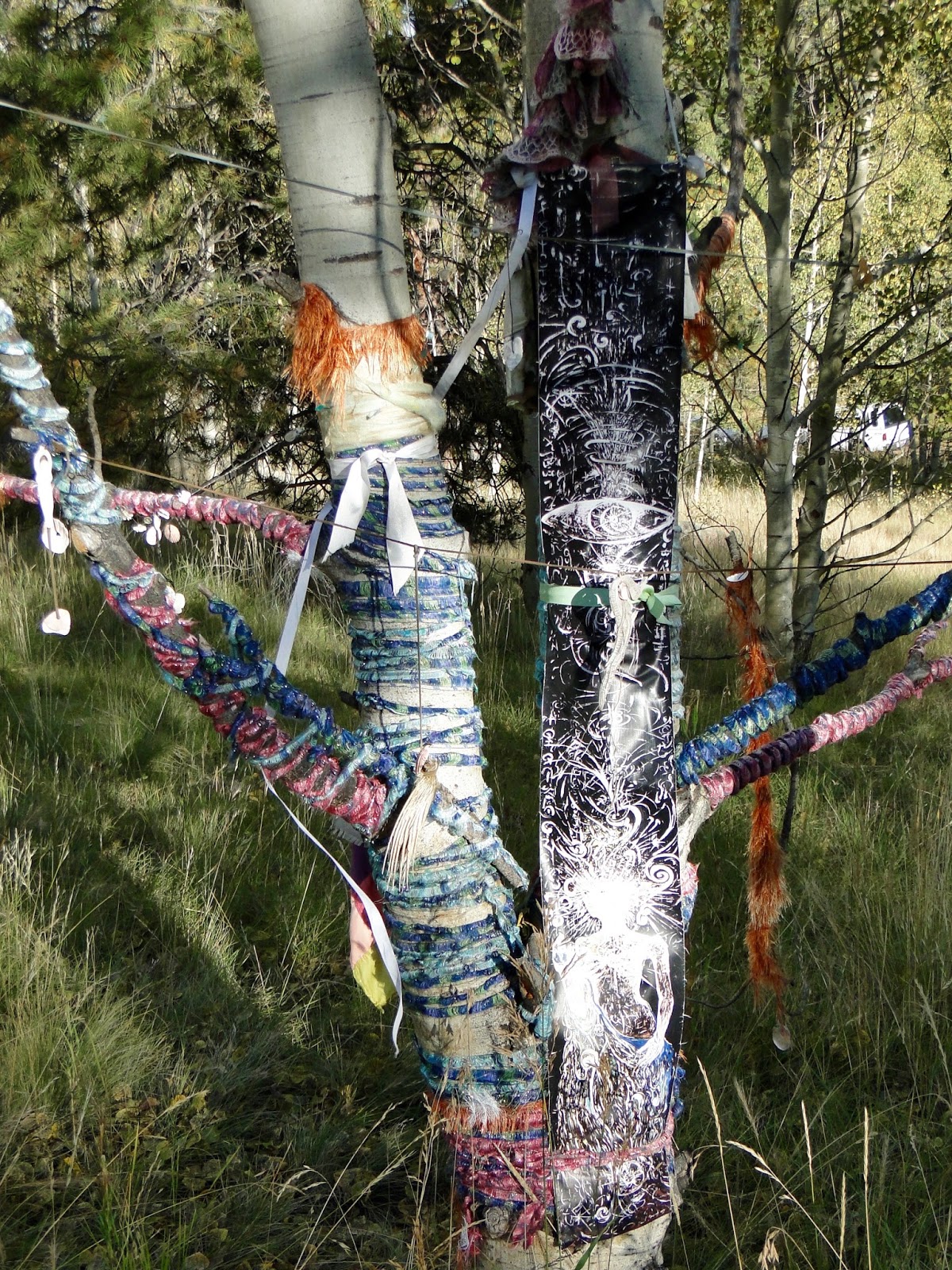
Then, last month,  came notice of Music and Magic in the Mountains festival last, and I decided to visit Tierra Sagrada and get a sense of what it's all about. The day included music of all kinds, artisan booths, a small blessing ceremony led by Pati, and various workshops, mostly related to healing or dance. Some sessions took place in Pati's house, but most things were outdoors on that beautiful autumn day. Two friends from Denver joined me, along with local friends Linda and Barbara, and the day proceeded as a festival day should: lots of time to set up lawn chairs, eat our picnic lunches, watch kids and dogs, listen to music, and chat with artisans. Wandering down to a food truck for a bowl of hemp broccoli soup, I spied a hammock from which I could gaze at the aspens, and nearby, a beautifully-decorated tree.


I think I realized then that participating in events there had nothing to do with "believing" or not believing in shamans. It had more to do with just being open: open to different forms of wisdom and beauty and healing. It's not an intellectual process, but rather one of spirit. You can see that in this photo of Pati (from her website) and feel it when you meet her.


Pati was introduced to this path she's chosen through the anthropology courses she took when she returned to college in mid-life. She became deeply interested in ancient cultures, especially the Huichol people of Mexico, with whom she spent short periods of time during her college years. She was impressed with the joy she experienced in their community--one with no running water or other Western amenities. In contrast, she says, those of us brought up in consumer culture often experience stress and disconnection rather than joy.

I'd love to visit Tierra Sagrada again soon, and events are scheduled this month and in November. But this week I'm going back to Denver, where I live most of the year. Next summer, when I hope to return to my cabin for most of the season,  I will make time for a return visit. Meanwhile, thanks to Pati, I feel more sensitized to the opportunities around me for connecting with the wisdom of indigenous cultures.

In Denver, there's a monthly indigenous film showing at the Museum of Science and Nature, and I attended several last year. The Internet has brought other opportunities. This year I've been following Honor the Earth, an organization founded by Winona LaDuke and friends/allies to unite Native communities in working for energy justice and protecting their lands from fossil fuel pipelines. There are a number of ways to contribute to their efforts, such as buying the wild rice they harvest. (I'm already preparing for Thanksgiving!) Also in Denver are the state's majority Native American population: 56,000 people if you count those who identify solely as American Indian/Alaskan Native, or nearly twice that if you consider those of mixed race heritage. I should have many opportunities to participate in the struggles, ceremonies, wisdom and art they share.

I'll close with some words from Thoreau--my favorite person to quote--in Walden.* Thoreau had a strong aversion to housework and the tendency of humans to cling to heaps of possessions. He especially admired the customs of the Mucclasse Indians, who had a yearly "custom of the busk" in which they burned all their old possessions (having previously gotten a modest number of new ones). After 3 days of fasting and abstinence, the fire was extinguished, a general amnesty was called permitting all "malefactors" to return to town. And then came the feast of new corn and fruits, which involved 3 days of feasting and dancing and singing. Mercifully, they had no plastic.

Such wisdom there is in downsizing--always an ongoing process for me, when it's a celebration rather than just a list of chores. No doubt some ideas for prison reform in there too.

*Thoreau admired Native American culture a great deal, and there are more than 50 references to it in Walden.


Sunday, August 16, 2015

To the top of Pikes Peak via the coolest train ride ever

Although I’ve visited or lived in the Pikes Peak region for about two decades now, I had never been to the top of Pikes Peak. For most of that time I lived at sea level in Japan, and when I could have gone up during summer vacation, I figured it would give me a huge headache—if not worse. Pikes Peak, reaching 14,115 feet (4,302 meters), can easily induce altitude sickness in the unacclimated. Now that I’ve been back in Colorado for a few years—much of that time at my cabin (altitude 8,800’)—I knew I was ready to take the trip. The perfect opportunity arrived August 3, when I joined the Cosmic Cacao Cog. What, pray tell? It turned out to be not only a beautiful journey to the top of this National Historic Landmark, but just about the coolest train ride ever.

Our 3-hour trip on the Cog Railway, which departs several times a day from Manitou Springs, was organized by Kat Tudor, yoga director at the new SunWater Spa in Manitou. Participants, many of whom were her yoga students and their friends or families, piled into our reserved car, along with holistic healer/artist Juan Pablo, sound healer and singer Shivani, and a small ensemble of musicians. I was delighted to be with these cheerful gentle lunatics and got into the spirit of it all as easily as they did. As the 90-minute ride to the top got underway, Kat invited us to set an intention—common practice in yoga classes. “Joy” was the word that first came to mind, so I went with that. Hopefully this photo communicates the joyful mood I enjoyed at the top, as clouds gathered and parted, revealing patches of sky and terrain.


As with all journeys, it was the process that counted. During the ride, we gazed at the valleys, patches of snow, tiny alpine flowers, and huge numbers of rocks made of the special pink granite characteristic of the mountain. As altitude increased, forests gave way to treeless slopes. The last 3 miles of the ride was above timberline--the point at which trees can't grow due to environmental conditions. I hiked above timberline once during my younger years and still remember the feeling of excitement and a sort of vague anxiety. This time I was glad I wasn’t hiking, biking or running to the top, as some do. The altitude gain on 13-mile Barr Trail, which leads to the summit from the east side, is about 8,000 feet.

Shortly after we left the station, Kat handed out small seed-filled balls, which made soft rattling sounds as we chanted Tava which was the name of the peak among the Ute tribes who once lived here. Tava means Sun, and Ute legends says their first ancestors were created here by all of the animals and living spirits. An alternate name used by the Arapaho was Heey-otooyo, which means Long Mountain. We chanted that too. We did not chant Pike—the name of a man who never made it to the peak’s summit.

Juan Pablo and Shavani are pictured here with participants and the official tour guide (center), who happily turned the program entirely over to us.


Later Kat passed out colorful scarves, and we waved them out the windows as musicians continued their magic and returning trains passed us by. Regretfully, I have no photo of the expressions on the faces of the returning tourists, expressions ranging from surprise to delight, to puzzlement, and sometimes stoic indifference. It’s the closest experience I’ve had to being in a flash mob, something that remains on my bucket list. Still, audience or not, we waved our scarves, shook our seed balls, danced in the aisles, or just sat back and enjoyed the changing views on the slopes of Tava.


It got steadily cooler. A warm summer afternoon in Manitou (low 80s) became a chilly one at the top (upper 40s/low 50s).* Jackets covered cotton tops and hats appeared on many heads. We were prepared for the weather as we piled out of the car at the terminal and decided how to spend our allotted 20 minutes.

The US soldiers who climbed Tava in 1806 under the command of Capt. Zebulon Pike would have envied us. On an exploratory mission, Pike and his party never made it to the top, wisely turning back 15 or so miles away. Unwisely, they chose to make the climb in November, in sub-zero temperatures, with the recruits clad in light overalls and wearing no socks. One wonders what they were thinking—whether they cursed their leader’s folly or the stinginess of the Army. They should have taken counsel from the Native Americans who spent winters at lower elevations, in what is now Manitou Springs and Garden of the Gods.

In 1820, fourteen years later, the first European-Americans reached the top when Edwin James, a young botanist, and two friends made the climb. In 1858 Julia Archibald Holmes, who climbed with her husband James,  became the first woman to reach the summit. Julia, wrote later that nearly everyone had tried to discourage her, “but I believed I could succeed….I would not have missed this glorious sight for anything at all.”

Forty years later another woman immortalized the beauty of the experience. Katharine Lee Bates, a visiting English professor at Colorado College, made the climb with other teachers in 1893. She wrote a poem about it, America the Beautiful, later set to music. She reported feeling “great joy” as “all the wonder of America seemed displayed there.” Would Katharine have envied our smooth sheltered ride on the cog railway? Her trip involved a wagon and pack mules—exhausting, she admitted—but perhaps all the more satisfying for the struggle. Reading her story, I thought what a thrill it must have been to have this experience before the era of air travel. Perhaps she would pity us in the 21st century, baffled at how we often turn away from the wonders outside the windows of our airplanes, in favor of napping or watching in-flight movies.

Another view from the cog railway window:


With limited time at the top, we dispersed to walk around and take photos and/or line up for the restroom inside the gift shop. Then came an all-too-brief “cacao ceremony”—perhaps 5 minutes before the train warning whistle blew. Juan Pablo laughed, saying he usually takes 2 hours for this ceremony, which is designed to help us “find connection to your inner self”. Gathering off to the side of the parking lot,** we formed a circle, made sounds and sipped a delicious small cup of intense cacao, flavored with herbs and spices. Though there was hardly time for any journey to our inner selves,  I thought the cacao cleared the slight light-headedness I felt and left me feeling if not exactly joyful, very relaxed and content.

Cacao ceremonies, with deep roots in indigenous communities in the americas, are happening today in New Age circles. Guinevere Short founded Heart Beats Raw Cacao and Dance Ceremonies in 2013. Reading about it on her website, I learned that today’s ceremonies often include forming sharing circles, invoking the cacao spirit with shamanic prayer and asking for our intentions to be heard. Cacao is usually served in liquid form with spices, as was ours. Ms. Short writes that the cacao helps flood our bodies with the many emotions stored in the heart, some of which may be painful, but the cacao “facilitates a deep sense of self-love.”

I’m not sure what the cacao might have unleashed in the hearts of my fellow yogis and yoginis, but our energy seemed undiminished on the 90-minute return trip. Jackets came off as we descended; chanting and music continued, as did our scarf-waving and appreciation of the changing beauty outside the windows. It seemed that for many of us, there was joy--and perhaps other realized intentions as well. I plan to go again next year. How could I not?

*The average daily temperature at the summit in July is 47F (8C)
**Driving to the top is another option on the Pikes Peak Highway, a paved 19-mile (31 km) ride.