Showing posts with label Justice. Show all posts

Thursday, December 23, 2021

Thoughts on a walk through downtown Denver

Taking a walk in a once-familiar place is like reading one of those layered books showing changes over time. That’s what I felt yesterday morning when I made a rare visit to what was once the center of Denver, the “overgrown cow-town”, as some called it when I arrived here in 1976. There was no 16th Street Mall then, just a busy downtown street with department stores, restaurants and offices, and sidewalks filled with people. The long-gone May D&F department store created a large ice rink in the winter, and the street looked like an auto parade route on Saturday nights.I worked for a time in the Petroleum Club Building near Broadway and Colfax, a short walk from the small central library and an art museum that looked like a castle. I stayed for a decade and more as changes came and visited during my Japan years. Following the construction of the mall, skyscrapers came to dot the town, and the library and museum grew new additions. 

And so I remembered these things when I went downtown yesterday, a warm December morning—three tasks in mind. I walked  from the Cultural Center parking garage adjoining the library down to a pharmacy on the 16th Street mall, blocks away. And during that walk I saw and felt the changes of recent years. A microcosm of the US, as the year rolls to an end. A familiar sight in many cities, only with different names.

As I walked along the perimeter of Civic Center Park, sandwiched between the Courthouse and the Capitol Building, I immediately saw the fencing keeping everyone out, put up in September to evict homeless campers and control trash and drug activity. One path leading to a small cluster of tents, the Christkindl market, looked like a mirage in an urban desert. I walked on. The library was fenced off too—a construction project no doubt timed by pandemic closures. 

I continued, crossing into a street bordering the mall, and came across a bunched sleeping bag on the street, wheelchair by the side of the person who was probably inside. I paused, uncertain, but decided not to disturb.  As I walked further, it took me a few moments to start seeing what wasn’t there on the streets—crowds of shoppers, tourists or workers heading to their offices, days before Christmas. There was very little traffic as well, and it was easy to cross against the light. Just a few pedestrians on their way to somewhere, workers hosing down outdoor tables on the 16th Street Mall, and a solitary waiter wiping tables on the patio of the Hard Rock Cafe. But there were signs of manufactured cheer, like this merry-go-round, no kids in sight.

Walking along the mall, I saw the empty storefronts, a few covered with murals promoting a Denver that once existed—snow-capped mountains in the distance, packed restaurants, city attractions. 

Department stores were few, and the open businesses tended to be franchises, a few fast food places, and the two pharmacies I was headed for. I was in search of a rapid covid test kit, and an online listing led me to believe that the downtown CVC had them in stock. In reality, no luck and no need to enter the store. Leaving the pharmacy, I encountered a woman in a wheelchair, asking for a dollar. I gave her the cookies in my bag and she seemed pleased. As I continued my return journey down 16th Street, I passed several other apparently homeless people, seeking donations. I sometimes carry protein bars to hand out when I think I might encounter those in need, and I regretted not having done that on this trip. 

I turned around and headed toward my next destination. Approaching Broadway, I saw well-kept thriving institutions—the real success stories of these past two years—banks and lending institutions. Starbuck’s was also open and well-tended. I passed by, aiming for the RTD office where I bought a packet of discount bus tickets. I haven’t been on a bus since pre-lockdown days, but I expect to hop on when necessary this coming year. Then my major destination of the morning appeared—a rally on the West steps of the Capitol. 


It was a rally for justice on behalf of Rogel Aguilera-Mederos , a 26-year-old truck driver who was recently sentenced to 110 years in prison for a 2019 crash  on I-70, that led to the deaths of four people. You can read about it here—about the mountain-inexperienced driver whose brakes failed and who missed the runaway ramps. The result was a crash that killed four people, caused by a man who was not reckless or impaired, a man with no criminal record or intent to harm, an immigrant from Cuba. Just about everyone agrees the sentence was wildly unfair, the judge included, but apparently required under the state’s mandatory sentencing laws. 

When I arrived, the rally had already started, a bilingual one, aimed at organizing people to understand what mandatory sentencing laws have created. Originally designed to eliminate racial disparities in sentencing, they have instead led to more injustice, in the opinion of rally speakers, particularly former State Rep Joe Salazar. Salazar gave a fiery speech, lambasting the misuse of power by prosecutors who often use the law to browbeat accused criminals into a plea bargain. Rogel’s mother, who spoke in Spanish wept through most of her speech, her pain so obvious that words were unnecessary. The crowd broke into chants of Justice Now, justicia ahora!. The crowd was small, perhaps 100, and there were several TV cameras. 

In just a few days this has become a high profile case. More than 5 million people, including me, signed a petition asking Gov. Polis to grant clemency to Rogel—either setting him free or reducing his sentence. Attendees were encouraged to call Gov. Polis’ office to request clemency, and there are legal moves underway to reduce Rogel’s sentence. Gov. Polis’s legal team is considering this as I write, and a decision is expected soon.

I returned to the parking garage, walking past History Colorado and the Denver Art Museum, both of which appear to be thriving. claimed my car, and returned home. And I thought of how easy it is to let the what counts as legal reform in one decade—in this case mandatory sentencing—lead to a whole new set of abuses unless underlying causes are addressed.  I had the feeling as I listened that this was a kind of George Floyd moment—an individual case that was so horrendously unjust that it might take us closer to creating a more just law enforcement system. A year past the Rallies for Black Lives Matter, we see that change can happen, but it’s often limited or non-existent in places, and will remain that way unless the patient work of nurturing change continues, both inside and outside the system.


Tuesday, January 19, 2021

Racism Part 2: My journey to understand race

My participation in Dr. King's 1965 march into Montgomery, Alabama, was the beginning of my journey to participate in the struggle for racial justice that emerged in the 1960s. As I wrote in a blog entry about that event, I joined a group of Mundelein College students who rode a bus from Chicago to Alabama. Our goal was to join the last leg of Dr. King's historic march. It was the first time I was in a racially diverse setting and the first time I saw that I could participate in the civil rights movement of that era. Of course, I still had a long way to go in my understanding of racism, a process that continues to this day. This blog is about what happened in years afterwards and how my thinking changed.

The march experience energized both the students and the administration of my college after we returned to Chicago. In 1965 the Johnson Administration launched the Upward Bound Program, and my school was among the first to sign up. Upward Bound was based on the premise that minority and inner city students were disadvantaged because of poverty and inferior schools. Many could succeed, however, if they were given a chance to get study skills, tutoring and encouragement. Colleges could play a role in bridging the gap between them and their more privileged counterparts by offering summer programs designed to provide these things. Perhaps because of my experience with the Montgomery march, I was hired for the first two summers. I think the program reflected what I then understood the struggle to be: bridging the gap while supporting all efforts to end poverty and erase prejudice. 

I loved my work as a tutor-counselor for Upward Bound and felt that I learned much. It was emotionally powerful as well. Perhaps the strongest benefit was the chance to be a tutor for the first time and also to get to know students who were African-American, the largest category of participants. Wanting to refresh my memory about the program, I started with Wikipedia, learning that the program exists to this day. And I was even more surprised to learn that a short 30-minute documentary was made in 1968 about the program. It's called A Space to Grow, and can be viewed on YouTube. Narrated by Henry Fonda, it was nominated for an Oscar.  As I watched it this morning, I was incredibly surprised to see that I was in it! (My brief scene is at 15:08.) This is the only fragment of my 20-year-old-self that I have, never having owned a video camera. Our lives are probably over-documented today, but for those of us who came of age then, finding such a fragment is is akin to a surprise discovery on an archeological dig. I digress.

As we all know, progress is not a straight line. Dr. King came to my city, Chicago, in the late sixties as a leader in the open housing marches held there. Due to what I later came to know as "red-lining"--the practice banks and mortgage companies used to limit where black people could live--Chicago housing remained starkly segregated: a largely white North Side, and largely African-American South Side. The exploitive parts of the real estate industry reinforced that through "block-busting"--the practice of selling a house in a white area to a Black family, prompting other white families to sell cheaply to avoid the threat of collapsing property values. And then there was my father. He was not a hateful man, but he nevertheless expressed a common form of racism at the time: segregation was good for everybody because "birds of a feather flock together", and attempts to change that often result in violence or economic ruin; furthermore, individuals should have the right to sell to whoever they chose. I didn't think I believed that, but I lacked a place to discuss it (Why I didn't raise the question in class I don't know.), a support group, or a way of dealing with the fear I probably felt about joining. (Marches were peaceful, I remember--except for angry whites who tried to disrupt them.) Things had seemed more clear-cut in The South: laws preventing African-Americans from voting amid the practice of Jim Crow.

In 1968 it was time to graduate and enter the workforce as a community journalist. At my first job, as a reporter for a community newspaper chain, I wrote a series with another reporter on poverty in Chicago, and I also covered a story on the murder of Black Panther Fred Hampton  by police. News stories of Hampton's death, including my own story, clearly pointed to a police massacre, but those stories led nowhere. We were still decades away from a reckoning with police violence against people of color. The miscarriage of justice then was part of my growing understanding that news reports would not, by themselves, lead to any change. Other concerns were growing at the time as well: the ongoing Vietnam War and my own fledgling understanding of feminism. It wasn't until the 1970s that my understanding went to another level.

In 1977, shortly after my move to Colorado, the TV miniseries Roots was broadcast, and like millions of others, I watched it.  Much of the research behind it, based on Alex Haley's novel of the same name, has since been challenged, but for me at the time it was my first real introduction to the history and brutality of slavery. And though I may not have it explained it as such, I began to see the links between that tragic episode of racism--along with more reading about the early wars against Indigenous people in the US-- and the issues of the day. The 70s were also a time when people challenged many of the assumptions of the 60s--that government programs like the War on Poverty and Upward Bound--could reverse intractable problems like war and racism.

But there was a new program that I thought might really help. As in Chicago, housing patterns were segregated in Denver and there were calls for change. During the early 80s, for a few years, I drove a school bus for the Denver Public Schools. I was one of many drivers hired for the district's attempts to desegregate schools through busing. Every morning and afternoon I drove white kids to largely black schools and vice versa. The aim was to boost the academic achievement of minority students, but once again real change failed to materialize. Years later, after I left my driving job, the program ended, and school choice became the focus of efforts to mitigate racial disparities in education. During those years, I had no ready arguments for what should be done, and my focus shifted to feminism.

By 1981, I had joined the volunteer collective of the Woman to Woman Feminist Book Center in Denver. In the larger feminist world, white women were being taken to task for insensitivity and neglect of issues important to women of color. (See This Bridge Called My Back: Writings by Radical Women of Color.) The bookstore collective, which had some diversity but was primarily white, had disagreements about many things, and in that year, about racism. White members were challenged by Jewish women and women of color, who said they, including me, were insensitive to communication differences (e.g., spontaneity vs. rules), religious symbols (a Christmas tree in the window, for example) and insufficient materials about diversity in the movement. At a collective meeting one night, four other members besides myself were told to leave. I was devastated, but the event led to a year-long study group that the five of us started for ourselves to try to understand what had happened. 

Eventually I developed an interest in different communication patterns among cultures and then followed my decision to go back to school with the aim of becoming an English teacher for foreign students. New understandings showed me that racism was not only prejudice and discrimination but also insensitivity to cultural differences and what is now called intersectionality.

By 1990 I had graduated with an MA in Education and had left Denver to teach English in Japan. During the 20 years I spent there I saw in different ways how race, gender and economic privilege can intersect and contradict each other. The setting shifted from US issues to those in Japan. For example, how did I look at my status as a white woman hired to teach a prestige language--and also a foreigner and a non-citizen in another country? There was a lot of debate among my friends about this.

At the same time, I was also absorbed in language learning and its various aspects. One was cross-cultural communication--a rather new academic field at the time. It invited us to examine how communication involved much more than learning vocabulary. Also important were a culture's values, non-verbal practices, communication strategies and cognitive processing. More and more I began to learn how important it is to really understand how our minds work in order to understand motivation, memory and many other aspects including bias and decision-making. In the 10 years since I retired and left Japan, it's psychology and cognitive bias that have come to fascinate me. More on that in my next blog: Racism: Part 3.


Monday, August 3, 2020

Montgomery, Alabama, 1965: reflections on my first protest march

It's been more than a half century--a fact that still startles me--since I took an overnight bus trip with a group of Catholic nuns, lay teachers and students to join the last leg of the historic civil rights march from Selma to Montgomery, Alabama. The late John Lewis, a very young man, was there with Dr. King and the march leadership, though I never saw or heard him. His death and funeral service this week brought back this time to me, so writing this is a way of reliving and reflecting on these experiences.

I was 18 years old, a freshman at Mundelein College in Chicago in the fall of 1964, a rather naive young woman who had never attended a Catholic school before. I was surprised to learn almost immediately that nuns and students were planning to join the march the following spring and plans were already underway. I knew immediately that I wanted to join it. Did I really understand much of what was at stake? I like to think so, though my understanding must have come from news reports of the growing Civil Rights movement in the early 60s: the fact that freedom fighters were working for basic human rights, that many Negroes (the word we used then) could not vote, that change was underway. And there was a book: John Howard Griffin's Black Like Me. Griffin, a Texas journalist and deeply religious man, had darkened his skin (with drugs and sun lamp treatments) so that he could tour the South and experience it as a Black man. The book was published in 1961 when I was in high school. I remember reading it, surprised and saddened by his account of racial injustices in the deep South.

For my trip to Alabama, all that was needed was $20 for the overnight Trailways bus trip to and from Alabama--and parental permission. The latter was surprisingly hard to get. Both of my parents were strongly opposed, being more aware than I was of the dangers involved. I persisted in my attempts to get them to sign--showing defiance for the first time in my teen life--and finally they relented. Perhaps they were mollified by the fact that the trip was sponsored by the Catholic Interracial Council, and a number of nuns would be on the bus with us. Mom and Dad would not pay, however, so I got a part-time job typing a textbook draft for a nun, and was ready to go when the time came the following March.

It may seem incredible today to say that I have no picture of myself from that event--no pictures at all. I didn't have a camera--they were large bulky things in those days. However, some photos existed from our group (taken by one of the nuns), including this one now in the Loyola University archives. I am not in it (Where was I?) But other classmates were. 


Actually, there is one photo of me which appeared in the college newspaper, The Skyscraper, a month later. You might not recognize me, however. I occasionally worked as a hair model, and had dyed my hair black the previous week.


I have no photos of the 6 religious faculty who joined us on the trip. They were members of the Sisters of Charity of the Blessed Virgin Mary (BVMs), and they wore a habit identical to the one in the photo below.  This BVM, Sister Leoline of Kansas City, was photographed wearing an orange vest showing she was one of the original marchers who had walked the entire 50 miles from Selma to Montgomery.


Lacking photos,  I took notes--fortunately!-- as I was a reporter for The Skyscraper. The stories we published then are an invaluable memory aid these many years later. 

I can confidently tell you that we left one cold March afternoon from Chicago, arriving 20 hours and 800 miles later. "Welcome to Montgomery, "Cradle of the Confederacy" we saw on a Highway 80 billboard. We knew there would be tensions if not danger: angry locals and members of the Alabama National Guard who would line the route of the march the next day. But first, we'd gather for a briefing on safety and later a rally. As Brenda, my co-reporter, and I wrote, "Drive, warmth and easygoing humor" greeted us when we went to the St. Jude campground on the outskirts of Montgomery. Our bus driver left, to stay safely outside the town and to park the bus in a safer, less open spot.

It was humid and hot, as we ate picnic-style on the grounds and were later treated to a fried chicken dinner by a local resident. Other volunteers fed marchers and offered encouragement.  "Late in the afternoon", we wrote in our news story, "residents and visitors began pouring into the field and taking places in front of the makeshift stage....The dark field, lighted only by spotlights and the repeated flash of photographers' cameras, revealed a standing crowd of thousands. Dozens clung to the trees overshadowing the stage." By 9 pm., Harry Belafonte, the host of the rally, welcomed other entertainers: Nina Simone, Peter, Paul and Mary, The Chad Mitchell Trio, Dick Gregory, Sammy Davis Jr., Tony Bennet and Shelley Winters. Would that I would have had 21st century technology to record the event!

Of course,  the rally included speeches: Dr. Ralph Bunch, UN undersecretary for political affairs, and the Rev. Ralph Abernathy, Dr. King's top aide. Dr. Abernathy urged us "to assemble at this same spot tomorrow and join the greatest march ever held...and when it takes place, Alabama will never be the same." Prophetic words, definitely.

The march began the next morning with ranks of marchers, six deep, and marshals yelling, ."Let's have a man on the outside", as they ran along the line. Those were pre-feminist times, and that didn't phase me then. No one near us, male or female, was forced to fend off an attack, as we moved forward singing and chanting. Songs are the lifeblood of any movement and several are still alive in memory: "This Little Light of Mine", "I'm on my Way to Freedom Land,""We Shall Overcome".Another popular marching song, "Can't turn me around" is in this 3-minute YouTube video, which also includes march scenes, words by Dr King, and commentary by Harry Belafonte.

In our campus newspaper story, we wrote, "During three-fourths of the trek, which cut through a Negro section of the city, onlookers cheered and joined in singing the freedom chants. Others watched expressionless. Several offered water to the marchers. An old Negro woman shouted that it was the greatest day she had ever seen." I felt a sense of exhilaration that I had not felt before, and a sense of gratitude that I could be there for this amazing event, like nothing I had ever experienced.

"Turning onto the downtown section a different mood confronted the marchers. Quiet heckling from a few white observers was emphasized by a large sign on one store showing Martin Luther King Jr. supposedly at a Communist training school. Confederate flags waved by bystanders, worn by some troopers and flown on top of the Capitol building itself seemed to indicate the real feeling behind the civil rights opposition."

As we reached the Capitol we were urged to sit down and rest, and the four-hour meeting opened with the movement classic, "We Shall Overcome".  The crowd raised American flags to the National Anthem led by Mrs. King. The optimistic tone of the previous night's speeches continued continued through the hours. One of the initial speakers declared, "This is a revolution that won't fire a shot....Our aim is to love the hell out of the State of Alabama with all the power of our bodies and souls." Other speakers spoke to how this march was only a beginning. Urging a continuation of the voting rights struggle in the South, Dr. King stressed that the "aim of the movement is to seek a society at peace with itself, a society that can live with its conscience." The struggle won't be smooth but it will succeed, he told us, "because no lie can live forever."

The event ended with another chorus of "We Shall Overcome" as my classmates and I made our way to 
our bus which had returned to pick us up. A day later we arrived home.

And then I went back to school for another three years, and the effects of the march continued to play out in my life then--and then in ways hidden or not, over the coming decades. Part 2 of this story to come.
 

Monday, January 30, 2017

Jan. 21, 2017: Pride and power in a sea of pink

It's been 10 days since I joined the Women's March on Denver, one of many sister marches to the massive gathering in Washington D.C. Altogether it was the largest protest in US history and it was a global event: nearly 700 sister marches were scheduled in more than 60 countries, and the estimated number of participants is nearly 5 million.

The terrible first week of the Trump Presidency unfolded after that, and I know I'm not the only one who carried the strength and determination of that march with me through the following days. I'm writing today about why that was so, and how that was so. I know I'll draw on that energy over the coming months and years.

On Friday, the day before, my friend Roberta and new friend Suzanne drove down from Boulder to stay overnight with me. We enjoyed dinner with some of my neighbors and then had a sign-making party. Suzanne, a novice to marching, came with a very clever trick of the trade: take a poster board, fold it in half and tape it, leaving room for a hand in the center. When tired of carrying it, it slips easily in a backpack. Two different messages on front and back. Here you see one with Suzanne and the other later with me. Organizers had asked participants to make signs with the C.A.R.E. acronym--another reason for the gentle vibe of this event. I didn't make my own sign, guessing correctly I'd have no trouble finding one. Suzanne later left her sign with me.


Here's Roberta with her sign: the rights of Mother Earth played a strong role in this march.


In the morning, we breakfasted and donned our pink hats, a gift of Roberta's sister, Bunnie, and Jackie, a friend in my square dance club. We joined others in the lobby of my building--neighbors as well as 3 other friends who wanted to start the day with us. A minute later we were at the bus stop, naively expecting to hop on one heading toward Civic Center Park downtown. We soon learned that full buses were passing people by further up the line. Thanks to neighbor Sid who offered to drive, we arrived downtown in 15 minutes. As we joined hundreds walking toward the park along the 16th Street Mall, we got a preview of the joyful, peaceful event this would be.

I was delighted by the signs--by their creativity and also the range. Though history shows achievements can be reversed, the underlying connections among people are less easily changed. The signs were so diverse. Some visual images in collage form, thanks to Roberta's work with my photos:


And more...


I don't often say I'm proud to be American--shame being the first feeling coming to mind these days when I think of this country's impact on other countries under the Trump administration. However, that morning I was proud, and it was oh, such a good feeling.

The march snaked through downtown streets--there was a shorter and longer option for walkers--returning us to Civic Center Park. There were an array of speakers and performers, all women. I didn't hear all of them, as we left early that chilly day. It was also not easy to hear everyone, the crowd being much larger than expected. (115,000 the latest estimate). But I was impressed by the accomplishments of these women, listed on the march website here.

For me the memories were in the walking, the spirit of being "for" rather than "against", waves from onlookers. There were no counter protesters that I saw. It was easy to walk on that sunny/cloudy morning, chatting briefly with sister/fellow walkers, enjoying our energy, reminding ourselves that we are not alone in our belief that America could become great--not again, but perhaps for the first time.

Finding a ride back home with two friends, we continued the event online. Roberta, Lauren and I watched speeches at the Washington rally; we talked all afternoon about ways to resist, to continue work important to us, to keep our lives in balance. It was good we did this, as we did not yet realize how many civil liberties and constitutional issues would be challenged in the coming week.

We talked more over dinner; it grew dark, Lauren headed back home, and Roberta and I continued on to our monthly square dance event. I laughed to myself, thinking that the day was the political equivalent of a visit to Lourdes. I threw away my metaphorical crutches (fears/limitations) and drew on an energy I didn't know I had. I didn't dance every tip that night, but I could have. The important thing then and now is that I know how to pace myself.
(NEXT: Post-march resistance)


Tuesday, January 17, 2017

Meeting MLK on his birthday, in a dream cafe

It was a snowy, cold day in Denver yesterday, the day of what is usually the largest march/parade in honor of the birthday of Dr. Martin Luther King Jr. I sat at my desk, listening to the megaphones in City Park, as a hardy band organized itself, and suddenly I found myself sitting in a cafe facing the Marade route, Colfax Avenue. An elderly gentleman sat next to me, and as he turned to acknowledge me taking the seat next to him, I gasped in surprise. Beneath the wrinkled forehead and thinning hairline, there was no mistaking those eyes and calm gaze.

"Dr. King," I stammered. "I can't believe what I'm seeing....."
"I can't either," he said smiling. I turned 88 yesterday. Hard to believe. Especially when you don't expect to live to old age, you can't quite imagine what it's like."
"But...how....how is this possible? You died in 1968....and now...."
"Yes, I passed when I was 39, but I took the return option--leave a little sooner and you can come back once a year to see how things turned out."
"You can do that?! I always wanted to.... Never mind, I have so many questions! First--why here?"
"Well, I always loved Soul Food, and....", he glanced back at the chef, lowering his voice, "and this isn't exactly the best place for that, but when the marchers come down Colfax in a bit, we'll have an excellent view. Every year I go to a different city, and usually I march too, but today...."
We smiled at each other. "Me too," I answered. "As my friend Linda puts it, 'you don't want to break an old lady bone' by going out in bad weather. But enough about that. I want to know what you think about today, about what's happening, about your birthday being a national holiday, about Obama, about who really carries your legacy, about...."

"Whoa," he stopped me. "Let's start with one of those". Then he continued, using the more sonorous language he's known for. First, about my birthday. I'm honored, not because I need ego satisfaction, not because Martin Luther King Jr. needs people to look at him, not because the past needs exalting, but because the nation needs a day to focus on its soul, on its ability to love and to seek justice above all." He stopped and looked at me.
"Sometimes," I said, it seems that gets lost amid all the press speculation about possible disruptions or loss of corporate sponsors or news about your oldest son meeting with Trump."
He winced. "I'd prefer to not talk about that... Let's just say our children are always going to chart their own paths." He paused. "I wonder sometimes if I wasn't home enough, that too much burden fell on Coretta. I still miss Yolanda. We used to play and swim together when I was home...."

Seeing his eyes mist, I changed the subject. "Please tell me, Dr. King, who carries your legacy today? I mean in the community."
"Why, everyone, of course. Everyone who carries the message of love and commitment to justice. There will always be a special place in my heart for my contemporaries, those who shared the struggle of the early days with me. John Lewis especially. He's been carrying on for a long time and is getting some pushback this year."
"Yeah," I mumbled. "War by Twitter...." Hoping to pin him down a little more, I asked, "Who were you marching with last year and where were you?"
He smiled, seeing where I was going. "I could say I was marching with everyone, but in fact...I was in Ferguson, walking with Black Lives Matter. Some people think my spirit wasn't there, but it was. And those young people knew it was. I'm still with them."
"As you probably know--your know everything now, right?--the Denver organizers said the BLM disruption last year cost them some corporate sponsors--the people whose money pays for scholarships and all the costs of marching these days."

"Corporate sponsors." He tilted his chin, staring into the distance. "Did you know when I went to college back in 1944, Morehouse College said it would accept any high school junior who could pass its admissions exam? They were trying to fill classrooms. So many young men and women had left to fight in World War II. I got in, got my degree and then went on to the seminary. Free of encumbrances."
"Very different situation today," I responded.
"Yes," he nodded slowly. "And I think we have to remember that corporate scholarships are not the answer. We need justice: an educational system dedicated to excellence, affordability and non-discrimination. That's really the root of everything," I've become convinced. Today's young people will inevitably create the future. Our life spans are limited, and we must always be aware of what we are passing on. I think Mr. Obama understands that."

"Do you ever wish human life spans were just longer?" I asked. I mean that a person could live to see more of the 'moral arc of the universe', as you used to call it--could live to see more of what happens with the struggles they were part of, could live, for example, to see the first African-American president take office."


"I think about that every year when I come back," he admitted. And I've concluded....well, the answer is no. The Creator knew what he was doing when he gave us 'fourscore and 10'. You see, I've realized that 'arc' was not the best metaphor for progressive change. Change doesn't move in a line, we see. It's more like a spiral, and with every return to an old issue, the issue becomes more complex. I don't know how I could lead if I were still on earth today. Perhaps I would have learned to cope the technology, continued to reframe my assumptions...lived through the death of a child...." His voice trailed off. Then he turned to me and said, "No, it's best that we have new leaders, new chances for youth to show us new directions to the promised land. I do wish I had had a chance to shake Mr. Obama's hand, though. I'm 88, two years shy of 'fourscore and 10'. Had things been different...."
"I remember that day," I said, turning to him. "I was a college senior, walking home from the library when I heard the news. I couldn't believe it. I remember feeling frightened about this world I would soon graduate into."
We both grew silent. Our food had arrived, and the first marchers were passing by, braving the cold and tapering snow. "Look at them," Dr. King said, sipping his coffee. "We have hope, yes, we have hope."


Wednesday, December 7, 2016

Standing Rock and Big Mountain: two issues, two eras, same movement

Just a few days before the Dec. 3 Standing Rock victory--the decision by the Army Corps of Engineers to reroute the contested pipeline segment--I discovered an old photo from another battle for water rights. I was standing with friends in front of Safeway one November afternoon in Denver, circa 1980, and we were in costume, handing out flyers about the "true story" of Thanksgiving. Here I am (right) with Marty Mathers (center) and Kim Womantree, dressed as pilgrims and Indian, ready to talk about our interpretation of the Thanksgiving story as one of continuing oppression. That oppression was then taking place then on Indian land at Big Mountain in the Four Corners region. A lot of Indian water was being used there to transport coal in slurry pipes.


I don't remember that we had too many real conversations with Thanksgiving-dinner shoppers that day, but we enjoyed the event and felt we were contributing to the support work local activists were doing at Big Mountain, also known as the Black Mesa coal fields. There corporate interests, especially Peabody Coal Company, were exploiting land shared by Navajo and Hopi tribes, to mine coal at Black Mesa. The precious aquifer, the only source of water for the tribes, then became the source of water to carry the coal in slurry pipes to feed power plants in Arizona and Nevada. Billions of gallons of precious ground water.

Of course, there was no Internet then, and like the struggle at Standing Rock, this was hardly a story that made mainstream news. Nevertheless, there were stories in counterculture papers and some of our friends travelled to the area to oppose the exploitation of the land. But then the issue dragged on in the courts, as such often do, and our own political work continued on in other ways. A line from a Judy Grahn poem, "A Woman is Talking to Death", ran through my mind: "(W)e left, as we have left all of our lovers, as all lovers leave all lovers, much too soon to get the real loving done." Substitute "causes" for "lovers", and you see the parallel.

Finding these photos in my friend Vickie Barriga's collection, I wondered what had become of the Big Mountain issue, 35 years later. I found some answers in a 2014 review of Judith Nies' Unreal City: Las Vegas, Black Mesa, and the Fate of the West. "The Indians were not the major players" in the deals taking place on their own land, Nies writes. "The real story was about energy and resources, about how coal was going to be used, and about who would make money." The leases the energy companies got from the US Interior Department violated every guideline the department had set up and the royalties were outrageously low. It was all done legally, Nies wrote, and Black Mesa became a "crucial resource colony for the expansion of the New West". By the late 1990s, the company strip mining Black Mesa was sold to a British takeover specialist,  Lord James Hanson. The review of Nies book reports, "At a 1996 stockholders' meeting in London, Hanson is surprised by the arrival of a delegation of Hopi and Navajo Indians who proceed to describe the effects of coal mining on their desert home: polluted water holes that kill their sheep, skyrocketing asthma rates caused by coal dust, and land stripped of vegetation that will never grow back thanks to desertification."

The parallel to Standing Rock seems obvious. Again, Native tribes--and the rural poor surrounding them-- are likely to pay the cost of our energy policy, still based in fossil fuels. There is reason to believe that Sunday's victory may be a mirage. A day later, the company building the DAPL announced they plan to continue building without rerouting. The pipeline, one of many crisscrossing the country is already more than 90 percent complete. The validity of 19th century treaty rights has long since been set aside in constitutional law. The President-Elect is an investor, and even if private gain were not an issue, he is advocating privatization of Native lands for energy development. Meanwhile, pipelines crisscross the nation, spills continue, the nation continues its dependency on fossil fuels.

Yet, there is reason to believe that Standing Rock can succeed in ways Big Mountain did not. I believe it is truly a victory, whether or not the pipeline is rerouted. As I write, about 10,000 protesters are camped at Cannonball, North Dakota, where the weather today is 4F and more snow is on the way. Clearly they have resilience and staying power. Tribes have come together. Millennials and their elders have come together, US military veterans have arrived to assist the water protectors. Thanks to social media, support has grown and mainstream media is now involved. A new generation is learning about Native American history, the risks of pipelines, the alternatives to a fossil fuel economy. This learning is all part of a movement that will certainly grow. The indefensible violation of civil rights by law enforcement on the land in recent weeks may be to this movement what attack dogs and beatings were to the Civil Rights Movement of the 1960s--a galvanizing force.

I think back to the struggle to save Big Mountain in the 70s and 80s with sorrow and compassion for all of us who gave up too soon, who left our causes (lovers) too soon. Protestors have tools today that we didn't even dream of: the power of Facebook as a truth-telling arena and a decentralized media, the understanding of and growth of opposition to climate change, the growth of alternative energy worldwide, and best of all, a belief in their ability to succeed. Perhaps my generation, those members who became history teachers and taught a different version of Native American history can claim some credit in the process.

Last month I attended a rally on the University of Denver campus in support of Standing Rock. I think these two photos, one of students who spoke and the other of the audience, show something of the passion and determination in this movement. I look forward to finding new ways to support their vision and efforts in 2017. Here are the photos:


Tuesday, November 22, 2016

Loving: marriage equality circa 1965

I went to see the film "Loving" last night, and I was reminded once again of the many historical events that were once current events for me. "Loving" is the story of Richard and Mildred Loving, the couple who challenged the slavery-era laws that made their interracial marriage a crime in Virginia and many other states--until 1967. Today that seems almost unbelievable! I was 20 years old then, on the verge of adulthood, and I had grown up on a country with laws such as these.

1967. That year the US Supreme Court ruled in favor of the ACLU, which had taken the Lovings' case to the high court. The process took years. Marriage equality--no one yet thought in terms of LBGT--became the law of the land when anti-miscegenation laws were declared unconstitutional in a unanimous decision. The film follows the historical record quite accurately, a narrative for younger generations of a time when America had its own version of Apartheid. To read Ann Hornaday's excellent review of "Loving" in The Washington Post and to see photos and video, click here.

The topic of interracial marriage came up in my family, possibly in the spring of 1965, when LIFE Magazine ran a story on the Loving family and their case. This was one of the photos taken by Grey Villet, reproduced by the actors in the film.


Villet snapped this one of the couple's three children, along with numerous others showing their warm family life. 

Like millions of other families who subscribed to this magazine, my parents very likely read this story. I may have missed it, though, as I was in my first year at Mundelein College and right around the time the story ran, I was boarding a bus along with other students to join Martin Luther King Jr.'s historic march as it entered Selma, Alabama. I have no photos of myself from this time, but here is one of our Mundelein group which later appeared in the student newspaper, The Skyscraper.


There were many discussions and arguments at home before and after the march, as my parents struggled to understand this sea change in American politics and culture, and I struggled to unlearn the racism I absorbed growing up in  1950s white America. I had no doubts about the rightness of the Civil Rights Movement in the South, but I was struggling to apply it beyond voting rights and the right to sit at a lunch counter. I think I remember my parents talking about interracial marriage as being a personal matter, but those couples ought to pause before having children and condemning them to a difficult life. I'm not sure I had an effective answer to that yet, as I was still trying to work out "morality" and social change in that tumultuous, life-changing decade. My father always argued that "you can't legislate morality", but I was starting to learn in my political science classes that you certainly can. I lived in Chicago, a very segregated city, but I got a job on campus with the Upward Bound program--part of the War on Poverty--and met African-American students for the first time. I learned and thought and tried to act. Today I feel grateful to have come of age during that time. 

Today it takes my breath away that the Lovings endured the harassment and fear that they experienced for nearly 10 years before the Supreme Court's landmark decision. The film recounts their arrest 5 weeks after their 1958 wedding, when the sheriff and his deputies burst into their bedroom. They avoided prison only by pleading guilty to violating the Racial Integrity Act and agreeing to leave the state for 25 years. They moved to Washington D.C. and raised their growing family there for the next 5 years before returning home to Virginia--with the possibility of re-arrest always hanging over them. 

While still in the city, Mildred drew courage from The Civil Rights Movement, which offered promise of an end to their exile. She wrote to Sen. Robert Kennedy, seeking help, and he sent her request on to the American Civil Liberties Union (ACLU). The novice volunteer ACLU attorney joined forces with another lawyer who knew how to handle the case, and they took it all the way past two losing appeals to the Supreme Court. The film acknowledges the Lovings' reluctance to be in the spotlight during this process; they did not attend the high court hearing. In a 1966 interview in LIFE, they insisted they were not going forward because they wanted to be the ones to overturn discrimination.  "We're doing it for us--because we want to live here."

Seven years after the ruling, Richard Loving was killed by a drunk driver. Mildred, who passed away from pneumonia in 2008, publicly showed her support for the right of everyone to marry--black or white, gay or straight.


Dr. King's words about the moral arc of the universe being long, but bending toward justice, resonates with many, but especially with the Lovings' one surviving child. Peggy Loving Fortune said in a People Magazine article after the movie came out, that she is "overwhelmed with emotion" and "so grateful" that her parents' story is finally being told. This film touched me deeply as well. Don't miss it.


Tuesday, August 16, 2016

Visiting Africa with Paul Theroux

Afternoon is reading time here at the cabin, and one of my favorite ways to read here is through audio books. Readers are often talented actors, and as I listen, my hands can do other things, like chop the morning's greenhouse foraging. Yesterday I finished what felt like a tour of Angola, Namibia and South Africa, all through the eyes and mind of travel writer Paul Theroux. His book, The Last Train to Zona Verde (2013) was Theroux's farewell to Africa, a continent he first discovered more than 50 years ago as a Peace Corps volunteer. In 2011, at the age of 70, he went again, as the book jacket says, "to explore the little-travelled territory of western Africa and to take stock of the place and himself". At the beginning he sensed it would be his final journey there, but perhaps he did not expect it to end with such sorrow, anger, and often fear.


The book has been described as "depressing yet compelling", and it was to me--though not without much insight and touches of humor. I put one CD in after another yesterday, watching afternoon rain clouds roll by, fascinated, unable to really do anything else. I have never been to Africa, though at one time, about 10 years ago, I thought I might go with a Japan-based group of English teachers called "Teachers Helping Teachers (THT)". It was the inspiration of the late Bill Balsamo, a kind, funny, generous man, who had a knack of talking with English teachers from other countries at international conferences, asking if they'd like our group to come visit them and do workshops for their colleagues. The answer was usually an enthusiastic "yes!" I joined THT for three week-long journeys, one to Laos, another to Bangladesh, and another to Hue, Vietnam, all during school holidays in Japan. We also visited a teachers' conference in Vladivostok, Russia, together.  Bill had a contact in Africa and there was some talk of organizing a trip there, but before any plans could be made, Bill developed an aggressive form of cancer and died within the year. A photo of Bill from our 2007 trip to a school in Laos:


And one more, showing a bit of his playfulness, sitting next to me at a restaurant in Dhaka, Bangladesh:


At this point in my life, I doubt I'll ever go to Africa. Now retired, I have less money, more contentment with being in either of my Colorado homes or with family in Illinois, more motivation to plan short rather than long excursions. Like Theroux, who was my age when he went to Africa for the last time, I'm happy, more often than not, just being at home. In picking up his book, perhaps I'm initiating myself into a future of armchair travel.

Theroux had more substantial reasons for ending his last Africa journey early, and he recounts them after he decides not to get on the train for the zone verde, the open land known as the bush. During the last weeks of the trip in Angola, he continually asks himself, "What am I doing here?" Three people he spent time with on the journey have died, two violently. Boku Haram and al Quaida were active in the direction he had planned to go, as murders and kidnappings filled the news. But more important, was his increasing revulsion with dysfunctional urban slums, full of violence, squalor and human despair. One seemed more like any other, he reports, noting that he never really cared for cities that much anyway; the villages brought him the experiences he was looking for. (In fact, some of the best parts of the book deal with his travels outside cities, in the townships.) Finally, he admits, he just can't stand any more jostling in bus lines, any more jeers from the gangs of young unemployed men loitering everywhere, any more of the relentless poverty.


Theroux zeroes in on the causes, a major one being the corruption of the government and exploitation of foreign companies. Angola, with a population of 25 million in a land area twice the size of Texas, is actually a wealthy country, a major exporter of oil and minerals. Yet, none of the benefits were apparent in the cities he visited. In Angola, the few at the top enjoy ostentatious wealth, and the expatriate community--largely oil companies and Chinese business investors--live in their own enclaves. Did Theroux believe once, as I did, that Africa's future would be a bright one, once the shackles of colonialism were thrown off? That was the dominant ideology among those of us on the Left in the 1960s; "the people united will never be defeated." Yet....Angola won independence from Portugal in 1975 after a long liberation struggle. Then a nearly-30-year civil war ensued. Since that war ended in 2002, Angola's economy boomed, thanks to its vast oil and mineral reserves. But the majority of the people continued to suffer. Life expectancy and infant mortality rates are among the worst in the world. If Theroux had visited in 2016, he would have certainly written about climate change as well. Drought has produced the worst food crisis in 25 years. Malnutrition rates have doubled and food prices are soaring. Reading Zona Verde, I find it hard to believe things could have gotten worse, but they have and will continue to deteriorate through the end of the year, according to a May article in The Guardian.

Theroux's anger and frustration are apparent in this book, as are his fears that the world will become more and more like this, as globalization progresses. Most people in the world now live in cities, and the pattern is so often the same, he reminds us: slums develop as rural people can no longer live in their home communities, and then squatter camps develop around the slums. No doubt this pattern is evident to some degree in Rio de Janeiro this summer, as complaints of crime, pollution, and poor preparation for the Olympics continue to come in.

But the real story behind these stories is the globalization story, including trade agreements. Theroux's book inspired me to do a little checking today, as this African journey is still very much on my mind. The US signed a Trade and Investment Framework Agreement (TIFA) in 2009 with Angola, and not surprisingly, there's a trade deficit: we buy twice as much as we sell. The US imported $2.7 billion worth of mineral fuels in 2015 from Angola and another 66 million in diamonds and precious metals. (Total imports: $2.8 billion) While our election rhetoric focuses on free trade, especially, the TPP, as it affects this country, our focus needs to be a lot broader. I think Theroux would agree that if we tied human rights to our trade agreements, we'd be contributing to a much better and fairer world.

No doubt Theroux needed a healing experience after his Africa sojourn, and perhaps he found it in the U.S.,  his home country, as reported in his 2015 travel memoir, Deep South: Four Seasons on Back Roads. Healing, in the sense that he turned away from megalopolises in favor of small communities, yet "unflinching", as the amazon blurb reports. His many readers, now including me, would expect no less. It's on my list.


Sunday, January 31, 2016

Reflections on the Marade

I attended my first Marade last year, and this year knew I wanted to go again. The Marade is an annual Denver event held every January on the birthday of Dr. Martin Luther King. This year it was held on Jan. 18, and two weeks later, I’m still thinking about it. Like last year, the weather was sunny and relatively warm, always a boon for outdoor events, and thousands turned out for it. Like last year, I walked from home and met marchers along the parade route, ready to watch and then join in. Judging by the signs, there were members of church groups and non-profits and progressive movements, along with parents and kids and friends. There were horses too, and bringing up the rear, a fire truck in parade mode. Unlike last year, however, there was less music and a different mood at the front of the march. Members of Black Lives Matter had displaced the traditional leaders—the mayor, various dignitaries and corporate sponsors. They did it by getting an early start, walking down a different street and then cutting in front of the others.


Looking at the diversity of faces and signs, I wondered how many others felt as I did, feeling that combination of pride in all that’s been done amid reminders of all that needs to be done for equality and justice in this country. Despite the pressing needs of now, I wanted the past to get its due. Dr. King’s work had been my initiation to political work. Fifty years ago, it was, and it still surprises me to realize that. Yes, half a century ago, I was a freshman at Mundelein College, a Catholic women’s college in Chicago, where a group of older students and nuns were planning to join the last leg of the historic Selma to Montgomery march. I knew right away I wanted to go, and when my worried parents objected, got a job to earn the $20 round trip bus fare. The Civil Rights Movement was in full swing in the South, where African-Americans were fighting for the basic right to vote and an end to oppression from the white power structure. Such excitement in the air! I remember many moments of that event—the beginning of my understanding of how people of different races could unite to make change. Months later, the landmark 1965 Voting Rights Act was signed into law.

Fast forward to the Marade. This year it was clear that the injustices needing to be addressed superceded any reflections on history. There were lots of signs and banners calling for specific things— an end to the death penalty, the freeing of Native American activist Leonard Peltier, a woman’s right to control her body, among others. Two Muslim women marched together holding a sign expressing hopes that children of all races might live in peace together. “Reclaim MLK” was one sign I noticed and wondered about. The answer came when the marchers spilled into the park facing the State Capitol and the speeches began.

I confess I skipped the speeches. Call it an aversion to crowds and waiting and noise. My friends and I watched the horses and the riders who let kids take a turn. I approached one of riders and learned that some of them were from Buffalo Soldiers of the American West, and some from a local horse rescue network. We enjoyed this somewhat quiet, pleasant corner of the park. In the background we could hear clapping, drumming, and the echoes of words. Before the speeches finished, we left the park and went to lunch.


Only later did we learn what we had missed. Thanks to youtube, I later heard the speech delivered by Amy Brown of Black Lives Matter 5280. You can listen to it here. The group—which had not sought any official permission to speak—had four demands. A key one surrounded the deaths of two men, one Michael Marshall, an African-American who died in police custody, and the other, Native American Paul Castaway, who was shot and killed by police called to help during a schizophrenic episode. In her speech, Amy Brown demanded the release of a video of Marshall’s death.* Black Lives Matter also called for more affordable housing in Denver, an end to the urban camping ban, and a renaming of the Stapleton community, as its namesake former mayor was a member of the KuKluxKlan. It was clear that the sign “Reclaim MLK” was a reference to making the day a time for taking on Dr. King’s own campaign against poverty and discrimination— not making it simply a safe acknowledgment of past victories.

Later, Denver Mayor Hancock was booed as he tried to say he was on board with Dr. King’s dream. You can hear his speech in this youtube video. My age shows here, as I don’t like what seems to be the political temper of the times: enhancing your own message by shouting down someone else’s. Yet, at the same time, I remember the words of Rev. Osagyefo Sekou, a Christian minister who gave an inspiring speech last summer. (Thanks to yes! Magazine for reporting on it.) “Martin Luther King ain’t coming back. Get over it,” Rev. Sekou said during a lecture at Warner Pacific College in Portland, Oregon. “(Today’s movement) won’t look like the civil rights movement. It’s angry. It’s profane. If you’re more concerned about young people using profanity than about the profane conditions they live in, there’s something wrong with you.”

Speaking to a Christian audience, Rev. Sekou had four suggestions for white churches who want to continue Martin Luther King Jr.’s dream. These are his words:  1) Your attitude toward the plight of African-Americans in this country reflects your theology. If you tell me what you think about Jesus, I can tell you what you think about Ferguson. Christianity in and of itself is not simply about the redemption of the world, it's about some peasant articulating a vision of the world and the state crucified him and he rose again.
2) White churches don't need to become multicultural. They need to show up. What if the next time a black boy gets shot a white church shows up? They don't say a word but they go sit with that mama and ask what she needs. What if some white clergy showed up in their robes and stood between the protestors and the police, telling the police, 'You're going to have to get through us to get to these babies.’
3) The first step toward understanding and justice is friendship.
4) Your opinion of the rioters' distasteful language and behavior shouldn't shape your opinion of their message.
5) Change is going to require sacrifice. Are you willing to fight for a world you’re never going to live in?

Perhaps, as much as the images and the pleasure of the day and the march itself, I’ll carry these words with me this year.

*The video was subsequently released, but the District Attorney did not press charges against any of the officers involved in Marshall’s death, saying multiple causes were involved.

Sunday, November 29, 2015

Cold day, warm hopes for a cool planet

We gathered near the City Park lagoon this afternoon, all 500-or-so of us, part of a global series of rallies on the eve of the Paris Climate Talks (COP21). Millennials, boomers like me, even-older folks, a mom with her infant bundled against her chest, young families, a few quiet dogs (in arms or on leashes), campaigners for Bernie Sanders, anti-frackers, members of interfaith or environmental groups. Almost everyone in warm hats and boots, as it was below freezing and patches of ice and snow still covered the ground. My "peeps", in other words. These days I love being in intergenerational groups, a reminder that all of us have a stake in the future of the planet.

Sometimes, with people my own age, it’s easy for conversations to bog down in the failures of the past, the many efforts at social change that we’ve participated in or watched, either derailed or co-opted. Buddhists might say we should not be "attached to outcomes". Yet, we need, if not successful outcomes, signposts that we're part of the good fight, the struggle, the human need to nourish the sprouts of a better world. We might see short-term results, but not the long-term results. As my former grad school prof, the late Dr. Marie Wirsing, used to say, “If you’re going to work for social change, you’d better be in it for the long haul.” A decade-plus older than I was, she had seen even more failures, but at the same time the value and necessity of standing up for what’s right and what’s possible.

It seems like thousands of people were doing that today around the world, and there are many photos of them at this site. No Denver photos at the time I posted this, but there should be later. My favorite is this news photo from Paris, where all demonstrations were banned following the recent terrorist tragedy. Shoes took the place of people. Likewise, perhaps every person who marched represents someone who could not, for one reason or another. 


In Denver, the bandshell was draped in Tibetan prayer flags, filled with notes and hopes and intentions from community groups and schools, dating back to ’09 when hopes were riding on the Copenhagen climate talks. Lots of talk at that one. Today the same sentiments infused hopes for the COP21, which starts tomorrow, convening in a climate-worsened world. There were two banners, one from Fossil Fuel Free Denver, a group working working to push the city toward more renewable energy, and the other from the Colorado chapter of Interfaith Power and Light, “a religious response to global warming”. The group whose mailing list I’m on—350.org—was one of the 10 sponsors of this event. Many other signs popped up amid the woolly hats, including those with puns I never tire of: “Don’t say frack to your mother”, and “There’s no Planet B.” Host emcee was Rev. Peter Sawtell from Eco-Justice Ministries, who promised that the rally would be exactly one hour long, and it was, a relief to those of us who found our fingertips and toes giving us grief near the end point. 

I thought back to the pre-Internet era, starting in the 60s when I came of age politically. The digital age has brought benefits amid the distractibility it promotes. I mused on rallies I had attended, usually starting on “anarchist time” or “feminist time” or whatever other time signaled it wouldn’t start at the appointed time. Speakers often spoke way too long on subjects the audience already knew about. The end point was usually on “counterculture time” also. Today’s event featured a number of speakers, all of whom spoke succinctly. Organizers were ready for the inevitable sound system glitch, which was fixed promptly. During the fixing process, we were distracted with chants, such as, “What do we want? Climate action! When do we want it? Now!” Back in operation, the mike was handed to a woman who had trained with Al Gore (remember An Inconvenient Truth in ’05? Click here for recent fact-checking of this landmark documentary). Later came a young woman from Environment Colorado, who reminded us we’re the first generation (or did she say generations?) in history to have this crucial opportunity to impact the climate of the future. Listening to her connect with us, call-and-response style, reminded me of Dr. Wirsing’s words. Each era has had losses;  any future course will encounter setbacks, but there is also opportunity to make a difference. 

The last 15 minutes or so was involved in photographing and recording a 30-second video which would be sent to President Obama, who will arrive in Paris tomorrow. Yes, clearly we were in the Internet age. No worries about the lack of TV cameras. No worries about the relatively small turnout; rather we were told the rally was even larger than last time. The important thing was the Facebook, Twitter and other digital coverage, the fact that our video would be sent, and that our photos would appear alongside those of the thousands of others around the world whose hopes for the future were also pinned on climate action now. Five speakers each said one sentence for the video. Afterwards the crowd yelled, “Yes, we *can* do it, now, now, now!” We rehearsed this 5 times. Earlier, we had been encouraged to whip out our cell phones and take a picture of our friends to post digitally. (I had left my non-smart flip phone at home.) Many complied with this request, friends huddling and leaning into smiles, duly recorded. Finally, video mission accomplished, the rally ended. Really, it's just the beginning, Rev. Sawtell reminded us. Some participants were headed over to Colorado Boulevard to wave their banners, but most of us looked headed for home, hoping to defrost our toes, encouraged and warmed by the event.


Tuesday, October 13, 2015

Healing connections at Tierra Sagrada

Yesterday the City of Denver joined a growing number of cities that have declared October 12 Indigenous Peoples' Day. In a year that saw the removal of the Confederate flag from many public places, the celebration of Columbus Day is being deconstructed as well. A long overdue event! The anniversary of the so-called "discovery" of America by Christopher Columbus has now been reframed as a day to acknowledge the tragedy that ensued for Native Americans after the European conquest and a day to celebrate their cultures. Therefore, it seems like a good time to write about a neighbor, who lives five miles down the road from me. She honors indigenous cultures just about every day of the year. Her name is Patricia J. (Pati) Turner and she is the founder of the Tierra Sagrada Foundation.

I met Pati several years ago after I retired from teaching and returned to Colorado. I learned then that she's a retired marine scientist from California and that she was looking for land in this area to follow what has become her new life's calling--honoring the wisdom of indigenous cultures. Eventually, she bought an 8-acre forested parcel in the Echo Valley Subdivision of Florissant and began making that place a center for healers and artists from different indigenous traditions. She called her place and foundation Tierra Sagrada, which means sacred earth. The foundation is a non-profit "dedicated to the conservation of indigenous cultures, protection of their territories, and preservation of their wisdom". In an article she wrote for the September issue of The Ute Country News, she quotes a Kallallit Eskimo Shaman from Greenland, who believes the greatest goal in the world "is to melt the ice in the heart of man". The greatest distance in the existence of humankind is not a matter of land geography, he says. Rather, it's the distance "from his head to his heart." Our task is to bridge that gap if we wish to know "our own immensity within". This way of thinking resonates with me.

Pati has sponsored guests from various countries over the years, offering workshops, sweat lodges,  initiations, or festivals. Although I joined her mailing list and read about her programs, I never attended one apart from an evening fire circle in 2010. Sometimes the dates didn't work for me, but even when they did, I felt that working with shamans wasn't, well,  quite my thing. I'm more of a politico in my approach to ideas and social change.

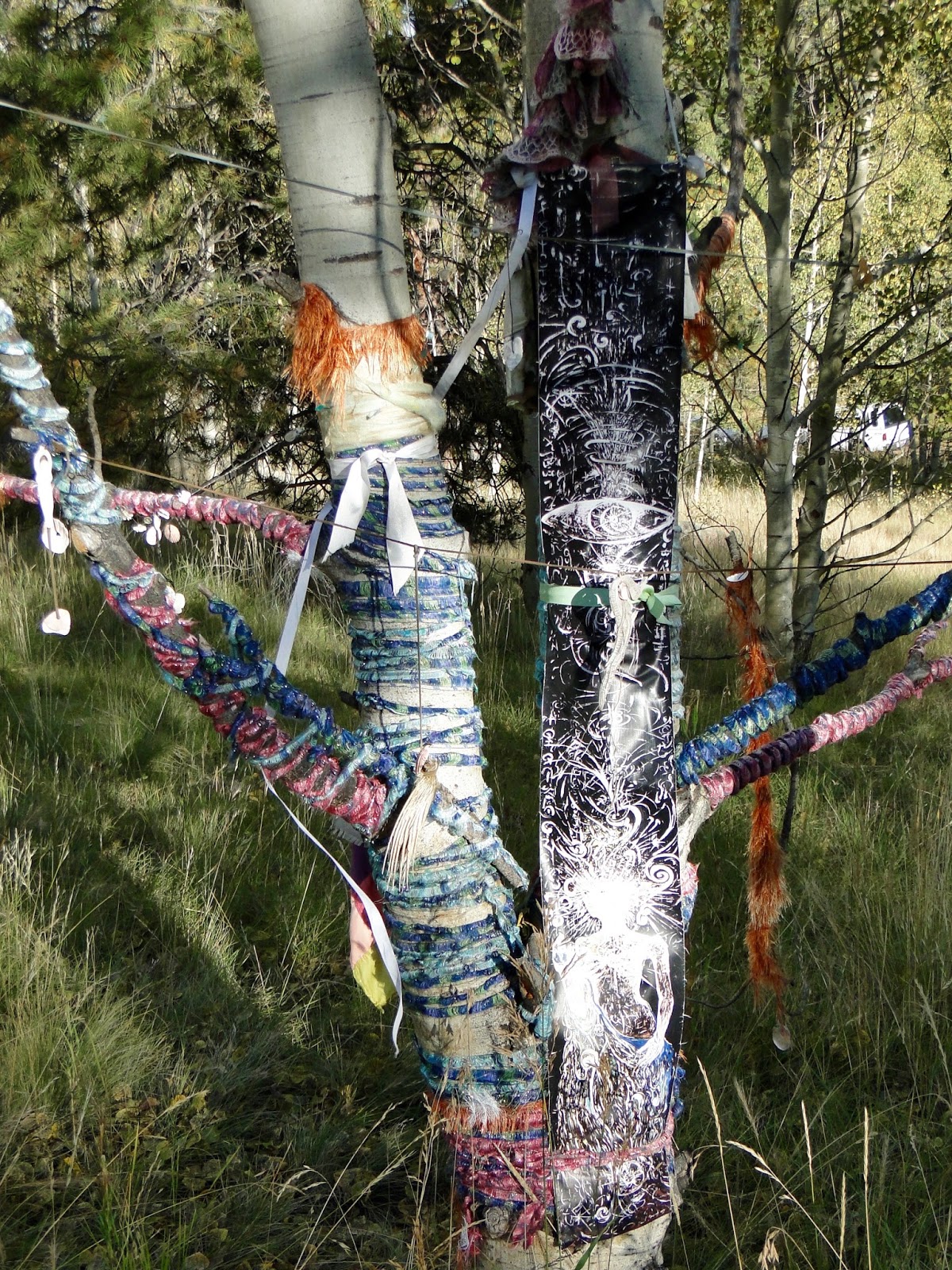
Then, last month,  came notice of Music and Magic in the Mountains festival last, and I decided to visit Tierra Sagrada and get a sense of what it's all about. The day included music of all kinds, artisan booths, a small blessing ceremony led by Pati, and various workshops, mostly related to healing or dance. Some sessions took place in Pati's house, but most things were outdoors on that beautiful autumn day. Two friends from Denver joined me, along with local friends Linda and Barbara, and the day proceeded as a festival day should: lots of time to set up lawn chairs, eat our picnic lunches, watch kids and dogs, listen to music, and chat with artisans. Wandering down to a food truck for a bowl of hemp broccoli soup, I spied a hammock from which I could gaze at the aspens, and nearby, a beautifully-decorated tree.


I think I realized then that participating in events there had nothing to do with "believing" or not believing in shamans. It had more to do with just being open: open to different forms of wisdom and beauty and healing. It's not an intellectual process, but rather one of spirit. You can see that in this photo of Pati (from her website) and feel it when you meet her.


Pati was introduced to this path she's chosen through the anthropology courses she took when she returned to college in mid-life. She became deeply interested in ancient cultures, especially the Huichol people of Mexico, with whom she spent short periods of time during her college years. She was impressed with the joy she experienced in their community--one with no running water or other Western amenities. In contrast, she says, those of us brought up in consumer culture often experience stress and disconnection rather than joy.

I'd love to visit Tierra Sagrada again soon, and events are scheduled this month and in November. But this week I'm going back to Denver, where I live most of the year. Next summer, when I hope to return to my cabin for most of the season,  I will make time for a return visit. Meanwhile, thanks to Pati, I feel more sensitized to the opportunities around me for connecting with the wisdom of indigenous cultures.

In Denver, there's a monthly indigenous film showing at the Museum of Science and Nature, and I attended several last year. The Internet has brought other opportunities. This year I've been following Honor the Earth, an organization founded by Winona LaDuke and friends/allies to unite Native communities in working for energy justice and protecting their lands from fossil fuel pipelines. There are a number of ways to contribute to their efforts, such as buying the wild rice they harvest. (I'm already preparing for Thanksgiving!) Also in Denver are the state's majority Native American population: 56,000 people if you count those who identify solely as American Indian/Alaskan Native, or nearly twice that if you consider those of mixed race heritage. I should have many opportunities to participate in the struggles, ceremonies, wisdom and art they share.

I'll close with some words from Thoreau--my favorite person to quote--in Walden.* Thoreau had a strong aversion to housework and the tendency of humans to cling to heaps of possessions. He especially admired the customs of the Mucclasse Indians, who had a yearly "custom of the busk" in which they burned all their old possessions (having previously gotten a modest number of new ones). After 3 days of fasting and abstinence, the fire was extinguished, a general amnesty was called permitting all "malefactors" to return to town. And then came the feast of new corn and fruits, which involved 3 days of feasting and dancing and singing. Mercifully, they had no plastic.

Such wisdom there is in downsizing--always an ongoing process for me, when it's a celebration rather than just a list of chores. No doubt some ideas for prison reform in there too.

*Thoreau admired Native American culture a great deal, and there are more than 50 references to it in Walden.


Thursday, October 8, 2015

Looking back on the Pope's visit

Just two weeks ago, I was sitting in front of a TV, fascinated by the words and images of Jorge Mario Bergoglio, known globally as Pope Francis, during his 3-day tour of the US. Had I blogged about this fairly soon afterwards (a habit I’m trying to develop), I would have focused on this fascination. Puzzling to friends perhaps, as I’ve long since left the Catholic culture I grew up with. Still, watching the Pope speak about climate change and poverty and peace and acceptance and many other things coming from the heart of Christian teachings, I felt tears brimming. Whatever reasons I could have come up with were overshadowed by emotion: relief that finally the right man was in the right job at the right point in history--and hope that he could make a difference.

Much of the time my feelings about the future are quite the opposite. My reoccurring image is that we—humans one and all—are orphans, strapped into the back seat of a car, while the grown-up drivers have wandered off to quarrel among themselves. They've failed to notice that the car is moving and the brakes don’t work. Finally, in Francis, I saw an adult leader who got the quarreling grownups to listen, who said important things, and who said them in a way that made all of us look at what we need to do to survive in this world. We were not lectured; rather we were inspired to connect with our best selves. Even so, I realized then that the experience might be what I call “the Christmas Effect”: business as usual comes to a standstill for a short time and we all focus on what we say are the really important things in life. Then the date passes and business as usual returns--or almost business as usual. Sometimes, some of us really do change if only in small ways. The image of House Speaker John Boehner crying as the Pope spoke and then resigning his position the next day is still with me. No doubt there are countless others in the crowd who cheered Francis and then went home and started to do things just a little bit differently. In the photo below, it's interesting that the word "honeymoon" from another story seems to extend to this event.


After the Pope returned to Rome, it didn’t take long for the honeymoon to disappear, especially among a number of people in the LBGT community. The Vatican confirmed that Francis had met with Kim Davis, the notorious Kentucky official who refused to issue marriage licenses to same sex couples. At that point, my fascination shifted to curiosity and reflection. (How did the meeting with her--she was one of a group-- really come about? Was the Pope “set up” by a loyalist to a previous pope? What did he actually say?) I thought about the crucial question of freedom of conscience—something every religious leader should uphold. I decided that if Francis had indeed conveyed approval of Kim Davis’ choice to honor her own conscience, he was only doing his job. If he had lobbied for a change in the law, that’s another matter—a matter best left to Caesar, not to God. Likewise, his visit with the Little Sisters of the Poor, who are opposing the birth control coverage provision of Obamacare, was another example of the same thing. For those of us who feel strongly that same sex marriage is a right, as is affordable birth control for women, our job remains what it’s always been: supporting political efforts to make those things happen.

In watching the coverage of the Pope’s visit, I also became fascinated by the story of Jorge Mario Bergoglio, the man he was before and after he became the head of the Catholic Church. Here is a man who has truly practiced what he preaches—who rejects the trappings of luxury, who has a human touch, who washes the feet of prisoners. I was also intrigued to learn that he considered himself an arrogant person at one point in his early Jesuit years. Demoted by his superiors and sent off to another city, he prayed and meditated—and emerged as a man who had learned to appreciate humility--the quality that has most characterized him during the past two years.

Nevertheless, you can argue that all admiration of Francis should be tempered by the fact that he heads a religious organization still mired in medieval doctrines. Birth control, euthanasia, priestly celibacy, ordination of women, all are at the top of the list. This week Francis is enmeshed in the politics of the Synod of Bishops on the Family. A key issue is whether divorced and remarried people should be allowed to participate in holy communion, which Francis supports. As of today, however, it looks like the conservatives will win on that. My admiration—now mixed with sympathy—for Francis continues. My own parents were affected by this issue, after my Dad, a divorced man, married my mother. They were excommunicated—a deep loss for my mother—until years later, when a sympathetic priest blessed their marriage. (Dad’s first wife had died by then). No doubt there are many couples today who are affected by the synod vote this week. Thanks, Francis, for fighting the good fight.


Today, with Francis still on my mind, I listed to the Democracy Now interview with musician/writer Patti Smith. Smith—who is not Catholic—talked about her admiration of St. Francis of Assisi—“truly an environmentalist saint” of the 12th century. Two years ago, when the College of Cardinals was choosing a new pope, Patti watched the coverage with her daughter Jessie. How wonderful it would be, Patti remembers saying, if the new pope took the name Francis and became an environmental pope for our century. Mother and daughter hugged each other when the decision was announced that the new pope would be Francis I. “We were like jumping up and down as if we were at the Kentucky Derby and our horse came in. So, I was quite happy, because I knew anyone who took on this name was taking on a great mantle of responsibility,” Patti told DN's Amy Goodman.

Today, Jessie Smith is involved with a huge concert to be performed as part of Pathway to Paris, the lead-up to the international climate talks in Paris, France, this December. Patti Smith will be performing there too, most likely including her signature People Have the Power song. She and everyone else will know that even if there’s no such thing as having God on your side, the next best thing is having Francis there. Maybe the Christmas Effect will work some magic too.