Saturday, February 27, 2016

A few thoughts on turning 69

I turned 69 this month, which means I’ve started my 70th year of life. It was not so much a plunge into a new decade as a swirling of a toe in its waters. I’m in the habit of getting ready for birthdays at least 6 months in advance, so when the day actually arrives, my new age seems just a slight shift on the calendar, a new number on a form. When I was younger, old age really seemed like a foreign country. I sang along with Simon and Garfunkel. You know, that song about two old men sitting like bookends on a park bench; “how terribly strange to be 70.” Simon and Garfunkel wrote the song in their 20s, when that foreign country was still so far away for them. Since then, they've arrived, as have I, and perhaps they'd agree it’s not so strange after all. There are people and buildings and nature, more or less different from the ones you knew, but not as disorienting as you feared. So you walk ashore and the journey continues.

Here I am at 21 in my college graduation picture. Did I even think about my 70s when 30 still seemed like a somewhat strange and distant land? Perhaps not.
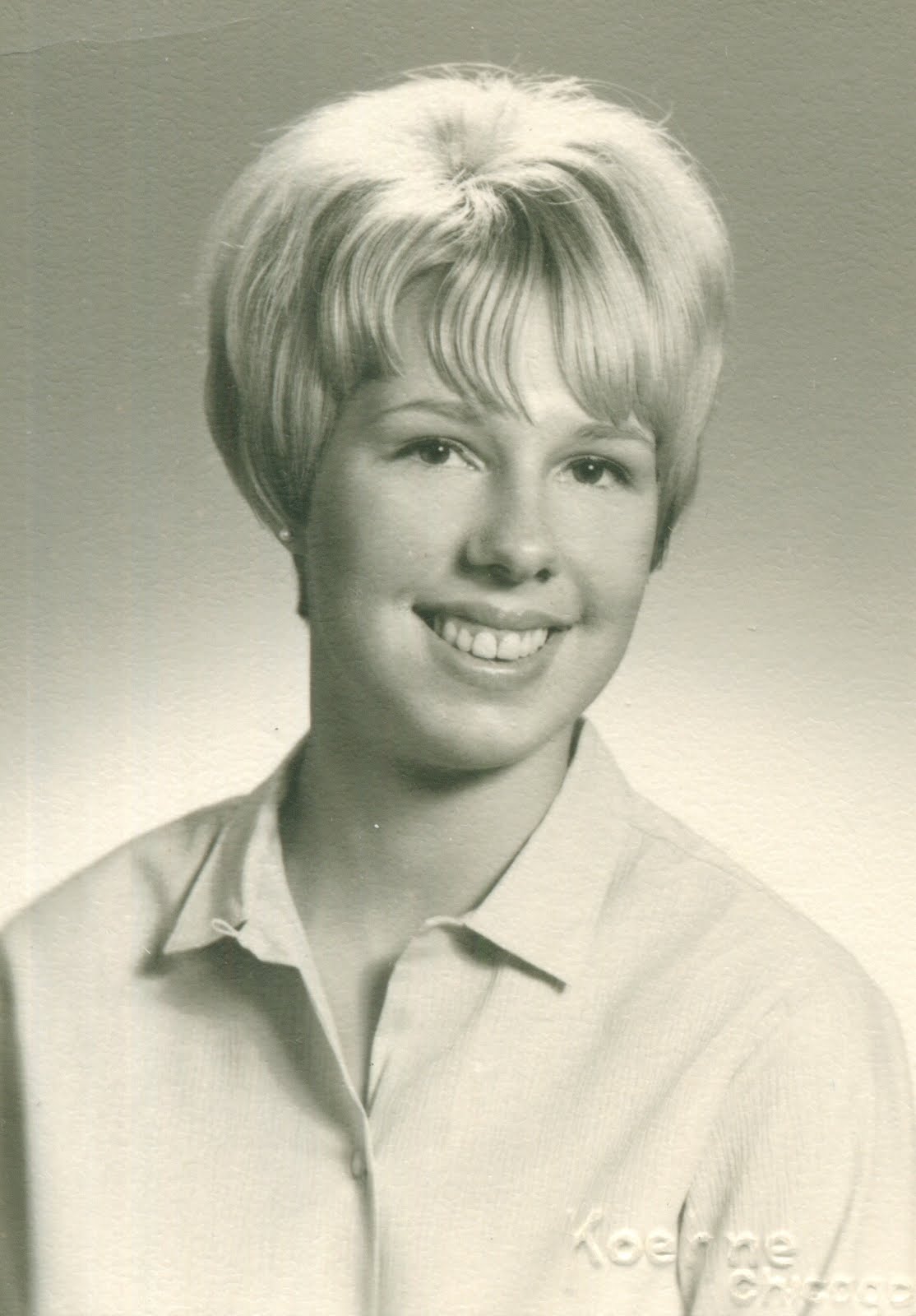


Every year a wave flowing into the next. At the same time this process of aging is like an undertow, not always seen but there nonetheless, a danger, a pull to an unknown place with no return. People my age, a little younger or a little older, are dying. Sometimes from long illnesses, sometimes suddenly. Decades ago my parents passed away, both suddenly from heart attacks at ages 74 and 77.  More recently (2009), Paula, a friend and once my partner, died suddenly at 59. Celebrities I remember growing up are now dead: Robin Williams, David Bowie, Leslie Gore, Natalie Cole, many more. Like everyone, I hear or read about fatal accidents. Of course, I’ve always known an accident is possible anytime, but older, I'm somehow more aware of the danger and the arbitrariness of it all.  Witnessing these deaths, I pause, promising myself to be more mindful, to make every day count.

Like other friends my age, I say sometimes that I wouldn’t choose to go back to my 20s even if I could. We agree that so many youthful worries have since been eased or abandoned. We’re stronger, freer, happier now. For those of us who are retired, there’s more autonomy than we had when jobs and/or growing families structured our days. It’s a kind of second adolescence, except we’re old enough to appreciate it. We don’t waste a minute sulking in our rooms. Five years after retiring from teaching English in Japan (a job and country I loved), I still wake up mornings, thrilled to be able to create my days pretty much as I like.

I’m also lucky to be aging along with the largest generation in US history: the post World War II baby boomers. Every month, when my AARP* magazine arrives, it’s full of stories about other people my age who are still in the game through their professions or making a new start in something. The cover of the latest issue includes these stories: Money Issue (get hired, best investments), Disrupt Aging, Choose Your Cruise, proactive health articles.


Surrounded by age-positive opportunities here in Denver, I take free Silver Sneakers exercises at my local YMCA, laugh with my laughter yoga friends (mostly older, as we meet in the middle of the day), and square dance with the Rainbeaus, a club known for having many senior members with playful spirits. Summers, when I return to my cabin in Florissant, I’m surrounded by enterprising seniors there too—hiking mountains, planting gardens, building stuff. The list goes on. A great time to be an old person. And yet this, from Emily Dickinson:

Presentiment is the long shadow on the lawn—
Indicative that suns go down—
Notice to the startled grass
That darkness is about to pass—

With this presentiment that time is getting shorter and the darkness is not all that far away, what still needs to be done? What can I still do? What do I really want to do? What should I do now while I’m able? Perhaps those youthful worries over how to create my future haven’t really gone away, just changed form, become more urgent. Thinking of my younger self, I shake my head with the other elders. What after all, did she have to worry about? She had youth!

“Aging sucks”, says my 84-year-old neighbor when I ask her about it. “I never thought about it until I got cancer.” Once a violinist and composer, she can no longer play because of arthritis in her fingers. She does her best to live on a very limited income. She's clearly not the only one. For two Decembers in a row I’ve helped deliver fruit baskets from Volunteers of America to seniors who are alone or financially poor in Denver, and have seen glimpses of the stresses endured by many seniors: failing health, loneliness, too little money for making ends meet. Many homeless people I see on the street are seniors.

Looking at my AARP magazine cover, I welcome everything that reinforces my sense of strength and agency. I need it to balance out my sense of vulnerability. A fall can lead to a broken bone which can lead to immobility and long recovery time, as happened to a friend in Florissant last year. (But our ability to heal is strength and my friend's neck brace was removed last week. Ah, freedom!) Other friends and family members are surviving cancer. Seeing their strength makes me feel stronger to meet whatever challenge comes my way.

 However, vulnerability is underscored every week when I visit a woman my age who has early-onset Alzheimers. I knew her before her illness and there seems to be flickers of our friendship in her long-term memory. This form of the disease is strongly linked to genetics, a time bomb hidden in a piece of DNA.  In offering caregiving services to her, I wonder about my own undiscovered vulnerabilities. “Just do what you can, make every day count”, I whisper to myself as the visit ends.

Memory is such a gift when and while we have it. When I was young, I thought it was a little sad to be old, to have most of life in the past. Okay, I had a point there. Unlike the past, the future always has hope and promise. I'm increasingly aware of how much of the future I'll never see.  But now I look at the past as a mansion, not quite Downton Abbey, rather much humbler, more complex, and very large. Mine has all sorts of rooms full of interest. A few rooms I’ve learned to keep closed; no need to revisit. As for the rest, wandering through them is a fascinating journey. I can go to any of them as the mood strikes: childhood rooms, classrooms, outdoor rooms, often alone or with others I’ve known and loved. Fun! As George Orwell said, “One’s memories grow sharper after a long lapse of time because one is looking at the past with fresh eyes and can isolate and as it were, notice facts which previously existed among a mass of others.” It’s fun to share these reminiscences with good friends who tell me about their own wanderings and new ways of seeing.

Still memory is always on a balance beam of strength and vulnerability. Just as maintenance of my body seems to take more time and work than before, so does memory. It always irritates me when my peers complain about not being able to remember names or where their keys or glasses are as if nothing can be done. Okay, it’s true--brain synapses slow down, but mindfulness and paying attention go a long way toward minimizing the problem, I argue. We can take notes or use one of many mnemonic techniques.   Just another exercise. Use those strengths. We can't abolish vulnerability but we can thumb our noses at it.

Speaking of strengths, it’s time to wet my toes in the current of today. Errands and more preparation for next week's trip to Japan. Yet there’s so much more to say about this and many other topics. Another day, another blog to come.

Sunday, January 31, 2016

Reflections on the Marade

I attended my first Marade last year, and this year knew I wanted to go again. The Marade is an annual Denver event held every January on the birthday of Dr. Martin Luther King. This year it was held on Jan. 18, and two weeks later, I’m still thinking about it. Like last year, the weather was sunny and relatively warm, always a boon for outdoor events, and thousands turned out for it. Like last year, I walked from home and met marchers along the parade route, ready to watch and then join in. Judging by the signs, there were members of church groups and non-profits and progressive movements, along with parents and kids and friends. There were horses too, and bringing up the rear, a fire truck in parade mode. Unlike last year, however, there was less music and a different mood at the front of the march. Members of Black Lives Matter had displaced the traditional leaders—the mayor, various dignitaries and corporate sponsors. They did it by getting an early start, walking down a different street and then cutting in front of the others.


Looking at the diversity of faces and signs, I wondered how many others felt as I did, feeling that combination of pride in all that’s been done amid reminders of all that needs to be done for equality and justice in this country. Despite the pressing needs of now, I wanted the past to get its due. Dr. King’s work had been my initiation to political work. Fifty years ago, it was, and it still surprises me to realize that. Yes, half a century ago, I was a freshman at Mundelein College, a Catholic women’s college in Chicago, where a group of older students and nuns were planning to join the last leg of the historic Selma to Montgomery march. I knew right away I wanted to go, and when my worried parents objected, got a job to earn the $20 round trip bus fare. The Civil Rights Movement was in full swing in the South, where African-Americans were fighting for the basic right to vote and an end to oppression from the white power structure. Such excitement in the air! I remember many moments of that event—the beginning of my understanding of how people of different races could unite to make change. Months later, the landmark 1965 Voting Rights Act was signed into law.

Fast forward to the Marade. This year it was clear that the injustices needing to be addressed superceded any reflections on history. There were lots of signs and banners calling for specific things— an end to the death penalty, the freeing of Native American activist Leonard Peltier, a woman’s right to control her body, among others. Two Muslim women marched together holding a sign expressing hopes that children of all races might live in peace together. “Reclaim MLK” was one sign I noticed and wondered about. The answer came when the marchers spilled into the park facing the State Capitol and the speeches began.

I confess I skipped the speeches. Call it an aversion to crowds and waiting and noise. My friends and I watched the horses and the riders who let kids take a turn. I approached one of riders and learned that some of them were from Buffalo Soldiers of the American West, and some from a local horse rescue network. We enjoyed this somewhat quiet, pleasant corner of the park. In the background we could hear clapping, drumming, and the echoes of words. Before the speeches finished, we left the park and went to lunch.


Only later did we learn what we had missed. Thanks to youtube, I later heard the speech delivered by Amy Brown of Black Lives Matter 5280. You can listen to it here. The group—which had not sought any official permission to speak—had four demands. A key one surrounded the deaths of two men, one Michael Marshall, an African-American who died in police custody, and the other, Native American Paul Castaway, who was shot and killed by police called to help during a schizophrenic episode. In her speech, Amy Brown demanded the release of a video of Marshall’s death.* Black Lives Matter also called for more affordable housing in Denver, an end to the urban camping ban, and a renaming of the Stapleton community, as its namesake former mayor was a member of the KuKluxKlan. It was clear that the sign “Reclaim MLK” was a reference to making the day a time for taking on Dr. King’s own campaign against poverty and discrimination— not making it simply a safe acknowledgment of past victories.

Later, Denver Mayor Hancock was booed as he tried to say he was on board with Dr. King’s dream. You can hear his speech in this youtube video. My age shows here, as I don’t like what seems to be the political temper of the times: enhancing your own message by shouting down someone else’s. Yet, at the same time, I remember the words of Rev. Osagyefo Sekou, a Christian minister who gave an inspiring speech last summer. (Thanks to yes! Magazine for reporting on it.) “Martin Luther King ain’t coming back. Get over it,” Rev. Sekou said during a lecture at Warner Pacific College in Portland, Oregon. “(Today’s movement) won’t look like the civil rights movement. It’s angry. It’s profane. If you’re more concerned about young people using profanity than about the profane conditions they live in, there’s something wrong with you.”

Speaking to a Christian audience, Rev. Sekou had four suggestions for white churches who want to continue Martin Luther King Jr.’s dream. These are his words:  1) Your attitude toward the plight of African-Americans in this country reflects your theology. If you tell me what you think about Jesus, I can tell you what you think about Ferguson. Christianity in and of itself is not simply about the redemption of the world, it's about some peasant articulating a vision of the world and the state crucified him and he rose again.
2) White churches don't need to become multicultural. They need to show up. What if the next time a black boy gets shot a white church shows up? They don't say a word but they go sit with that mama and ask what she needs. What if some white clergy showed up in their robes and stood between the protestors and the police, telling the police, 'You're going to have to get through us to get to these babies.’
3) The first step toward understanding and justice is friendship.
4) Your opinion of the rioters' distasteful language and behavior shouldn't shape your opinion of their message.
5) Change is going to require sacrifice. Are you willing to fight for a world you’re never going to live in?

Perhaps, as much as the images and the pleasure of the day and the march itself, I’ll carry these words with me this year.

*The video was subsequently released, but the District Attorney did not press charges against any of the officers involved in Marshall’s death, saying multiple causes were involved.

Monday, January 4, 2016

A Japanese New Year: Part 2--Seven Lucky Gods

One of the many things I enjoyed about New Year in Japan was the fact that it did not end on January 1. The 3—5 days following were usually days off for many if not most workers—time to catch up on sleep, relax, or visit friends or relatives. My favorite activity was a Seven Lucky Gods walk in one of the neighborhoods in or around Tokyo. I usually went with my friend Renate. We chose a neighborhood and the best-weather day, and then off we went for a day-long hike, including stops at 7 different shrines or temples, each devoted to a different deity.

“Gods” seems a misnomer for the Seven Lucky Gods, all but one derived from mythological or historical characters from China and India. Collectively, they reminded me of the things we hope for in a new year, like riches (defined broadly), happiness, prosperity, longevity, and protection. You can often see their images as the new year arrives in Japan—usually smiling atop a takarabune (treasure ship)—on flyers or cards. At each temple or shrine on our walk, a monk would stamp our cardboard with the deity’s image.


Some years we got small figurines instead of stamped boards, and I still have my favorite set on display each New Year and beyond.


Sometimes there would be stone reproductions of the dieties in the shrine gardens.


Like pagan gods of the West, they often had funny or eccentric characteristics and special groups of devotees. Fukurokuju (riches, happiness, wisdom), has an enormous head, long beard and sweet smile; Jurojin (wisdom) is more normal-looking, often portrayed with a sacred deer; Daikoku (demon chaser) dresses like a dandy and is short-legged and plump. The only woman in the group is Benten, who is often pictured with a stringed instrument called a biwa; she is the goddess of music, arts and eloquence. Then there’s Ebisu—the only native Japanese god—often elegantly dressed while carrying a bamboo fishing pole and huge fish; he’s the god of good fortune and fair dealing. I'm especially fond of Hotei, said to be modeled on a real-life Zen priest, who has a narrow forehead and huge belly and was so funny to the Chinese that they called him “Cho-tei-shi” (old cloth bag); he is the patron of children, wits, bartenders and fortune tellers. Rounding out the cast is Bishomon, a warrior and guardian of Buddhist virtues. He is sometimes considered a god of healing on the theory that sickness comes from evil and Bishomon defends against evil. A photo from a shrine honoring this guardian deity:


Most years I did the walk with my friend Renate, who enjoyed it as much or more than I did. Here she is on a particularly chilly day in early 2008, posing in front of a map above an illustrated takarabune, with an image of Benten on the right:


Approaching a shrine, we always found a fountain, where we could purify ourselves by running water over our fingers, using a bamboo or tin ladle. Some fountains were especially decorative. 


The walk was often a day-long affair, allowing train travel time, periodic rest breaks, exploration of the shrines, and food stops (sandwiches or onigiri, cookies and a small bottle of champagne being popular choices).   Some years our friend Marimar joined us, and one time she brought along her fiancĂ© (now husband), Frank.


Usually we stopped at a restaurant at some point, when a tea break or warm spot for chilled fingers and toes seemed like a good idea. Food displays could attract, including this basket of these rather fiercely-decorated sweet potatoes outside one shop.


Returning home, I’d usually feel pleasantly tired and content that my new year had started well—with exercise and a kind of hopeful and peaceful feeling from all those shrine visits. Back in the US now, I still like to display a print of this photo which summarizes that feeling. 


I used to think that people in Japan were less focused on making new year resolutions than we are in the US. I don’t recall making them or hearing about them very much. Yet, when I quizzed my friend Junko about this, she told me that Japanese are often very focused on making resolutions for things they want to commit to in the coming year. They just don’t talk about it very much. The old proverb, “Actions speak louder than words” is taken to heart. Shrine visits are a way of getting spiritual support or enlisting a diety as witness. I was surprised to hear this, realizing once again how easy it is to make cultural generalizations. Just because we don’t notice something doesn’t mean it doesn’t exist.

I’ve pretty much stopped making resolutions. My friend Roberta and I were talking the other day about how we want to continue the good things we’re already doing—things that bring us energy and satisfaction. Some things on my list: the strength training program I started last fall at the YMCA, time for being, communicating, dancing or laughing with friends, exposure to more books and ideas and finding opportunities for being at least a part-time political activist. Perhaps I can summon the Seven Lucky Gods as my witnesses. According to the Chinese zodiac, 2016 the Year of the Monkey, so I’ll try to be as clever and playful as one in the process.


Saturday, January 2, 2016

A Japanese New Year: Part 1

One of the many things I got from my years in Japan was a new appreciation for the New Year holiday, which became my very favorite holiday there. In the US I just couldn’t get into it. I had no enthusiasm for football or travel amid substance-impaired drivers or for balls dropping at midnight in large crowds. But in Japan—where the new year is a family holiday— there were various rituals I enjoyed exploring: eating morsels of osechi ryori (special holiday foods) placed in lacquer boxes, watching the variety show, Kohaku Uta Gassen, followed by the Joya no Kane (the ringing of temple bells), and then a day or two or three later, taking one of the Seven Lucky Gods walks held in neighborhoods throughout Tokyo and environs. Fortunately, I’ve had a chance to repeat some of those rituals in Colorado over the past several years. Thanks to Susie, Anne and Marga, who live in Boulder and have a subscription to the Japan Broadcasting Network (NHK), I could renew my favorite rituals this omisoka (New Year’s Eve).

This year Susie’s daughter Gwyneth was visiting from Japan, and she managed to bring an ojubako (lacquered box) of osechi delicacies to the early evening feast of goodies: small colorful heaps of black beans, small fish, puree of sweet potatoes and chestnuts, a sweet rolled omelet, and more. (For photos and recipes, try this chef’s blog.) I remembered the many beautiful osechi arrangements I had enjoyed with Junko, who lives in Japan and is still family to me. Here’s a photo of her and one osechi feast she shared with me in 2004.


Of course, other foods make their way onto the table on this holiday, especially if kids are there. I still remember my surprise when I first joined Junko’s family for a New Year dinner and two of her nephews brought McDonald’s take-out. Kids don’t like the traditional foods that much, I was told. So I suppose the non-traditional tidbits we had this year, such as guacamole and chips, were right in step with changing traditions.

Having a buffet is useful on New Year’s Eve for all who watch Kohaku (Red and White Singing Battle), as I did with my friends in Boulder. Junko first introduced me to this show about 20 years ago; she has been watching it since childhood. The closest image I can suggest for this unique event is Las Vegas, Walt Disney and Lawrence Welk all rolled into one 4-hour extravaganza. Technically it’s a contest between the Red (female) and White (male) teams, with the audience voting at the end. I’m not sure how much anyone cares about the result, though. The important thing is how important it still is in Japan. An estimated 40% of the country watches, and it’s a big deal to be selected to perform. There were fifty-one acts this year, ranging from teenie-bopper acts with once-improbable names, like AKB48 to elaborate dance numbers (Sandaime J Soul Brothers from the EXILE TRIBE) to enka veterans (Yoshimi Tendo, Shinichi Mori) whose songs tell of heartbreak and struggle and longing, to pop stars who’ve had long careers or made comebacks.  A photo of idol group AKB48 (from The Japan Times):


Although the NHK-produced show avoids political controversy (no mention—at least none that I could catch— of the widespread peace demonstrations in the country last year), it pays tribute to disasters survived. This year marked the 70th anniversary of the end of World War II, and there were songs commemorating the struggles of that era. The future got its due also, as Olympic athletes were honored, with an eye toward the upcoming 2020 Summer Olympics in Tokyo. Kohaku emcees vary from year to year; this year one of them was 82-year-old veteran actress and UN cultural ambassador, Tetsuko Kuroyanagi. The show continues to fascinate, and occasionally, appall me. (Must so many young women dress and sound like little girls?) The fascination comes the showmanship of it all and the reminder that we are not all living in a globalized, homogenous world. It’s a very Japanese production. The number of costume changes throughout the evening is astonishing, and increasingly, computer graphics have been integrated into the choreography. 

Is there any other show that has such a broad reach? The producers are clearly mindful of the fact that New Year’s Eve is still often an intergenerational event in Japan, that new audiences must continually be attracted while satisfying the older ones. This has benefits for all viewers, I think, as everyone appreciates having acts they don’t mind missing to make a trip back to the kitchen for something. This was true at our Boulder party, as attendees included Susie’s two granddaughters, ages 5 and 8, who joined us around the screen in the basement, all of us taking breaks for rollicking play or food.
Unfortunately, I couldn't snap a good picture of our group, but I did manage this mother and daughter (or are they twins?) photo of Susie and Gwyneth.


In addition to the osechi buffet, there is another traditional food, usually served around midnight on New Year’s Eve: buckwheat (soba) noodles in a soy-flavored dipping sauce, topped with chopped onion. They’re called toshikoshi soba, meaning long-life noodles, a very appropriate and tasty idea, as we all get ready to plunge into the uncertainties of the new year. Our hosts brought our lacquer bowls of soba downstairs, which we ate as we watched the Kohaku finale. It was a rousing finish and then the winner was announced (Red broke White’s 3-year winning streak), and then came the part I always stayed up for and never tire of: the ringing of the temple bells. NHK cameras are stationed at various temples throughout Japan, including one in Fukushima that had been closed since the 2011 nuclear disaster. In Buddhist tradition, the bells toll 108 times, for the number of evil desires humans suffer from. (And to think Christians focused on only 7 deadly sins, perhaps the original sin-labelers had no time for the many minor ones we commit.) Mercifully, the cameras did not wait for all 108 strikes of the bell; rather, we saw lines of people waiting to enter the Buddhist temple or Shinto shrine—both traditions co-existing in Japan. Some were waiting to pray or ring the bell, others to get a lucky arrow or sip a bit of sake around a bonfire.

During most of my 20 years in Japan, I visited shrines on New Year’s Eve or sometimes the day after. Here’s one of me with Junko’s late mother (circa 2004).


This year, with no shrine opportunity in sight, my friend Roberta and I bid our hostesses good night, and drove a mile or so back to her place, where we each soon fell asleep. On January 1, we joined Roberta’s friend Hannah for a New Year’s Day brunch at a restaurant in Chatauqua Park, and drove by the Boulder mall, where in years past there has been a Japanese-style celebration sponsored by a local sushi restaurant. It usually included mochi-poundings and the resulting soft rice cakes with toppings, as well as a stand serving hot soup and performances by taiko drummers. The event was cancelled last year due to extremely cold weather, so with this year’s warmer temperatures, we had high hopes for attending one. No luck. Instead we joined a few walker and shoppers on the mall, appreciating the sun and the start of a brand new year.
Next: Part 2: Beginnings of things and the Seven Lucky Gods

Monday, December 28, 2015

Christmas Eve at First Baptist Church of Denver

This Christmas Eve I met a new neighbor—the First Baptist Church of Denver, just a block and a half away from my apartment on Grant Street. Fortunately, we had no white Christmas this year; I say fortunately, given my aversion to walking on snowy or icy streets. On this chilly but snow-free evening, I walked this short distance, part of the way alongside a string of candelaria, leading to the entrance of the church for the evening candlelight service. Here's a photo of the altar. Imagine the candles lit and the background lighting softer.


First Baptist is a small church with a long (150 years) and respectable history. Martin Luther King Jr. once preached here. It has a large pipe organ that people are very proud of. You can hear it if you click here.

Plain setting, unadorned crucifix, no stained glass. Lit candles on the altar gave the space an intimate feeling. I took a seat and soon we were invited to greet our neighbors, the 100 or so congregation members who had filled half the benches that evening. I was warmly welcomed by two attendees who seemed about my age, Nancy and Mike, who sat in front of me. Their bench was strewn with children’s toys and books. It was a good beginning of the evening—also a good ending to a day of companionship among friends in Boulder. 

This evening was the first time I had ever set foot in a Baptist church, and I was curious to see what a service was like. Perhaps there was a taste of the forbidden in this decision, as during my Catholic youth, we were not allowed to consort with Protestants in their churches. I also knew, thanks to a friend who had once attended Northern Baptist services like this one, that this congregation would not fit my stereotypes of Southern Baptists, likely to be anti-pleasure and anti-gay. Not that I had any direct experiences with Southern Baptists either.  

This visit was the second in a new would-be tradition I started last year—spending Christmas Eve in a church in my area. I plan to go to a different one each year, preferably one I can walk to. Last year my friend Roberta joined me for a stroll to the spacious, stained-glass-infused St. John’s Episcopal Cathedral on 14th Street. We enjoyed the beauty, the trained voices of the choir, the flowers, and the message that churches do best at Christmastime: peace on earth and good will to all. Here’s a photo of the interior of St. John’s.


First Baptist was the polar opposite of St. John's. Both setting and service were simple, without frills. Their mission is simple as well. They aim to be “a place that welcomes and affirms all people and their questions about life and faith. We are a progressive, justice-seeking congregation that strives to follow Jesus’ ethic of love.” Amen, I say. 

The service started with music—one of the major reasons I like to be in a church at Christmas. A small choir of 5, informally dressed, stood to the side. There were readings from Luke and Isaiah, interspersed with carols. Early in the service attendees were invited to light a candle for someone and then tell the congregation who and why. Ten or so attendees came up and lit tapers. Grandparents and other family members or friends were thanked or remembered; two men acknowledged their same-sex partners. The service continued with music. After the next carol, my bench-neighbor Nancy—introduced as the Rev. Darnell—got up and came to the front, inviting children to sit near her to hear a story. It was a modern-day story of an adopted special-needs child and family love. Then came more carols, a reflection on Christmas by the senior minister, and finally the scene that stays in my mind: the candle lighting. The candles we received upon entering were lit row by row, and we all filed out to the north porch, facing the dome-lit State Capitol building across the street. We sang Silent Night in unison on this relatively silent evening—no sirens or revelers’ shouts intervening. 

We sang all verses of the song, and afterwards, the minister reminded us of some of the ways First Baptist fulfills its mission: providing meals for those in need, shelter for homeless women, and a job training center for recently arrived immigrants. Earlier this month, the church provided space to The Spring Institute to operate a coffee shop on its premises. Eventually Spring hopes to create a program including ESL classes, something it already coordinates at other locations. 

Perhaps the the activities of First Baptist are not unusual. Not being a regular churchgoer, I don’t know to what extent churches have intensified their traditional role of ministering to people in need—a role needed now, more than ever, as social needs grow exponentially along with social inequalities. In any case, here's one place where that ministry is happening.

Years ago, when I attended Catholic mass with my family, I used to love Midnight Mass on Christmas Eve. But as I’ve grown older, my fondness for late-night events has shifted to appreciation for those that start early. Ninety minutes after the 7 p.m. service began, I was back home, ready to tend to my own personal holiday rituals. These have changed over time. For a number of years, I just had to watch Miracle on 34th Street (1947), one of the earliest film critiques of the commercialization of Christmas and a gentle tribute to the power of fantasy. 

However, my years in Japan changed most of my habits around this holiday. In my first few years there, I worked on Christmas Day, as did everyone I knew. Sometime in the 90’s, a globalized version of Christmas entered Japan. Falling two days after the Emperor’s birthday (Dec. 23, a national holiday), Christmas got included in a winter holiday break that gradually started earlier and ended earlier than the traditional New Year break had.  By the time I left Japan in 2010, Christmas was widely celebrated as a festival of lights and a romantic date occasion for the young. 

Still, Christmas has a limited place in Japan, preceding the real winter holiday celebration—the New Year, when families and friends come together to share special foods and memories, visit a shrine and watch incredibly bad junk TV. I usually used my time off from teaching to catch up with work and visit friends. Before classes ended for the year, I remember teaching lessons on A Christmas Carol as an internationally-known piece of literature or showing A Muppet Christmas in class. In private, I just had to pull out Dylan Thomas’ classic short story, A Child’s Christmas in Wales. 

Perhaps you’ve read it too. It starts this way: One Christmas was so much like another, in those years around the sea-town corner now and out of all sound except the distant speaking of the voices I sometimes hear a moment before sleep, that I can never remember whether it snowed for six days and six nights when I was twelve or whether it snowed for twelve days and twelve nights when I was six…. Later, my sister and brother-in-law sent me a video version which I also enjoyed. You can watch it on youtube.

This year, after my lovely visit to First Baptist, I watched my favorite version of A Christmas Carol on Netflix: the 1938 black-and-white film starring Reginald Owen. It was so satisfying, as this non-colorized version was perfect for ghostly shadows. When it ended, I was still awake enough to watch A Child’s Christmas in Wales. 

Then sleep, and then Christmas Day, a Friday this year, marked by a ritual they say is common among many Jews—going out for Chinese food. I joined Roberta and her sister Bunnie for this, as I’ve done in the past, except this time we chose a Japanese restaurant, one in the small town of Lafayette near Boulder. They were doing a brisk sushi take-out business—perhaps a new ritual for non-cooks on this day. Late afternoon I drove back to Denver for a relaxing evening of Netflix watching, and then finally, snow began to fall. Like Dylan Thomas, “I got into bed. I said some words to the close and holy darkness and then I slept.”


Sunday, November 29, 2015

Cold day, warm hopes for a cool planet

We gathered near the City Park lagoon this afternoon, all 500-or-so of us, part of a global series of rallies on the eve of the Paris Climate Talks (COP21). Millennials, boomers like me, even-older folks, a mom with her infant bundled against her chest, young families, a few quiet dogs (in arms or on leashes), campaigners for Bernie Sanders, anti-frackers, members of interfaith or environmental groups. Almost everyone in warm hats and boots, as it was below freezing and patches of ice and snow still covered the ground. My "peeps", in other words. These days I love being in intergenerational groups, a reminder that all of us have a stake in the future of the planet.

Sometimes, with people my own age, it’s easy for conversations to bog down in the failures of the past, the many efforts at social change that we’ve participated in or watched, either derailed or co-opted. Buddhists might say we should not be "attached to outcomes". Yet, we need, if not successful outcomes, signposts that we're part of the good fight, the struggle, the human need to nourish the sprouts of a better world. We might see short-term results, but not the long-term results. As my former grad school prof, the late Dr. Marie Wirsing, used to say, “If you’re going to work for social change, you’d better be in it for the long haul.” A decade-plus older than I was, she had seen even more failures, but at the same time the value and necessity of standing up for what’s right and what’s possible.

It seems like thousands of people were doing that today around the world, and there are many photos of them at this site. No Denver photos at the time I posted this, but there should be later. My favorite is this news photo from Paris, where all demonstrations were banned following the recent terrorist tragedy. Shoes took the place of people. Likewise, perhaps every person who marched represents someone who could not, for one reason or another. 


In Denver, the bandshell was draped in Tibetan prayer flags, filled with notes and hopes and intentions from community groups and schools, dating back to ’09 when hopes were riding on the Copenhagen climate talks. Lots of talk at that one. Today the same sentiments infused hopes for the COP21, which starts tomorrow, convening in a climate-worsened world. There were two banners, one from Fossil Fuel Free Denver, a group working working to push the city toward more renewable energy, and the other from the Colorado chapter of Interfaith Power and Light, “a religious response to global warming”. The group whose mailing list I’m on—350.org—was one of the 10 sponsors of this event. Many other signs popped up amid the woolly hats, including those with puns I never tire of: “Don’t say frack to your mother”, and “There’s no Planet B.” Host emcee was Rev. Peter Sawtell from Eco-Justice Ministries, who promised that the rally would be exactly one hour long, and it was, a relief to those of us who found our fingertips and toes giving us grief near the end point. 

I thought back to the pre-Internet era, starting in the 60s when I came of age politically. The digital age has brought benefits amid the distractibility it promotes. I mused on rallies I had attended, usually starting on “anarchist time” or “feminist time” or whatever other time signaled it wouldn’t start at the appointed time. Speakers often spoke way too long on subjects the audience already knew about. The end point was usually on “counterculture time” also. Today’s event featured a number of speakers, all of whom spoke succinctly. Organizers were ready for the inevitable sound system glitch, which was fixed promptly. During the fixing process, we were distracted with chants, such as, “What do we want? Climate action! When do we want it? Now!” Back in operation, the mike was handed to a woman who had trained with Al Gore (remember An Inconvenient Truth in ’05? Click here for recent fact-checking of this landmark documentary). Later came a young woman from Environment Colorado, who reminded us we’re the first generation (or did she say generations?) in history to have this crucial opportunity to impact the climate of the future. Listening to her connect with us, call-and-response style, reminded me of Dr. Wirsing’s words. Each era has had losses;  any future course will encounter setbacks, but there is also opportunity to make a difference. 

The last 15 minutes or so was involved in photographing and recording a 30-second video which would be sent to President Obama, who will arrive in Paris tomorrow. Yes, clearly we were in the Internet age. No worries about the lack of TV cameras. No worries about the relatively small turnout; rather we were told the rally was even larger than last time. The important thing was the Facebook, Twitter and other digital coverage, the fact that our video would be sent, and that our photos would appear alongside those of the thousands of others around the world whose hopes for the future were also pinned on climate action now. Five speakers each said one sentence for the video. Afterwards the crowd yelled, “Yes, we *can* do it, now, now, now!” We rehearsed this 5 times. Earlier, we had been encouraged to whip out our cell phones and take a picture of our friends to post digitally. (I had left my non-smart flip phone at home.) Many complied with this request, friends huddling and leaning into smiles, duly recorded. Finally, video mission accomplished, the rally ended. Really, it's just the beginning, Rev. Sawtell reminded us. Some participants were headed over to Colorado Boulevard to wave their banners, but most of us looked headed for home, hoping to defrost our toes, encouraged and warmed by the event.


Tuesday, November 24, 2015

Journeying through time with the film characters in Brooklyn

Spoiler alert: Reading this blog entry will give you plot of this film. 

Brooklyn is a beautiful and powerful movie. It’s the story of Eilis Lacey (Saoirse Ronan), a young Irish woman who arrives in mid-20th century Brooklyn to begin a new life. She’s left behind a mother, a devoted older sister, and a small town in County Wexford that feels too small for the life she wants to create. After an initial bout of homesickness, she has a remarkably good first year in Brooklyn, where she rents a room in a boarding house and starts a job at an upscale department store. Thanks to a kindly priest, she has the tuition for a bookkeeping course in night school. Then one day, at a parish dance, she meets Tony, a sweet Italian charmer with an eye for Irish girls. They fall in love—and then the plot turns. The sudden death of her sister brings Eilis back to Ireland, where she faces a dilemma that forms the crux of the film. Should she stay in her beloved Ireland—where her mother is now aging alone—or should she return to her life in America, the life she has begun to love.


Brooklyn, based on Colm Toibin’s novel, touched me deeply. It goes back to a time half a century ago or more when a labor-needy US welcomed a huge number of immigrants—no background checks required. The film’s protagonist embodies one of thousands of young Irish who emigrated during a spike in unemployment at home. Most went to the London or other places in the UK, but a good number came here, passing through the same Ellis Island where my own maternal grandparents arrived more than 100 years ago.

The art, more than the history of the film, shaped my response. Brooklyn has top-notch acting, a well-adapted screenplay, beautiful photography, and excellent direction.  A friend  of mine who follows the Oscars, bets this one will get it’s share of Academy Award nominations; it’s already a film festival favorite. It’s the subject matter, though, that made the film so powerful for me. Brooklyn is an immigration story that is relevant to all of us who leave our hometowns to make lives in other places. What is the nature of the life left unchosen? What is the cost of leaving it behind? 

There is no real doubt about the choice Eilis will finally make, but the film does present a choice. It’s the choice every immigrant faces—at least those with the option to return home: to continue making a life in a new and promising though unfamiliar world or to remain in a world where one is known and loved. Things looks different when Eilis returns home for her sister’s funeral. The limited life she had foreseen in Ireland before she emigrated seems different now. She has been offered her sister’s old job, the landscape seems open and uncrowded, and most crucially, she connects with Jim, a shy young man who wants to see more of the world and of her. She comes to like him a great deal. Jim also has prospects—the large house and family business (a pub) his parents are leaving behind, and he is clearly getting ready to propose. Her mother wants her to stay. It looks like she might. But then an encounter with a mean-spirited former employer reminds her of why she left in the first place: the petty cruelties of gossip and social control in this small town, the future life that could be finer than the one she once envisioned, but limited all the same.

As a 3rd-generation descendant of immigrants (from Poland and Ireland), I should have had no issues with the choice the protagonist makes in this film. On feminist grounds if nothing else. A look at Irish history circa 1950 almost no job opportunities for women. And a powerful and restrictive Catholic Church made life there much worse for women who transgressed social norms. The films Philomena (2013) and The Magdalene Sisters (2002) come to mind here. Watching Brooklyn, I should have been cheering for the protagonist’s return to the possibilities of freedom. Yet, I wasn’t. I sat there during Eilis’ stay in Ireland, silently willing her to stay there—until it was clear she could not. 

A few thoughts of Eilis’ future started flitting through my mind. Success, we know, won’t depend on the choice of place alone. The key involves the very specific people and experiences that populate it. In New York, Eilis could well be part of a fun-loving Italian family, the wife of a man who loved the Brooklyn Dodgers and had big plans to start a construction business on undeveloped Long Island. We can imagine a happy life filled with family and financial security. Or not. It was the 1950s after all. Would she disappear into the kitchen, while Tony and his brothers watched baseball and ran the show? Would the sweet young man who adored her stay true? As the decades passed, would she see Ireland grow and prosper while America’s problems seemed to multiply? Would she bring her mother to live with her—or would her mother insist on finishing her life in Ireland? Would Eilis ever see her mother again and would that matter to her when she became old? Conversely, would life necessarily be so limited if this spirited girl married Jim? Perhaps they’d travel together or move to London or do something else that neither could envision at the time. Her mum would likely become a grandmother who knew her grandkids. Or not. Pub work could lead to alcoholism, and life in Wexford could become lonely or bitter. The future remains remains hidden, not yet created. No doubt this uncertainty is why choices can be so wrenching, especially when we’re young. We don’t know how they’ll turn out. We can only guess and hope. The screenplay leads us to see that Eilis was making the best guess possible.

It took me awhile to realize that in watching Eilis in Ireland,  I was reviewing and mourning the places I had left behind. The character of Eilis in Brooklyn was taking me back into my own un-lived life choices. Good movies can do that—draw us in and make us a part of a parallel story.

I left Chicago for Colorado when I was 27. Somewhat like Eilis, I had lost sight of how to build a life in my hometown. Moving to Colorado brought a new set of freedoms for me—a chance to live outside of Chicago for the first time, to test my mettle in a new place—a beautiful place, where I quickly took to hiking and backpacking and exploring The West. Though I missed my family and friends, I made new ones over time. I got a job in Denver, a city that was starting to develop from cowtown to metropolis. Then a year after I moved, my father died. I returned for the funeral but did not stay. No one expected that I would. Years passed. I was part of a vibrant feminist community, I had a partner, a job, and then after 4 years of night classes at the University of Colorado at Denver, a master’s degree in education with a specialty in teaching English as a second language. After struggling with the job market and a changing relationship with my partner, I went to Japan for a year or two to live and work. It was exhilarating to live in such a very different culture, working in a field I had trained for. That year stretched into many more—20, and during that time my mother passed away. I came back for the funeral and then returned to Japan. Paula, my former partner, died a year before I left Japan and returned to Colorado.

I can imagine the fictional Eilis looking back on her life in America when she was an old woman, content that she had made the right choice by following her heart and instincts. But I’m guessing she would also mourn the loss of her unlived life in Ireland, her separation from her mother and the relationships that might have been nurtured there. As do I, though the feelings are never quite in balance. On some days the mourning washes over the contentment. On others, it’s the reverse. And on still others, I just accept the past and wade into the future—wondering and hoping.