Wednesday, November 24, 2021

Remembering Stephanie Bogdanski Mack who would turn 110 this month

When I was growing up in the 50s, Aunt Steph was the aunt who never failed to slip me five bucks anytime we had a Bogdanski family get-together. A generous gift, perhaps the equivalent of $20 today. When she visited my childhood home, she was always a force to be reckoned with, often to be found with the men of the family in the living room, while my other aunts gathered in the kitchen. One topic in the living room was union politics at the Mercoid Corporation, an electrical parts factory on Belmont Avenue. It was as close as we get to a family business, as several of my uncles and aunts worked there for a long time.

As a child, I equated her loud voice and strong opinions with power, not having learned yet that it sometimes means just the opposite. Still, Aunt Steph was perhaps my earliest model for an outspoken woman. She cut a fine figure too--usually wearing a body-hugging dress and heels to family affairs. Her presence was never unnoticed, and I always looked forward to seeing her. Not just for the five bucks. I was fond of her and perhaps a little in awe, shy little girl that I was.

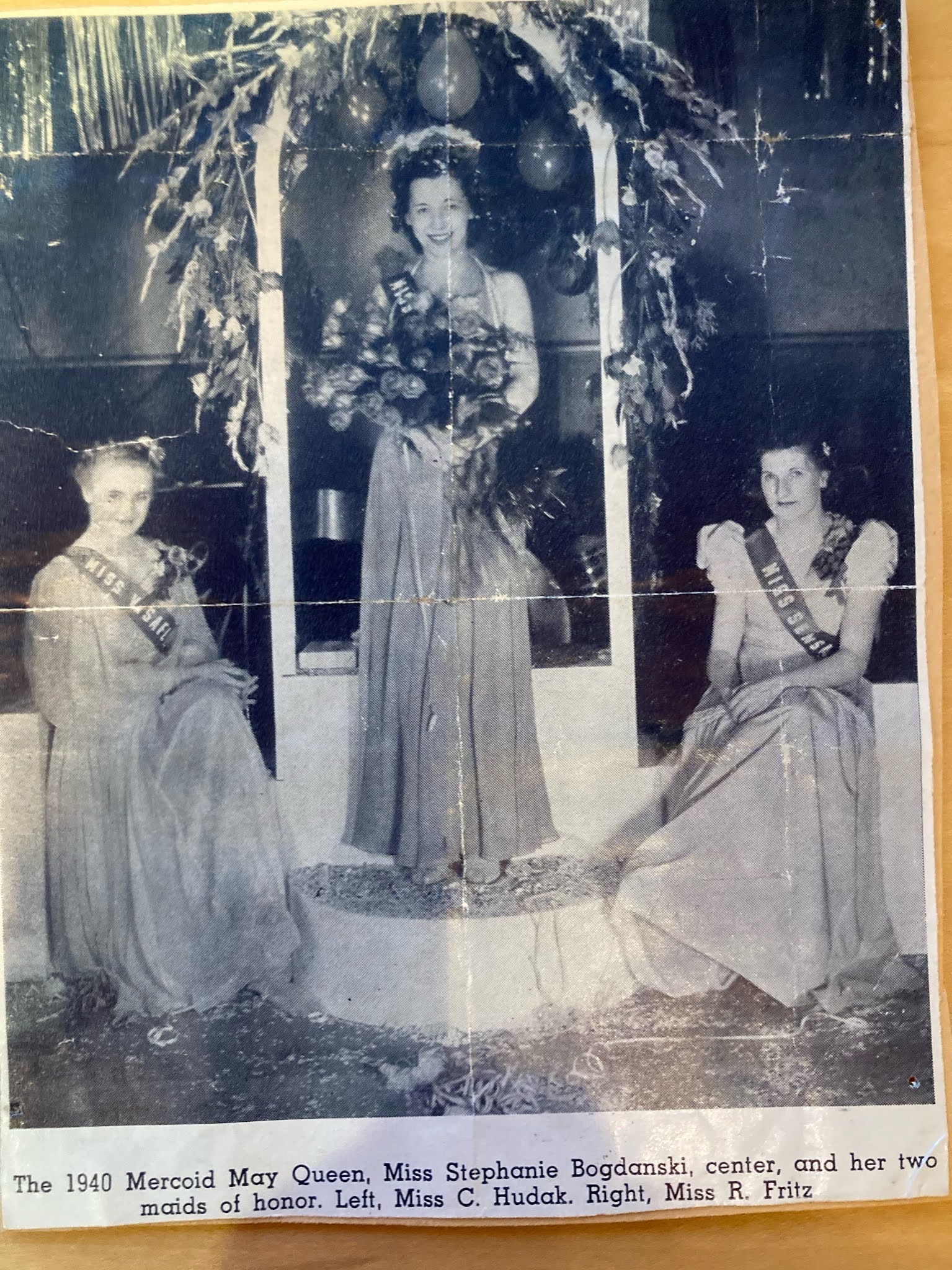
Steph, often called Stefka by her siblings, was the second child of Leon and Barbara, born in November of  1911. I know very little about her early life, other than she was born at home and did not finish high school. She went to work at Mercoid, like her older sister Marie (Myne-ka), and her earnings no doubt helped keep the family afloat during the Depression. She was a dark-haired beauty in her youth (and later as a blonde), and was named the Mercoid May Queen in 1940. (Factories had May queens? you may wonder, as do I).
Stephanie married a quiet man, a bartender named Frank Mack. They had no children, and Frank died of cancer in the early 60s. Later, Steph partnered with a co-worker, Ronnie Wronski, though they never married and the relationship ended after several years. Ronnie had become a friend of the family during Frank's lifetime and you can see all three of them here, along with other family members, in this photo, circa 1960. Taken in the backyard of the Hammond, Indiana home where my sister Joan and I grew up, this photo shows (from left): Ronnie Wronski, Steph, Kitch, Jack Beck, Marie Beck, Frank Mack, Joan Riley and Edward Bogdanski.

After Steph and Ronnie separated, Steph remained in Chicago, living alone, until the mid-70s. It was then that she and my mom, Angie (Anielka) moved into an apartment on the northwest side. They called themselves "the odd couple": Angie liked good books, plain wholesome food, and simple comfortable clothes. Steph, (who "likes everything fried", Angie once confided), was fond of The National Enquirer, and quiz shows. But they both kept a neat house and kept each other good company--at least in the beginning.

By the time Angie and Steph moved in together, I was living in Colorado, but made regular visits back to their home every summer. One year, on a visit back from Colorado, I drove them to the country home of their youngest sister, Virginia (Gina), near Toledo, Ohio. Here they are,  circa 1985, "the girls", as Gina called them, waving to the camera.


I got to know Steph better on those visits. I asked her once how she felt about her job at Mercoid, which she kept for 40-plus years, until she retired at the age of 72. She had been a "floor lady" at one point. She told me that she was proud that the electrical parts she made were used all over the world. I don't know that Steph ever had hobbies, but she enjoyed dressing up, going downtown, visiting department stores like Marshall Fields, and eating at Berghoff's Restaurant. She loved fine food, a highball or two, and always took pride in her appearance. She was also proud that she had what she considered good Polish skills, having once been a secretary for a Polish organization.

Steph never had children, she said, because she had a "tipped womb". Perhaps there were other reasons, as  that condition is not considered a barrier to fertility, I later learned. I never had the sense that she missed being a mother of young children, but later, when her nieces and nephews were grown, she spoke of her regret at not having had kids. Toward the end of her life, when she was in the Alden nursing home with advanced dementia, she was convinced that Joan and I were her children, and perhaps we were in a sense. Joan, especially, as she and her husband Jim navigated Steph's medical issues until Steph died in 2002.

Steph was devastated when Angie, her younger sister by 6 years, died suddenly of a heart attack in 1994. Both had suffered some health issues in the last few years, and Steph had become fearful, which caused Angie stress. After Angie's death, Steph coped for a few years on her own in the apartment they had shared, but after a fall and an injury, she was moved to Alden,  By then, dementia had set in, and she could no longer live on her own. Joan and I and others visited her there until her death. She was not an easy patient/resident, being confined to a locked ward and being a smoker.  On my visits I would take her to the patio to smoke. Conversation was difficult, and one time, at one poignant moment, she opened a compact in her purse, looked at herself and said, "How did I become a hag?" More than anything, this broke my heart, for this once-proud and attractive woman.

Steph would have shuddered at the idea of living to 110, which she would be on Nov. 26 this year. "I want to go like Marilyn Monroe," she used to say more than once, referring to that star's death from an overdose of sleeping pills. Yet I doubt she would have ever taken steps to end her life, even knowing the coming end. Had she been asked, I think she would have agreed the end should be left up to God, as was the beginning and everything in between.


Saturday, May 22, 2021

Reflections on the passing of Alix Dobkin

 When news of Alx Dobkin’s stroke and immanent death broke last week, I felt a twinge of guilt before recognizing my sorrow and sense of immanent loss. As I thought of her occasionally during recent years, the first memory to pop up was an uncomfortable conversation with her at a conference over a political disagreement several years ago. In the face of death, the great equalizer, all disagreements seem trivial, and I suddenly felt it was churlish and a waste of time to even remember it. What’s worth remembering are the gifts she had in her life and the difference she made in mine. 

Alix, who died at 80, was a pioneer of what became “women’s music", a genre she helped birth in the early 70s. It was a genre that celebrated women’s autonomy, our right to love and make love with each other and our proud membership in what was called the second wave of feminism. With Kay Gardner and other lesbian-feminist musicians, she recorded the first recorded album of lesbian music: Lavender Jane Loves Women in 1973.  Then no mainstream recording label would touch an album by an artist who only wanted to perform for women, so Alix formed her own record company, Women’s Wax Works. It was a breakthrough album for lesbian-feminists seeking a sound track to our lives. 

Alix was already a celebrity of sorts, having played with Bob Dylan and other early folk greats of the 60s. At one point, her obituary in The Washington Post notes, she reportedly turned down the chance to record one of his songs. She married and had a daughter, but later separated from her husband and made a major life change. The catalyst was a radio interview with British feminist Germaine Greer, one of many consciousness raising events that marked that period. She took her daughter, partnered with a female lover, Liza Cowan, and took a new turn in music and toward lesbian-feminist organizing.

I remember playing songs from Lavender Jane in the Chicago apartment I shared with five other women in the early 70s. We lived collectively and felt we were part of something new. I had just quit my first job, writing for The Lerner Newspapers, and was searching for something that I hadn’t quite defined yet. I had been volunteering with the Emma Goldman Women’s Health Collective, which was trying to help women navigate a sexist health system and get good screening and counseling services for their reproductive needs. In the larger culture women were questioning whether the traditional career path of marriage and children was the only way to go—or whether it was wise at all in an often-oppressive culture  “I am a woman giving birth to herself” was the phrase on a poster, one of many aimed at women’s autonomy in that era. Alix’ s song “The Woman in your Life is You”, resonated with me and so many other women I know or once knew. I realized after her death was announced this week that the feelings of sorrow I had came not only from the end of a fine woman’s life, but also losses in mine: a person who was familiar to me over half a century, a reminder of my youth, and part of what seems a stream of losses as I age. 

At 74, I confess that I am a regular reader of obituaries—not out of a morbid search for who’s dying at a younger age than mine. Rather it’s because obits have become a kind of art form, the ultimate short story of the arc of someone’s life. In papers like The Washington Post, the writer is aware that readers want to know the deceased ’s contributions to the larger culture—a new invention or contribution to some field. In Alix’s obit in The Post, she was identified as the source of a meme that resonates in our time: ”The future is female”. Her lover, Liza Cowan, photographed her wearing a T-shirt with that phrase, and decades later it was echoed by Hillary Clinton and young feminists empowered in ways Alix could only hope for in her and my youth. It made me laugh, as I had not even been aware of the origin of the meme in the years since I first heard her songs.

Social media posts by friends and admirers focus on her music, and a tribute from Liza, her lover in those early days, told more of the story. Alix “called on her roots in folk music, Broadway musicals, and Balkan songs…based on storytelling.” Her confidence came early, “from a loving Jewish family in Philadelphia”, members for a time in The Communist Party, “and  she spent her early years listening to the music of Paul Robeson—who once visited her family—Pete and Peggy Seeger, Leadbelly, The Red Army Chorus” and others. There, Liza writes, “she gained a passion for civil rights and storytelling.” She later published a biography of her young years as a “red-diaper baby”.

Alix recorded 5 more albums after Lavender Jane and toured various countries, always performing for women. As she aged, she remained a performer and organizer, especially with Old Lesbians Organizing for Change (OLOC). In the last half of her life, Liza writes, she lived in Woodstock, New York, raising her daughter along with former husband Sam, leaving only to tour. And in her last years, performing took a back seat to helping care for her three beloved grandkids. This recent photo was taken in Woodstock.

Alix, like all of us, had many influences in her life, and no doubt she made decisions she either regretted or wished she had handled differently. Our uncomfortable discussion at the 2016 OLOC gathering revolved around the steering committee’s decision to disallow a Native American drumming circle from performing at the event because the group included men. The drummers had been invited by the guest speaker, a Native American poet, who later called out the conference for racism during her address. As an attendee, I felt embarrassed and angry. When I asked whether the issue would be discussed, Alix responded with a vague answer: it could be brought up at the Sunday finale. I did not follow through with that, leaving the gathering with the feeling that such a lesbian separatist stance, perhaps appropriate in the second wave’s early feminist days, was clearly inappropriate in the present. Perhaps Alix later re-evaluated that decision as both OLOC and the white-majority culture began to deal seriously with racism in following years. Like many, I have a tendency to freeze my ideological opponents in the past. 

Alix contributed much to music, lesbian-feminism and to those who loved her. Looking at the arc of her 80 years, it seems to me that she expanded more than she rejected the traditional family. She and her ex-husband Sam both raised their daughter, Adrian, for years. At the end her daughter  and son-in-law were with her, and lesbians around the world kept vigil online and perhaps in person. Obituaries select sections of a life to make a short story for the news. As we know intuitively, we all deserve a novel. If our lives end with the love and admiration Alix experienced, we will definitely be fortunate.


Saturday, May 15, 2021

The beauty of armchair travel

While a number of my friends are happily planning trips now that pandemic restrictions are eased, I'm not one of them. The exceptions are my upcoming summer sojourns on Linda Lane's land near Guffey, a beautiful place where my tiny house sits; the other, a trip to Chicago, where until last year I travelled every year to visit family and friends. What I'm talking about here are the other kinds of trips, the ones to new places or adventure opportunities. 

Despite my love of travel--I've had so many opportunities, especially during my Japan years--I find that the relative solitude of the past year jumpstarted a new appreciation for travel via a screen. In January I decided to do an informal project--look for international films that would give me the sense of having visited places. I looked for films from countries I never had the chance to visit, and given the narrowing window of opportunity brought about by getting older, I probably never will. Consequently, I avoided historical dramas or fantasy in favor of more current offerings, preferably those including a road trip or characters using a lot of shoe leather on city streets. The project is still ongoing and is still very limited in scope, but I'd like to share a few of my favorites from the past 5 months. If you're in the "I've seen everything already" doldrums, here are a few you might have missed:

1. Cuba and The Cameraman. This 2017 Netflix original documentary by Jon Alpert covers 45 years of this journalist's visits to post-revolutionary Cuba. The film got a rather stunning 100% rating from Rotten Tomatoes, and  I think it's deserved. Alpert, who gained the trust of Fidel Castro early on, had unprecedented access to the late leader. Brief interviews are sprinkled throughout the film, but what really makes it outstanding is its focus on stories of ordinary Cubans over time. On each visit Alpert looks up the same people, and if you're like me, their stories, told with humor and heart in the face of suffering and resilience, stay long after the film is over. (113 minutes in English and Spanish)

2. One Man and His Cow (La Vache). This French language 2016 film directed by Mohamed Hamidi takes viewers on a road trip from Algeria to Paris. It's a"charming and feel-good" production which will take you to Paris, mostly on foot, from a small Algerian town  where our protagonist devotedly cares for his cow, Jacqueline. After years of unsuccessful tries, he finally gets an invitation to enter Jacqueline in a Paris agricultural fair. Along the way he meets a variety of kind and eccentric people, gets embroiled in a social media scandal, and in the end transforms just about everyone's life or viewpoint in both countries. Yes, I'm betting you'll cry and laugh, as I did, wishing it were a whole lot longer. And, of yes, you'll see a lot of scenery along the way. (91 minutes.Available for rent on Amazon Prime, Vudu or Apple TV)

3. Atlantics. This 2019 drama from Senegal is a genre-bender, blending social commentary with the paranormal--generally not my favorite genre. A group of desperate construction workers, unpaid for months, set off by boat for Europe, but their boat capsizes and they are lost. How they "return" is the mystery of the film which is beautifully photographed and directed by Mati Diop, a woman making her debut as a director. The protagonists of the film are the women left behind and the lost men who are "with" them. It took me awhile to figure out just what was going on, but when I did it drew me in through its beauty and message. (105 minutes, original language Wolof, subtitled in English. On Netflix)

4. The Mole Agent. This 2020 documentary from Chile got a 95% rating from Rotten Tomatoes for its portrayal of the residents of a home for the elderly. Our protagonist, an 80-something widower, is hired to infiltrate the home and check to see that a client's mother is being treated properly. You'll quickly see that this is less an investigation of possible abuse and more a look at the varied stories of residents and workers there. Our investigator knows how to listen with an open heart and he is valued for that. The film ends with a message for the client and a feeling among viewers like me that we've gotten a view of Chilean society that would be impossible to get on any tour. (90 minutes, on Hulu. In Spanish with English subtitles)

5. The Disciple. This 2020 music-filled drama comes from India, a recent addition to Netflix that has a 95% rating on Rotten Tomatoes. It's the story of a vocalist who has devoted his life to the spiritual practice of Indian classical music. However, he struggles with his ability to achieve his goal of mastery amid challenges both internal and external. This is no standard drama of success after beating all odds. Rather it's a very nuanced look at talent, perfection, a media-saturated music environment, and the necessity of choice in an imperfect world. (127 minutes) As a traveler-viewer, you'll ride with our protagonist on the streets of Mumbai and attend a number of concerts. It's too good to be depressing, but feel-good is not the first word that comes to mind.

6. Magical Andes. This two-season series of short half-hour episodes was my favorite pre-bedtime viewing for several weeks. It is an incredible photographic journey along the Andean mountain range which extends through various countries along the western edge of South America. Each episode focuses on a different area and introduces you to locals whose livelihoods or passions are connected to this amazing 7000-km long mountain range. It makes no attempt at social commentary in favor of letting viewers tag along for the ride. I've mentioned this series most often when people ask what I've been watching. May well watch again for the sheer beauty of the photography and the joy of visiting 7 different countries--Colombia, Argentina, Peru, Chile, Ecuador, Venezuela and Bolivia. (On Netflix)

7. If you're in the mood to stay awhile longer in South America, consider El Pepe: A Supreme Life in Uruguay. It's a 2018 documentary about Jose Pepe Mujica, known as El Pepe, a 1970s revolutionary who later became president of the country and then a farmer devoted to teaching kids about sustainable agriculture. Based on interviews conducted by Serbian director Emir Kusturica. I watched this film in January and it still echoes with me. "My youth belongs to the world of illusion", El Pepe tells the camera. The real revolution is in our minds and cultural values. 

Happy viewing and traveling, reader.


Tuesday, May 11, 2021

Remembering Joanne Hauschild Kastrul

 In sorting through my digitized family photos lately, I've been especially touched by those of my oldest cousin, Joanne. She died last year in February, just days after her 84th birthday, of pancreatic cancer. Because it was a cancer with a poor prognosis and often rapid spread, Joanne chose to forego treatment for that reason and another more important one: She had met the love of her life just 15 years before. "He is the most wonderful man I've ever met," she told me just months before her death, saying that she wanted every moment of quality time with him--without the side effects of treatments unlikely to extend her life. The wonderful man was Jack Kastrul. Joanne and Jack married in 2008--her for the first time, he for the second--at the tender ages of 72 and 71.

Another wonderful man in Joanne's opinion was Joe Biden, who she thought was just about the kindest man she had ever heard in the political arena. She would have proudly cast her vote for Joe and Kamala had she lived, and when Joe and Kamala succeeded, I felt I had to celebrate double--for me and Joanne, and of course, for the world too.

Here are Jack and Joanne on their wedding day. In front are me--one of the lucky maids of honor, my sister Joan and brother-in-law Jim. Also part of the wedding party were Sandee Kastrul, Jack's daughter, and her partner Kim Crutcher. We all felt like we were creating a new family that day.


Joanne and Jack's wedding reflected one of the important things that brought them together: love of the Bible. What was somewhat unusual was that Jack was Jewish and Joanne Catholic. Their wedding, at the Catholic church Joanne had long attended in her Chicago neighborhood of Rogers Park, included a priest and a rabbi--something unthinkable in my Catholic childhood. They continued attending services--both at a church and a synagogue--for several years after their marriage. They also shared a love of music, having met in a choir. It seemed to me that for the ensuing decade each gave the other what they most needed--a family. Joanne, who had no siblings or children, had lived with her late mother, Marie, for decades. Jack had lost his beloved first wife, Clair, to cancer years before.

Before their marriage, I had met Joanne yearly on my visits to Chicago, and our relationship bloomed again after years of relatively little contact. Starting in the late 90s, we would usually make a date to go to the cemetery, where my mother, her mother and adopted father were buried. Joanne had been tending their graves regularly for years, and she understood, after my mother died in 1994, how healing cemetery visits could be. Then we would go out to dinner and talk and get-reacquainted telling family and teacher stories. Joanne had been an elementary school teacher all of her life, most of the time teaching second graders, and she had the energy and enthusiasm that I've seen with others who spend their daytime hours with young children. Here she is (circa 1980) with her mother, Marie, my mother's oldest sister.

Joanne blossomed after her marriage. She cut and dyed her hair--previously worn in a graying bun--and started calling herself JoJo. She and Jack built a life together in an apartment on North Kedzie Avenue, traveled often, and developed a close relationship as a couple with Jack's daughters, Sandee and Kim. Every year when I visited my sister and brother-in-law in Chicago, we would visit them. We'd talk, eat pizza, and sometimes Joanne would play the piano and sing. Here's a picture from the early years of their marriage.


The sadness and suddenness of Joanne's passing was all the more jarring because she was the last of a generation in my mother's family. She was already a grown-up--age 14--when I celebrated my 3rd birthday in 1950. She's sitting across from the cake next to her friend, Babs in this photo:


To me, Joanne always seemed part of a bridge generation--almost like a much younger aunt. I was still in elementary school when she graduated from college--the first in our family to go. Her choice of career was a surprise to no one, as I remember when I was a young child, she would play school in her bedroom when we visited, and her young cousins were willingly corralled as students. Later, when she had been teaching for a few years in Arlington Hts., she was courted by the principal. Everyone expected them to marry but in the end she backed out, choosing to live with her mom and adopted dad, Jack Beck. Her birth father, Bill Hauschild, had died early in her life, and Jack was Marie's loving husband, the one who entered later in her life and became her real dad.

Joanne's death came just weeks before the world shut down due to Covid, but already it had become unsafe to fly. Add jury duty for me and an incipient snowstorm in Chicago in the days after her death. I was unable to attend her modest funeral, though I plan at some point in the future to do some tending to her grave and our respective parents' graves which I think would please her very much. 

Joanne's death took a toll on Jack, whose health declined and then exposure to Covid led to his death earlier this year. At that point he had lost two wives to cancer, a sadness that must have been so difficult to bear. I had written him a letter, sent just a week before he died, telling me how much I appreciated his being in our family, though I'm not sure he either received or read it. I hope so. May his memory and Joanne's be a blessing for those of us who loved them both.


Tuesday, January 19, 2021

Racism Part 2: My journey to understand race

My participation in Dr. King's 1965 march into Montgomery, Alabama, was the beginning of my journey to participate in the struggle for racial justice that emerged in the 1960s. As I wrote in a blog entry about that event, I joined a group of Mundelein College students who rode a bus from Chicago to Alabama. Our goal was to join the last leg of Dr. King's historic march. It was the first time I was in a racially diverse setting and the first time I saw that I could participate in the civil rights movement of that era. Of course, I still had a long way to go in my understanding of racism, a process that continues to this day. This blog is about what happened in years afterwards and how my thinking changed.

The march experience energized both the students and the administration of my college after we returned to Chicago. In 1965 the Johnson Administration launched the Upward Bound Program, and my school was among the first to sign up. Upward Bound was based on the premise that minority and inner city students were disadvantaged because of poverty and inferior schools. Many could succeed, however, if they were given a chance to get study skills, tutoring and encouragement. Colleges could play a role in bridging the gap between them and their more privileged counterparts by offering summer programs designed to provide these things. Perhaps because of my experience with the Montgomery march, I was hired for the first two summers. I think the program reflected what I then understood the struggle to be: bridging the gap while supporting all efforts to end poverty and erase prejudice. 

I loved my work as a tutor-counselor for Upward Bound and felt that I learned much. It was emotionally powerful as well. Perhaps the strongest benefit was the chance to be a tutor for the first time and also to get to know students who were African-American, the largest category of participants. Wanting to refresh my memory about the program, I started with Wikipedia, learning that the program exists to this day. And I was even more surprised to learn that a short 30-minute documentary was made in 1968 about the program. It's called A Space to Grow, and can be viewed on YouTube. Narrated by Henry Fonda, it was nominated for an Oscar.  As I watched it this morning, I was incredibly surprised to see that I was in it! (My brief scene is at 15:08.) This is the only fragment of my 20-year-old-self that I have, never having owned a video camera. Our lives are probably over-documented today, but for those of us who came of age then, finding such a fragment is is akin to a surprise discovery on an archeological dig. I digress.

As we all know, progress is not a straight line. Dr. King came to my city, Chicago, in the late sixties as a leader in the open housing marches held there. Due to what I later came to know as "red-lining"--the practice banks and mortgage companies used to limit where black people could live--Chicago housing remained starkly segregated: a largely white North Side, and largely African-American South Side. The exploitive parts of the real estate industry reinforced that through "block-busting"--the practice of selling a house in a white area to a Black family, prompting other white families to sell cheaply to avoid the threat of collapsing property values. And then there was my father. He was not a hateful man, but he nevertheless expressed a common form of racism at the time: segregation was good for everybody because "birds of a feather flock together", and attempts to change that often result in violence or economic ruin; furthermore, individuals should have the right to sell to whoever they chose. I didn't think I believed that, but I lacked a place to discuss it (Why I didn't raise the question in class I don't know.), a support group, or a way of dealing with the fear I probably felt about joining. (Marches were peaceful, I remember--except for angry whites who tried to disrupt them.) Things had seemed more clear-cut in The South: laws preventing African-Americans from voting amid the practice of Jim Crow.

In 1968 it was time to graduate and enter the workforce as a community journalist. At my first job, as a reporter for a community newspaper chain, I wrote a series with another reporter on poverty in Chicago, and I also covered a story on the murder of Black Panther Fred Hampton  by police. News stories of Hampton's death, including my own story, clearly pointed to a police massacre, but those stories led nowhere. We were still decades away from a reckoning with police violence against people of color. The miscarriage of justice then was part of my growing understanding that news reports would not, by themselves, lead to any change. Other concerns were growing at the time as well: the ongoing Vietnam War and my own fledgling understanding of feminism. It wasn't until the 1970s that my understanding went to another level.

In 1977, shortly after my move to Colorado, the TV miniseries Roots was broadcast, and like millions of others, I watched it.  Much of the research behind it, based on Alex Haley's novel of the same name, has since been challenged, but for me at the time it was my first real introduction to the history and brutality of slavery. And though I may not have it explained it as such, I began to see the links between that tragic episode of racism--along with more reading about the early wars against Indigenous people in the US-- and the issues of the day. The 70s were also a time when people challenged many of the assumptions of the 60s--that government programs like the War on Poverty and Upward Bound--could reverse intractable problems like war and racism.

But there was a new program that I thought might really help. As in Chicago, housing patterns were segregated in Denver and there were calls for change. During the early 80s, for a few years, I drove a school bus for the Denver Public Schools. I was one of many drivers hired for the district's attempts to desegregate schools through busing. Every morning and afternoon I drove white kids to largely black schools and vice versa. The aim was to boost the academic achievement of minority students, but once again real change failed to materialize. Years later, after I left my driving job, the program ended, and school choice became the focus of efforts to mitigate racial disparities in education. During those years, I had no ready arguments for what should be done, and my focus shifted to feminism.

By 1981, I had joined the volunteer collective of the Woman to Woman Feminist Book Center in Denver. In the larger feminist world, white women were being taken to task for insensitivity and neglect of issues important to women of color. (See This Bridge Called My Back: Writings by Radical Women of Color.) The bookstore collective, which had some diversity but was primarily white, had disagreements about many things, and in that year, about racism. White members were challenged by Jewish women and women of color, who said they, including me, were insensitive to communication differences (e.g., spontaneity vs. rules), religious symbols (a Christmas tree in the window, for example) and insufficient materials about diversity in the movement. At a collective meeting one night, four other members besides myself were told to leave. I was devastated, but the event led to a year-long study group that the five of us started for ourselves to try to understand what had happened. 

Eventually I developed an interest in different communication patterns among cultures and then followed my decision to go back to school with the aim of becoming an English teacher for foreign students. New understandings showed me that racism was not only prejudice and discrimination but also insensitivity to cultural differences and what is now called intersectionality.

By 1990 I had graduated with an MA in Education and had left Denver to teach English in Japan. During the 20 years I spent there I saw in different ways how race, gender and economic privilege can intersect and contradict each other. The setting shifted from US issues to those in Japan. For example, how did I look at my status as a white woman hired to teach a prestige language--and also a foreigner and a non-citizen in another country? There was a lot of debate among my friends about this.

At the same time, I was also absorbed in language learning and its various aspects. One was cross-cultural communication--a rather new academic field at the time. It invited us to examine how communication involved much more than learning vocabulary. Also important were a culture's values, non-verbal practices, communication strategies and cognitive processing. More and more I began to learn how important it is to really understand how our minds work in order to understand motivation, memory and many other aspects including bias and decision-making. In the 10 years since I retired and left Japan, it's psychology and cognitive bias that have come to fascinate me. More on that in my next blog: Racism: Part 3.


Wednesday, August 26, 2020

Aug. 26, 1970: Don't Iron While the Strike is Hot

 Fifty years ago today, I was standing in the (then-named) Civic Center Plaza in downtown Chicago, listening to a plethora of speakers talk about women and equality and the need to end the war in Vietnam. As is so often the case with my early adult life, I have no photos--only a button from the event and a memory of the slogan, "Don't iron while the strike is hot." I've had the button in my collection for the past 50 years.

I was working at my first real job after college--as a staff reporter for the Lerner Newspapers, a  chain of community papers in Chicago. I have no clip from the event, as not working was a key idea of the strike. My boss, Terry Gorman, a young man who considered himself progressive, did not object. So off I went--on my own, as I recall, to an event that did not...leave a strong impression. I don't remember any particular speech or speaker that day. The documentary She's Beautiful When She's Angry has a brief scene of the Chicago event showing hundreds filling the plaza.  I could blame my faulty memory for this limited recollection, but it's more a case of my feminism being in its nascent stage then. I had yet to join any group, and in 1970, my mind was more focused on Chicago politics and the continuing, tragic war in Vietnam. The shooting of student demonstrators at Kent State University by National Guard troops had occurred just a few months earlier, and with my colleagues I tried to find stories about the war protests with a "local angle". Meanwhile, another important strike was happening that August in California: Cesar Chavez and the United Farm Workers were striking for better wages and working conditions in the fields. My roommates and I were honoring that strike. An incredibly eventful year it was.

Although I had graduated from a women's college just two years earlier, I had not yet internalized just what discrimination and systemic sexism meant and would mean for me as a woman. But I had read Betty Friedan's 1963 book The Feminine Mystique, credited today with being one of the sparks of second wave feminism. I also knew about the stirrings of the Women's Liberation Movement all around me; I just had no personal entry point yet. The abortion I needed and almost didn't get in the pre-Roe v. Wade era--was still two years away. That experience later brought me to my first feminist collective, the Emma Goldman Women's Health Center, a free well-woman clinic on Chicago's North Side.

Thanks to digital archives, I can revisit the Women's Strike for Equality on Aug. 26, fifty years ago. An article in TIME, a couple of weeks later, called it the largest demonstration since suffrage was won in 1920.  The main event was in New York, where 20,000 women and men marched along Fifth Avenue, chanting and waving banners. TIME wrote: "In nearly half a dozen cities, women swept past headwaiters to 'liberate' all-male bars and restaurants. At the Detroit Free Press, women staffers, angered because male reporters had two washrooms while they had only one, stormed one of the men's rooms, ousted its inhabitants and occupied it for the rest of the day.

"In Manhattan leafleteers collared brokers at financial-district subway stops early in the morning; teams of women activists made the rounds of corporations whose advertising "degrades women" to present them with "Barefoot and Pregnant Awards....In the nation's capital, 1,000 women marched down Connecticut Avenue behind a "We Demand Equality" banner....Los Angeles liberationists were confined to the sidewalk during their march, which drew only 500. Seven women dressed in suffragette costumes stood a "silent vigil" for women's rights during the day at the Federal Building. Easygoing street theater and speeches marked demonstrations in other cities. More than a thousand women and men sympathizers attended a noon-hour rally in Indianapolis, where they watched guerrilla theater."

For some visual imagery of the event within the context of suffrage and other women's struggles, a 3-minute student presentation is worth a watch. And for a broader understanding of the feminist movement of the 60s and early 70s, I highly recommend the documentary, She's Beautiful When She's Angry. It's available free online. 

From these archives and my limited memory, it's clear that voting was not a demand in 1970; voting rights has been a centerpiece of the Civil Rights Movement, and I remember how satisfied I felt, just months after I went to Selma, that Pres. Johnson signed the Voting Rights Act of 1965.

On Aug. 26, 1970, observance of the suffrage anniversary was an entry to a new, second-wave women's movement. In the following 20 years the concept of equality was taken to every field: business, health, politics, literature, the arts, many more. And since then, we've seen third and fourth wave feminism come into being. The latter, according to a Wiki, began around 2012, focusing on empowerment of women and intersectionality, the interconnections of categories such as race, class and gender.

And now on Women's Equality Day 2020, a century after the 19th Amendment was ratified, voting is once again center stage in the struggle for justice and equality. Voter suppression is evident as the current occupant of the White House tries to manipulate his way to a second term. Perhaps we could argue we're in a fifth wave of feminism, which will challenge us to help make all of the gains of the past century a living reality for all and protect the gains we once thought we had won for good--reproductive rights being at the top of the list.

A little more than two months away from the Nov. 3 election, in the middle of a pandemic, I have no plans to protest in person. But I'll be phone banking and writing letters for the Democratic ticket, making sure my ballot is in on time.  To quote suffragist Carrie Chapman Catt, "To the wrongs that need resistance, To the right that needs assistance, To the future in the distance, Give yourselves."


Monday, August 3, 2020

Montgomery, Alabama, 1965: reflections on my first protest march

It's been more than a half century--a fact that still startles me--since I took an overnight bus trip with a group of Catholic nuns, lay teachers and students to join the last leg of the historic civil rights march from Selma to Montgomery, Alabama. The late John Lewis, a very young man, was there with Dr. King and the march leadership, though I never saw or heard him. His death and funeral service this week brought back this time to me, so writing this is a way of reliving and reflecting on these experiences.

I was 18 years old, a freshman at Mundelein College in Chicago in the fall of 1964, a rather naive young woman who had never attended a Catholic school before. I was surprised to learn almost immediately that nuns and students were planning to join the march the following spring and plans were already underway. I knew immediately that I wanted to join it. Did I really understand much of what was at stake? I like to think so, though my understanding must have come from news reports of the growing Civil Rights movement in the early 60s: the fact that freedom fighters were working for basic human rights, that many Negroes (the word we used then) could not vote, that change was underway. And there was a book: John Howard Griffin's Black Like Me. Griffin, a Texas journalist and deeply religious man, had darkened his skin (with drugs and sun lamp treatments) so that he could tour the South and experience it as a Black man. The book was published in 1961 when I was in high school. I remember reading it, surprised and saddened by his account of racial injustices in the deep South.

For my trip to Alabama, all that was needed was $20 for the overnight Trailways bus trip to and from Alabama--and parental permission. The latter was surprisingly hard to get. Both of my parents were strongly opposed, being more aware than I was of the dangers involved. I persisted in my attempts to get them to sign--showing defiance for the first time in my teen life--and finally they relented. Perhaps they were mollified by the fact that the trip was sponsored by the Catholic Interracial Council, and a number of nuns would be on the bus with us. Mom and Dad would not pay, however, so I got a part-time job typing a textbook draft for a nun, and was ready to go when the time came the following March.

It may seem incredible today to say that I have no picture of myself from that event--no pictures at all. I didn't have a camera--they were large bulky things in those days. However, some photos existed from our group (taken by one of the nuns), including this one now in the Loyola University archives. I am not in it (Where was I?) But other classmates were. 


Actually, there is one photo of me which appeared in the college newspaper, The Skyscraper, a month later. You might not recognize me, however. I occasionally worked as a hair model, and had dyed my hair black the previous week.


I have no photos of the 6 religious faculty who joined us on the trip. They were members of the Sisters of Charity of the Blessed Virgin Mary (BVMs), and they wore a habit identical to the one in the photo below.  This BVM, Sister Leoline of Kansas City, was photographed wearing an orange vest showing she was one of the original marchers who had walked the entire 50 miles from Selma to Montgomery.


Lacking photos,  I took notes--fortunately!-- as I was a reporter for The Skyscraper. The stories we published then are an invaluable memory aid these many years later. 

I can confidently tell you that we left one cold March afternoon from Chicago, arriving 20 hours and 800 miles later. "Welcome to Montgomery, "Cradle of the Confederacy" we saw on a Highway 80 billboard. We knew there would be tensions if not danger: angry locals and members of the Alabama National Guard who would line the route of the march the next day. But first, we'd gather for a briefing on safety and later a rally. As Brenda, my co-reporter, and I wrote, "Drive, warmth and easygoing humor" greeted us when we went to the St. Jude campground on the outskirts of Montgomery. Our bus driver left, to stay safely outside the town and to park the bus in a safer, less open spot.

It was humid and hot, as we ate picnic-style on the grounds and were later treated to a fried chicken dinner by a local resident. Other volunteers fed marchers and offered encouragement.  "Late in the afternoon", we wrote in our news story, "residents and visitors began pouring into the field and taking places in front of the makeshift stage....The dark field, lighted only by spotlights and the repeated flash of photographers' cameras, revealed a standing crowd of thousands. Dozens clung to the trees overshadowing the stage." By 9 pm., Harry Belafonte, the host of the rally, welcomed other entertainers: Nina Simone, Peter, Paul and Mary, The Chad Mitchell Trio, Dick Gregory, Sammy Davis Jr., Tony Bennet and Shelley Winters. Would that I would have had 21st century technology to record the event!

Of course,  the rally included speeches: Dr. Ralph Bunch, UN undersecretary for political affairs, and the Rev. Ralph Abernathy, Dr. King's top aide. Dr. Abernathy urged us "to assemble at this same spot tomorrow and join the greatest march ever held...and when it takes place, Alabama will never be the same." Prophetic words, definitely.

The march began the next morning with ranks of marchers, six deep, and marshals yelling, ."Let's have a man on the outside", as they ran along the line. Those were pre-feminist times, and that didn't phase me then. No one near us, male or female, was forced to fend off an attack, as we moved forward singing and chanting. Songs are the lifeblood of any movement and several are still alive in memory: "This Little Light of Mine", "I'm on my Way to Freedom Land,""We Shall Overcome".Another popular marching song, "Can't turn me around" is in this 3-minute YouTube video, which also includes march scenes, words by Dr King, and commentary by Harry Belafonte.

In our campus newspaper story, we wrote, "During three-fourths of the trek, which cut through a Negro section of the city, onlookers cheered and joined in singing the freedom chants. Others watched expressionless. Several offered water to the marchers. An old Negro woman shouted that it was the greatest day she had ever seen." I felt a sense of exhilaration that I had not felt before, and a sense of gratitude that I could be there for this amazing event, like nothing I had ever experienced.

"Turning onto the downtown section a different mood confronted the marchers. Quiet heckling from a few white observers was emphasized by a large sign on one store showing Martin Luther King Jr. supposedly at a Communist training school. Confederate flags waved by bystanders, worn by some troopers and flown on top of the Capitol building itself seemed to indicate the real feeling behind the civil rights opposition."

As we reached the Capitol we were urged to sit down and rest, and the four-hour meeting opened with the movement classic, "We Shall Overcome".  The crowd raised American flags to the National Anthem led by Mrs. King. The optimistic tone of the previous night's speeches continued continued through the hours. One of the initial speakers declared, "This is a revolution that won't fire a shot....Our aim is to love the hell out of the State of Alabama with all the power of our bodies and souls." Other speakers spoke to how this march was only a beginning. Urging a continuation of the voting rights struggle in the South, Dr. King stressed that the "aim of the movement is to seek a society at peace with itself, a society that can live with its conscience." The struggle won't be smooth but it will succeed, he told us, "because no lie can live forever."

The event ended with another chorus of "We Shall Overcome" as my classmates and I made our way to 
our bus which had returned to pick us up. A day later we arrived home.

And then I went back to school for another three years, and the effects of the march continued to play out in my life then--and then in ways hidden or not, over the coming decades. Part 2 of this story to come.